
Learn How to Read the Clock at PlanetSpark
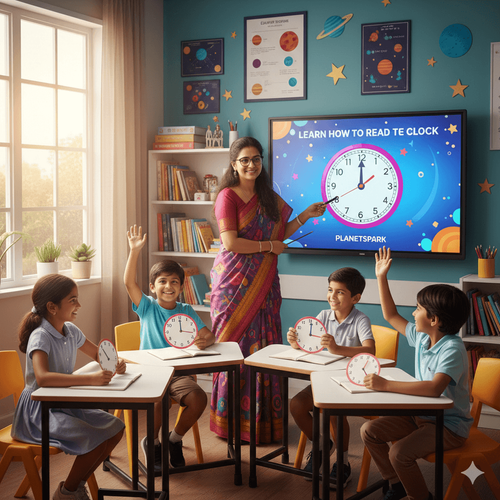

Table of Contents
- Understanding the Clock: The Basics Students Must Know
- PlanetSpark’s Step-by-Step Method to Read the Clock
- Learn How to Read the Clock Through Fun Activities at Planet
- PlanetSpark’s Unique Teaching Style Makes Time Telling Easie
- Why Learning to Read the Clock Matters for Every Student
- How Students Benefit After Learning to Read the Clock
- Rishivardhan’s Inspiring Achievement in Abacus Mastery
- Common Mistakes Students Make While Learning to Read the Clo
- Tips for Students to Master Time Telling at Home
- Why PlanetSpark Is the Ultimate Destination for Maths Master
- Master the Clock with Confidence & PlanetSpark
Learning to read the clock is an important skill that helps students understand time, plan their day, and build better study habits. This guidance introduces the concept in a simple and friendly way, showing how clocks work and how students can grow confident in time telling. With PlanetSpark’s lively lessons, interactive activities, and supportive teachers, children learn with joy while gaining a skill that stays useful throughout their lives.
Understanding the Clock: The Basics Students Must Know
Before students dive into reading time, they need a clear understanding of what each part of the clock represents. PlanetSpark teaches these concepts using visuals, interactive lessons, and hands-on activities.
1. The Two Main Types of Clocks
Students learn that clocks generally come in two forms:
Analog Clock: The traditional round clock with hour, minute, and second hands.
Digital Clock: A number-based clock that simply displays time like 07:25.
While digital clocks are easy, learning to read an analog clock builds a deeper understanding of how time actually moves.

2. Parts of an Analog Clock
PlanetSpark begins with clarity:
The face: The circular part with numbers 1 to 12.
The hour hand: Short hand that shows the hour.
The minute hand: Long hand that tells the minutes.
The second hand: Thin, fast-moving hand that measures seconds.
Students also learn that the hour hand moves slowly and continuously and not jumping from one number to the next.
3. Values of Each Number on the Clock
Every number on the clock represents:
An hour (1 to 12),
And also the number of minutes (multiples of 5).
PlanetSpark teaches students to see that:
1 = 5 minutes
2 = 10 minutes
3 = 15 minutes
4 = 20 minutes
…and so on, up to 60 minutes.
This prepares them for reading the minute hand with accuracy.
PlanetSpark’s Step-by-Step Method to Read the Clock
PlanetSpark’s teaching method breaks down this skill into small, achievable steps so students feel confident and excited at every stage.
Step 1: Start with the Hour Hand
Students first learn that the shorter hand always shows the hour.
PlanetSpark ensures that they notice:
When the hour hand points exactly at a number, it is that hour.
When it lies between two numbers, it represents the hour it has passed.
If the hour hand is between 3 and 4, the time is still in the 3 o’clock hour.
Step 2: Understand How Minutes Work
Before counting minutes, PlanetSpark helps students practice skip counting by 5s—5, 10, 15, 20… up to 60.
This helps students immediately connect each number with its minute value.
Help your child build strong maths skills with expert guidance!
Step 3: Read the Minute Hand
Students learn that the long hand tells the minutes past the hour.
PlanetSpark uses colourful diagrams to show that:
When the minute hand points at 1 → 5 minutes
At 6 → 30 minutes
At 9 → 45 minutes
At 12 → 0 minutes (o’clock)
Step 4: Combine the Hour and Minute Reading
PlanetSpark teaches students to:
Read the hour first.
Then read the minutes.
Combine them into a sentence like:
“It is 3:15.”
“It is 8:40.”
“It is 11:05.”
This method builds accuracy and clarity.
Step 5: Practice Quarter and Half Expressions
Students learn expressions used in everyday language:
Quarter past → 15 minutes
Half past → 30 minutes
Quarter to → 45 minutes
PlanetSpark gives real-life examples like:
“It’s half past 5, time for your evening snack!”
Step 6: Practice with Real Schedules
Students apply their learning to:
School timetable
Daily routine
Class periods
Meal times
Bedtime
PlanetSpark lessons include fun worksheets where children match activities with their time. Students can click this link to master maths with confidence with the help of online professionals who are there to assist around the clock.
Give your child the advantage of personalised one to one maths coaching!
Learn How to Read the Clock Through Fun Activities at PlanetSpark
Learning is most effective when it is joyful. PlanetSpark follows activity-based teaching designed to hold a child’s attention and boost retention.
1. Build-Your-Own Clock Craft
Students create their own paper clocks with movable hands.
This hands-on model helps them visualise hour and minute positions effortlessly.
2. Time-Matching Games
Games include matching time cards with clock faces, turning learning into a playful competition.
3. Real-Time Observation Exercises
Students check the clock during:
Class start
Break
Reading time
Activity time
This helps them connect learning with everyday life.
4. Digital vs. Analog Challenge
Children learn to convert digital time (like 09:30) into analog time (half past nine), developing flexibility and deeper understanding.
5. Role-Play Activities
PlanetSpark uses scenarios like:
“You have to catch a bus at 7:45 – show the time!”
“Your class begins at 8:30 – set the clock!”
This builds confidence in real-life situations.
PlanetSpark’s Unique Teaching Style Makes Time Telling Easier
What makes PlanetSpark stand out is its modern teaching method blended with child-friendly delivery.
1. Interactive Digital Lessons
The platform uses animations, visuals, and simulations to help children grasp how clock hands move.
2. One-to-One Personalised Guidance
Every child learns at their own pace. PlanetSpark’s experts give patient, step-by-step support that suits each student’s learning speed.
Build your child’s confidence in numbers, logic, and problem solving!
3. Concept Reinforcement Through Play
Learning isn’t just about theory. Students repeatedly practice time telling through:
Quizzes
Games
Audio-visual cues
Live examples
4. Continuous Assessment
Students receive regular feedback to identify areas of strength and improvement.
5. Motivational Learning Environment
PlanetSpark celebrates small achievements, boosting students’ confidence and removing fear of making mistakes.
Why Learning to Read the Clock Matters for Every Student
Before diving into the techniques, it’s important to understand why this skill is so important. In today’s digital world, children often depend purely on devices to check the time. But learning to read an analog clock builds a wide range of foundational skills:
1. Strengthens Mathematical Thinking
Time is all about numbers which are groupings of fives, halves, quarters, skip counting, and mental addition. When children learn how to read a clock, they build number sense naturally.
2. Enhances Daily Independence
From waking up on time to planning schoolwork, knowing how to read the clock allows students to structure their day and follow routines responsibly.
3. Improves Cognitive Skills
Time telling enhances memory, sequencing, and logical reasoning. Students learn to think in patterns, understand intervals, and connect abstract concepts with real life.
4. Builds Self-Discipline
Children who learn to manage time and understand its value tend to develop stronger study habits, planning skills, and punctuality.
PlanetSpark recognises these benefits and offers a student-friendly approach to turn time reading into a joyful learning experience rather than a confusing challenge. Click this link to excel in numbers and logics with Maths Olympiad Classes from the professionals of PlanetSpark.
How Students Benefit After Learning to Read the Clock
After mastering how to read a clock, students experience strong improvements across various life and academic areas.
1. Better Time Management
Students can plan study schedules, breaks, and daily tasks with clarity.
2. Increased Punctuality
They learn the importance of being on time for school, classes, and activities.
3. Improved Maths Skills
Fractions, skip counting, addition, subtraction are all improved through time telling.
4. Strengthened Discipline
Students gain a deeper understanding of time’s value and start using it wisely.
5. More Independence
They don’t need reminders for everything and they take responsibility for their routine.
Rishivardhan’s Inspiring Achievement in Abacus Mastery

With stronger focus and confidence from PlanetSpark, Rishivardhan won his abacus competition. His dedication, combined with the right guidance and consistent practice, helped him shine and achieve this proud milestone.
PlanetSpark continues to empower young learners just like Rishivardhan by building confidence, sharpening skills, and nurturing true potential. If you want your child to grow with the same clarity, focus, and enthusiasm, encourage them to join PlanetSpark and begin their own journey of success.
Common Mistakes Students Make While Learning to Read the Clock
PlanetSpark understands exactly where students struggle and corrects those errors early.
Mistake 1: Confusing Hour and Minute Hands
PlanetSpark uses colour coding and size differences so students instantly recognise each hand’s purpose.
Mistake 2: Reading the Hour After the Minute
Children often read the minute hand first.
PlanetSpark teaches a simple rule: “Hour first, minutes next.”
Mistake 3: Misreading Time When Hour Hand Is Between Numbers
PlanetSpark uses animated examples showing how the hour hand moves smoothly, helping students understand transitional hours.
Mistake 4: Forgetting That Minute Numbers Represent Multiples of Five
Through skip counting exercises, PlanetSpark ensures students never forget the pattern.
Mistake 5: Confusing ‘Quarter To’ and ‘Quarter Past’
Through storytelling, PlanetSpark explains concepts like:
Quarter past → already 15 minutes gone
Quarter to → 15 minutes left for next hour
Tips for Students to Master Time Telling at Home
Parents can help reinforce what students learn at PlanetSpark.
Tip 1: Practice Daily
Ask students to read the clock several times a day.
Tip 2: Remove Dependence on Digital Clocks
Encourage children to check the wall clock instead of a phone.
Tip 3: Use Routine Timings
Example:
“Dinner is at 8:00. What time is it now?”
This builds awareness.
Tip 4: Use Timers and Alarms
Show how 10 minutes feels in real life.
Tip 5: Play Time Telling Games Together
Board games and mobile apps help reinforce the skill.
Why PlanetSpark Is the Ultimate Destination for Maths Mastery
PlanetSpark delivers a complete learning experience that strengthens every aspect of a child’s mathematical understanding, accuracy, and confidence. With personalised one-on- one guidance, interactive practice, and real world learning, students don’t just learn maths—they master it.
Services That Build Strong Mathematical Skills
Personal Maths Trainers for concept correction, problem solving support, and skill enhancement
Customised Learning Roadmaps tailored to each child’s strengths and learning gaps
SparkX AI Analysis to assess accuracy, speed, and conceptual clarity
AI Guided Practice Sessions for computation, reasoning, and application based learning
Spark Diary for daily maths practice and real life number application
Gamified Learning Tools including Speed Maths, Number Ninja, Logic Lab, and Fraction Quest
SparkBee Daily Quizzes to strengthen calculations, logic, and numerical fluency
SparkShop eBooks covering arithmetic, geometry, data handling, and reasoning
Progress Reports and PTMs offering clear, actionable insights
With PlanetSpark, your child builds mathematical confidence, logical thinking, and a future ready foundation that lasts a lifetime.
Master the Clock with Confidence & PlanetSpark
Learning to read the clock is a simple skill, yet it shapes a child’s ability to plan, focus, and understand their daily world. When students grasp time telling early, they naturally become more responsible, independent, and organised in everything they do.
PlanetSpark transforms this learning journey into an engaging, child-friendly experience using visuals, games, and hands-on practice. Students not only understand how to read a clock but also develop stronger maths skills and sharper thinking with every lesson they complete.
With the right guidance, consistent practice, and a fun learning environment, every student can master time reading confidently. PlanetSpark ensures that children build this essential life skill with excitement, clarity, and long-term understanding.
Frequently Asked Questions
Learning to tell time helps students develop independence, plan their daily routines, stay punctual, and strengthen mathematical thinking. It builds confidence and supports better organization, decision making, and real world awareness from an early age.
Teaching minutes through skip counting by fives makes learning simple. When students connect each number to a five minute jump, the clock becomes clear and predictable, helping them read time accurately and confidently.
Yes, analog clocks help children understand the movement of time, improve number sense, and build logical thinking. Digital clocks show time, but analog clocks teach how time progresses, strengthening deeper learning and awareness.
Parents can encourage practice by asking children to read clocks at home, using routines like mealtimes or study hours. Short daily practice and real life examples greatly reinforce understanding and build confidence in time reading.
PlanetSpark teaches time telling through interactive activities, visual tools, and personalised guidance. Students learn with clarity and enjoyment, making even tricky concepts easier. The platform ensures step by step progress and strong practical understanding.
PlanetSpark offers engaging lessons, fun practice tasks, and expert coaching that make time learning simple and memorable. Children stay motivated, enjoy learning, and develop lifelong skills that support better planning, scheduling, and everyday independence.