
Unit Conversion Made Easy with Charts | PlanetSpark
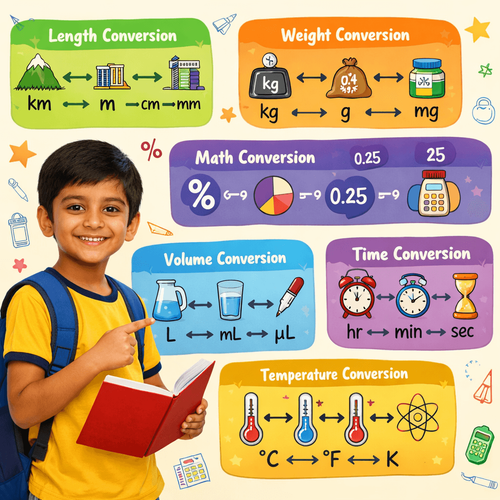

Table of Contents
- What Is Unit Conversion?
- Why are Unit Conversions Important?
- Key Formula for Unit Conversion
- Types of Unit Conversion
- Unit Conversion Table of Measurement
- Guide to Use a Unit Conversion Chart
- Practice Problems to Test Your Unit Conversion Skills
- Real-Life Uses of Unit Conversion
- Common Errors in Unit Conversion
- How PlanetSpark Makes Learning Unit Conversions Fun and Easy
- Conclusion
Mathematics becomes simpler when you learn how to change one unit into another. From converting inches to centimeters, meters to kilometers, or liters to milliliters, unit conversion is an important skill for students in Classes 11 and 12. It helps in solving numerical problems correctly, strengthens concepts in physics and chemistry, and is useful in many real-life situations.
At PlanetSpark, we make learning conversions of units of measurement engaging and interactive. For example, children practice with digital unit conversion tables and quizzes, reinforcing concepts while having fun. Therefore, PlanetSpark transforms ordinary math lessons into exciting, hands-on learning experiences.
What Is Unit Conversion?
Unit conversion means expressing the same measurement in a different unit without changing its actual value. For example, 1 meter is equal to 100 centimeters—the quantity stays the same, only the unit changes.
This concept is an important foundation for solving problems related to distance, area, volume, and even percentages. You can understand it better by exploring practical examples like converting inches to centimeters.
Why are Unit Conversions Important?
Unit conversions are essential in academics and daily life because they ensure accuracy in measurements. For example, converting meters to centimeters, liters to milliliters, or kilograms to grams prevents errors in calculations.
Additionally, understanding the conversion of units enhances problem-solving skills and helps students apply math concepts confidently. Using a chart makes this process structured and reliable. Consequently, mastering unit conversions builds both competence and confidence in practical and academic tasks.
To apply unit conversions accurately, it’s important to follow a clear, step-by-step approach. Next, you will explore how to use a unit conversion chart effectively for precise results.
Key Formula for Unit Conversion
Here is a simple and standard rule to follow while converting units:
- When converting from a bigger unit to a smaller unit, multiply.
- When converting from a smaller unit to a bigger unit, divide.
Examples to understand easily:
- 1 meter = 100 centimeters
- 1 kilogram = 1000 grams
- 1 hour = 60 minutes
To convert back to the larger unit:
- Centimeters ÷ 100 = Meters
- Grams ÷ 1000 = Kilograms
- Minutes ÷ 60 = Hours
Explore a detailed unit conversion chart to simplify every measurement calculation. Start practicing today and improve your accuracy, speed, and confidence in solving real-world math and science problems. Talk with our experts right now!
Types of Unit Conversion
To understand unit conversion better, it helps to look at how different types of measurements are converted using simple rules. Conversions can be grouped based on what is being measured, such as length, area, volume, and metric units.
1. Length Conversion
Length conversion is used to measure distance in uniform units.
Common conversions include:
- 1 kilometer = 1000 meters
- 1 meter = 100 centimeters
- 1 centimeter = 10 millimeters
- 1 inch = 2.54 centimeters
2. Area Conversion
Area conversion is widely used in geometry, agriculture, and construction work.
Common conversions include:
- 1 square meter = 10,000 square centimeters
- 1 hectare = 10,000 square meters
- 1 acre = 4046.86 square meters
3. Volume Conversion
Volume conversion is important in chemistry, fluid measurements, and everyday usage.
Common conversions include:
- 1 liter = 1000 milliliters
- 1 cubic meter = 1000 liters
- 1 cubic centimeter = 1 milliliter
These conversions are especially useful while solving problems related to capacity and density.
4. Metric Conversion
Metric conversion focuses on changing units within the metric system using powers of ten, making calculations simple and consistent.
Example:
- 1 kilometer = 10³ meters, which means multiplying by 1000 to convert into meters.
Unit Conversion Table of Measurement
A unit conversion table organises units for length, mass, volume, and time, making conversions easier and more systematic. Students can quickly identify conversion factors and apply them accurately in different mathematical situations. Moreover, structured tables reduce confusion and save time during problem-solving.
Further, with interactive charts to practice conversion of units of measurement, reinforcing accuracy and confidence. By practicing regularly, students begin to understand the relationships between various units. Consequently, they develop stronger calculation skills and improve overall accuracy in measurements.
Length Conversion Table:
From | To | Factor | Example |
1 inch | cm | 2.54 | 5 inches = 12.7 cm |
1 foot | m | 0.3048 | 10 ft = 3.048 m |
1 mile | km | 1.609 | 3 miles = 4.827 km |
Mass Conversion Table:
From | To | Factor | Example |
1 pound (lb) | kg | 0.4536 | 5 lb = 2.268 kg |
1 ounces (oz) | gram | 28.35 | 3 oz = 85.05 g |
Volume Conversion Table:
From | To | Factor | Example |
1 litre | ml | 1000 | 2 liters = 2000 ml |
1 gallon | litre | 3.785 | 1 gallon = 3.785 litres |
With these comprehensive tables, students can confidently manage the conversion using a well-structured conversion table of units of measurement, ensuring accuracy and speed in calculations. Now, let’s examine important conversion factors that simplify complex problem-solving and make mathematical operations more efficient.
Guide to Use a Unit Conversion Chart
Learning unit conversion becomes simple when students follow a clear method. Using a unit conversion chart or unit conversion table helps in converting length, mass, and volume with accuracy. With regular practice, the conversion of units becomes quick and error-free.
Step 1: Identify Units
First, note the unit you have and the unit you need to convert. Understanding the type of measurement supports accurate conversion of units of measurement.
Step 2: Find the Conversion Factor
Check a conversion table of units of measurement or unit conversion chart to get the correct value. Choosing the right factor is key for proper unit conversion.
Convert measurements instantly and make complex calculations easier, whether for homework, projects, or everyday practical tasks. Try the advanced unit conversion calculator for quick and error-free results. Start learning with us today!
Step 3: Do the Calculation
Multiply or divide based on the direction of conversion. You can also use a unit conversion calculator for faster and more accurate results.
Step 4: Verify the Answer
Finally, confirm that the result is in the correct unit. This strengthens understanding of the conversion of units and reduces mistakes.
Once students understand the basics of unit conversion and learn how to use a unit conversion chart or unit conversion table, the next step is to build speed and accuracy. By consistently practicing the conversion of units of measurement, students develop confidence and clarity. Over time, referring to a unit conversion chart becomes a habit, helping them perform calculations faster and more accurately across different topics.
Practice Problems to Test Your Unit Conversion Skills
Practice is the best way to build confidence in unit conversion. These simple questions will help you apply conversion rules, improve accuracy, and understand measurement relationships better. Try solving them on your own before checking the answers to test your learning.
- Convert 5 miles into kilometers.
- How many quarts are there in 3 gallons?
- Change 10 pounds into kilograms.
- Convert 30 centimeters into inches.
Answers and Explanations
Miles to Kilometers:
1 mile = 1.61 kilometers
5 miles × 1.61 = 8.05 kilometers
So, 5 miles is approximately 8.05 kilometers.Gallons to Quarts:
1 gallon = 4 quarts
3 gallons × 4 = 12 quarts
So, 3 gallons equals 12 quarts.Pounds to Kilograms:
1 kilogram = 2.2 pounds
10 pounds ÷ 2.2 = 4.5 kilograms
So, 10 pounds is approximately 4.5 kilograms.Centimeters to Inches:
1 inch = 2.54 centimeters
30 cm ÷ 2.54 = 11.81 inches
So, 30 centimeters is about 11.81 inches.
Use these problems to check your understanding. After solving, compare your answers with the correct conversions to identify what you’ve learned well and where you need more practice.
Real-Life Uses of Unit Conversion
Unit conversion plays an important role in everyday life. From the kitchen to classrooms and travel planning, people constantly switch between different units to measure and compare values.
Help your child master unit conversion with PlanetSpark’s personalised learning programs. Get structured lessons and consistent practice for long-term academic success. Enroll in PlanetSpark and simplify math problems!
Understanding Unit conversion helps students apply concepts practically and improves their problem-solving ability in real situations. Students also use conversions while interpreting data, solving problems, and understanding formulas across different subjects.
- Cooking: Measuring ingredients in grams, cups, or teaspoons.
- Travel: Converting kilometers into miles or meters for distance calculations.
- Science: Using standard SI units during experiments and measurements.
- Finance: Applying conversions while working with percentages and ratios.
Common Errors in Unit Conversion
While learning the conversion of units, students often make small mistakes that lead to incorrect answers. Misunderstanding factors, mixing systems, or ignoring units can affect accuracy.
Recognising these errors early and using a unit conversion chart or unit conversion table properly helps improve precision and confidence.
- Ignoring conversion factors: Forgetting to multiply or divide correctly.
- Mixing systems: Confusing metric and imperial units.
- Incorrect decimal placement: Changing the value or magnitude.
- Skipping units: Not writing units at each step of the calculation.
Avoiding these mistakes ensures better accuracy in both exams and real-life applications. With the basics in place, the next step is to make learning more engaging and practical. This is where PlanetSpark supports students by turning unit conversion into a fun and easy learning experience.
How PlanetSpark Makes Learning Unit Conversions Fun and Easy?
PlanetSpark transforms learning unit conversion into an engaging experience for children. Through interactive charts, gamified exercises, and structured quizzes, students participate actively instead of memorising formulas. Moreover, visual aids and real-life examples strengthen conceptual clarity. As a result, children retain knowledge longer and confidently apply conversion of unit skills independently.

By following a structured, step-by-step guided approach, PlanetSpark ensures that students clearly understand the logic behind every calculation. Consequently, learning conversion of units of measurement becomes systematic and stress-free. Personalised attention further supports individual growth, making even complex conversions simple, manageable, and enjoyable for every learner.
Personal Trainers for Every Child
PlanetSpark assigns dedicated trainers to guide each child step by step in unit conversion concepts. They explain the conversion using simple examples and structured practice. Moreover, trainers clarify doubts instantly to prevent confusion. As a result, children build confidence while mastering the conversion of units of measurement accurately and efficiently.
Personalised Curriculum and Learning Roadmap
PlanetSpark designs a personalised curriculum tailored to every learner’s pace and ability. This roadmap gradually strengthens understanding of unit conversion through structured lessons. Additionally, targeted exercises improve accuracy in the conversion of units of practice. Consequently, students develop strong conceptual clarity in the conversion of measurement over time.
Structured Parent-Teacher Meetings
Structured parent-teacher meetings ensure continuous progress tracking and improvement. Trainers discuss the child’s performance in unit conversion exercises clearly and transparently. They also highlight strengths and areas needing improvement in the conversion of unit tasks. Therefore, parents stay informed about their child’s growth in the conversion of units of measurement skills.
Comprehensive Progress Reports
Comprehensive progress reports provide detailed insights into learning milestones and achievements. These reports assess accuracy and speed in unit conversion regularly. In addition, they measure improvement in understanding the conversion of unit concepts. Thus, structured feedback strengthens mastery of the conversion of measurement effectively and consistently.
Conclusion
Unit conversion is an essential skill that improves accuracy in mathematics, science, and daily life. By using a conversion table or chart, students can perform calculations confidently and avoid common errors. Consistent practice strengthens understanding and builds long-term problem-solving ability.
Boost your child’s confidence in mathematics through PlanetSpark’s interactive classes. Experience engaging activities, professional mentors, and a proven approach to mastering unit conversions. Book PlanetSpark’s free session now!
At PlanetSpark, we make learning unit conversion engaging through personalised guidance and interactive lessons. With expert mentors and structured practice, students gain clarity, confidence, and the ability to apply concepts independently in real-world situations.
Frequently Asked Questions
A unit conversion table is a structured chart that displays standard conversion factors for measurements like length, mass, volume, and temperature. It helps students quickly reference values and convert units accurately in math, science, and real-life situations.
To use a unit conversion chart, first identify the units involved. Then locate the correct conversion factor, apply multiplication or division accordingly, and verify the final unit. This method simplifies the conversion efficiently.
Unit conversion is important because it ensures accurate measurements in cooking, travel planning, construction, and shopping. It also strengthens understanding of academic concepts, especially in math and science problems involving the conversion of units.
A unit conversion calculator is a digital tool that automatically converts one unit into another using built-in formulas. It reduces manual errors, saves time, and helps students verify answers quickly for homework or practical tasks.
PlanetSpark teaches unit conversions through interactive charts, engaging activities, and personalised mentoring. Structured lessons and consistent practice help students understand concepts clearly while building confidence in using conversion tables accurately.
Yes, PlanetSpark provides quizzes, games, worksheets, and guided exercises to strengthen conversion skills. Through regular practice and feedback, children master conversion of units of measurement in a supportive and enjoyable learning environment.