
Mental Math Skills for Kids: Meaning, Tricks, and How to Develop Them
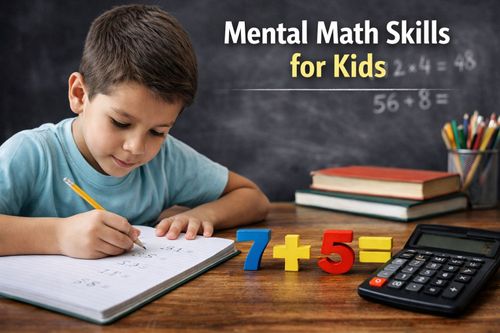

Mathematics becomes much easier when children learn to calculate numbers quickly in their minds. Many parents often wonder what is a mental math approach and how it helps students solve problems faster without relying on calculators or written steps. Mental calculation strengthens number sense, improves focus, and builds confidence in solving everyday maths questions. When students practise regularly, they begin recognising number patterns and shortcuts that simplify even complex calculations.
PlanetSpark supports students in developing stronger logical thinking and communication skills through personalised mentoring and structured learning programmes. With engaging lessons, interactive exercises, and expert guidance, children improve their confidence in subjects like mental math while also strengthening their overall academic abilities.
What Does Mental Math Mean?
Mental math is the ability to solve mathematical problems in your head, without using paper, calculators, or any other tools. It involves understanding number relationships and applying quick strategies. With regular practice, mental math helps make calculations faster, easier, and more accurate. This skill is a great way to sharpen your overall mathematical abilities and improve problem-solving skills, making math more fun and efficient.
There are times when you need quick calculations on the spot, such as when shopping and a store offers a 10% discount. In these moments, you won't have pen and paper, so mental math becomes essential. Developing specific tricks and strategies allows you to solve problems quickly and efficiently. Regular practice of mental math improves your speed and accuracy, and it also enhances your mathematical and logical reasoning abilities.
Effective Mental Math Tricks to Master
Mental calculation becomes easier when students learn simple strategies that break big problems into smaller and easier steps. These techniques improve number sense and confidence. With regular mental math practice, children can solve everyday calculations faster without relying on written steps.
Breaking Numbers Apart (Decomposition)
One of the most useful mental math strategies is decomposition, which means breaking a number into smaller parts, such as tens and ones. This makes calculations easier because the brain handles round numbers more comfortably. Instead of solving a problem directly, students divide it into simpler steps and combine the results later.
Example:
To add 46 + 27, your child can break it down:
40 + 20 = 60
6 + 7 = 13
60 + 13 = 73
By splitting numbers into manageable parts, children can perform calculations quickly and with fewer mistakes.
Using Friendly Numbers
Another powerful mental math technique is the friendly numbers method. In this strategy, students round a number to a nearby easy value like 10, 50, or 100, complete the calculation, and then adjust the answer. This trick simplifies addition and subtraction because round numbers are easier to handle mentally.
Example:
Calculate 49 + 27
Step 1: Round 49 to 50
Step 2: Add 50 + 27 = 77
Step 3: Since we added 1 extra earlier, subtract 1
Final Answer: 76
This method helps children think flexibly about numbers and improves their ability to estimate and adjust calculations mentally.
Doubling and Halving
The doubling and halving technique is very useful for multiplication. In this method, one number is doubled while the other is halved. The product stays the same, but the calculation becomes easier because the new numbers are simpler to multiply.
Example:
Calculate 16 × 25
Step 1: Half of 16 = 8
Step 2: Double 25 = 50
Step 3: Multiply 8 × 50 = 400
By transforming the numbers into easier combinations, children can solve multiplication problems faster and improve their overall calculation speed.
Help your child build faster calculation skills with simple mental strategies. When students practise smart techniques regularly, confidence in mental math grows naturally. Start strengthening their calculation abilities today.
Using Patterns and Tricks
Certain numbers follow patterns that make calculations much easier. Teaching children to recognise these patterns helps them apply quick shortcuts instead of long multiplication steps.
Example:
To multiply 9 × 7, your child can use a pattern trick.
10 × 7 = 70
70 − 7 = 63
So, 9 × 7 = 63.
By learning patterns like this, students begin to solve multiplication problems faster and develop stronger confidence in mental math calculations.
Rounding Up to the Nearest Ten
Rounding is a useful mental math strategy that simplifies addition or subtraction. In this method, students round a number to the nearest ten, complete the calculation, and then adjust the answer if needed. This makes the numbers easier to handle mentally.
Example:
To add 58 + 27, your child can round 58 to 60.
60 + 27 = 87
Since we added 2 extra, subtract it.
87 − 2 = 85
This trick helps children manage larger numbers quickly while keeping their calculations accurate.
Working From Left to Right
When solving problems on paper, students usually start from the right side and move left because of carrying or regrouping. However, for mental math practice, it is often easier to calculate from left to right. This method follows the natural way we read numbers and helps students keep track of the calculation without worrying about regrouping.
Example:
To add 44 + 17, your child can solve it step by step.
First, adding 4 and 1 in the tens column
This means 40 + 10 = 50
Then adding 4 and 7 in the ones column
4 + 7 = 11
Lastly, adding 50 and 11
50 + 11 = 61
Squaring Numbers Ending in 5
There is a quick trick for squaring numbers that end with 5. Students multiply the first digit by the next number and then attach 25 at the end. This pattern makes squaring numbers much faster in mental math calculations.
Example:
To calculate 35²
3 × 4 = 12
Attach 25
Answer: 1225
So, 35 × 35 = 1225. This trick works for numbers like 25, 45, 65, and so on.
Tricks for finding 10% of Any Number
Calculating 10% is one of the easiest percentage tricks. Students simply move the decimal point one place to the left. This technique is widely used in mental math games and real-life situations such as discounts or tips.
Example:
Find 10% of 350
Move the decimal one place left.
350 → 35
So, 10% of 350 = 35.
This quick trick helps children perform percentage calculations instantly.
Calculating 5% of Any Number
Finding 5% becomes easier when children first calculate 10% and then divide the result by two. This method improves flexibility in calculations and strengthens mental math strategies used in everyday situations.
Example:
Find 5% of 200
10% of 200 = 20
Half of 20 = 10
So, 5% of 200 = 10.
This approach helps students quickly estimate percentages without complex steps.
Getting 20% of Any Number
To calculate 20%, students can first find 10% of the number and then multiply the result by two. This method simplifies percentage calculations and improves speed in mental math practice.
Example:
Find 20% of 150
10% of 150 = 15
15 × 2 = 30
So, 20% of 150 = 30.
By using these simple percentage tricks, children can solve practical maths problems much faster.
Once children understand the key skills behind fast calculations, the next step is helping them practise regularly. With the right learning habits and guidance, students can gradually build strong and confident mental math abilities.
Discover simple tricks that make numbers easier and calculations quicker. With the right mental math strategies, children can solve problems faster and think more logically. Encourage your child to start practising today.
How to Develop Mental Math Skills in Your Kid?
Developing strong calculation ability takes patience, regular practice, and the right learning methods. When children are encouraged to explore numbers in engaging ways, they gradually become more confident and efficient in mental math practice.
Let Them Practice
Regular practice is essential for mastering mental math. Encourage children to solve small calculations daily, such as quick addition, subtraction, or multiplication questions. Consistent practice strengthens number recall and improves speed.
Divide Difficult Areas
Some students may struggle with particular concepts, such as multiplication tables or fractions. Breaking these topics into smaller steps helps children understand them better and apply mental math strategies more confidently.
Help them With Visuals
Visual learning tools like number charts, diagrams, or counting blocks make calculations easier to understand. You can also take the help of the abacus mental math approach to help your kid see number relationships clearly.
Insist on Memorising the Needed Information
Memorising multiplication tables, number bonds, and basic arithmetic facts helps students calculate faster. When these fundamentals are remembered easily, mental math practice becomes smoother and more efficient.
Play Mental Math Games
Interactive activities such as quizzes, puzzles, and timed challenges make learning fun. These engaging mental math games encourage children to practise regularly while improving their calculation speed.
Always Offer Positive Reinforcement
Praise and encouragement motivate children to keep improving. When students feel confident about their efforts, they are more willing to continue practising and strengthening their mental math skills.
With the right guidance and consistent practice, children can steadily improve their calculation abilities. Structured learning platforms and expert mentors can make mastering mental math easier, more engaging, and more effective.
Importance of Developing Mental Maths Skills
Developing mental arithmetic skills is essential for children as it helps improve their understanding of math concepts, enhances problem-solving speed, boosts confidence, sharpens the brain, and prepares them for academic and real-world challenges.
- It enhances the understanding of both basic and advanced mathematical concepts in a more intuitive way.
- Regular practice with mental problems improves a child’s number sense. For instance, they can easily compare deals, like deciding whether it's better to buy a box of 12 chocolates for Rs.100 or individual bars for Rs.10 each.
- It allows students to solve complex problems with greater speed and efficiency.
- Practicing these skills stimulates the brain, making it sharper, and encourages creativity, visualization, and imagination.
- Mastering mental calculations boosts a student’s confidence and self-esteem, making them feel more capable in their abilities.
- Mental arithmetic exercises keep the brain healthy and active, improving overall cognitive function.
- These skills have wide practical applications, from everyday calculations to solving real-world problems.
- Consistently practicing these calculations prepares students for success in academics and competitive exams.
It’s essential to develop these abilities. They aren’t something we’re born with, but can be cultivated through various techniques, leading to improvements in both academic and practical areas.
Turn everyday learning into powerful thinking exercises. PlanetSpark helps students build confidence, logic, and communication skills through structured mentoring and interactive activities. Book a free PlanetSpark session today.
How PlanetSpark Helps Your Kid Master Mental Math?
Strong calculation ability grows when students practise regularly and receive proper guidance. When children develop logical thinking, confidence, and number sense together, their mental math practice becomes faster and more accurate. Structured learning methods, engaging exercises, and regular feedback help students strengthen their problem-solving ability and approach mathematics with greater confidence.
PlanetSpark supports children through personalised mentoring, interactive learning tools, and engaging practice opportunities that build strong thinking skills. Our mental math trainers encourage curiosity, creativity, and confidence while helping students improve academic performance.
Personal Mentorship With Dedicated Trainers
Every student learns with a certified mentor who understands their learning pace and style. Our mental math trainer offers personalised attention to help build confidence, strengthen logical thinking, and support the cognitive growth of children.
Custom Learning Roadmaps for Continuous Growth
PlanetSpark evaluates each student’s current abilities and designs a personalised learning plan. This structured roadmap ensures gradual improvement and encourages consistent mental math practice over time.
Smart AI Tools for Performance Feedback
With advanced tools like SparkX and AI-guided practice sessions, students receive detailed insights into their performance. These tools help identify improvement areas and support better mental math practice through targeted feedback.
Gamified Learning That Makes Practice Fun
Interactive quizzes, challenges, and features like SparkBee turn learning into an engaging experience. These activities encourage students to practise regularly through enjoyable mental math games and skill-building exercises.
Conclusion
Mental calculation is an essential skill that helps students become faster and more confident problem solvers. By learning useful tricks and practising regularly, children gradually strengthen their number sense, logical thinking, and overall mental math ability.
Build confidence, clarity, and strong thinking skills, one lesson at a time. With expert mentors and AI-powered insights, PlanetSpark supports children in developing essential academic abilities. Start your child’s learning journey with a free class today.
PlanetSpark supports students with personalised learning, interactive sessions, and expert mentors who make complex concepts easier to understand. With the right guidance and structured mental math practice, children can build strong calculation skills while also improving their confidence and academic performance.
Frequently Asked Questions
Children can begin learning simple mental math techniques as early as five or six years old. At this stage, they start understanding basic addition and subtraction. Introducing simple number games and calculation tricks early helps build strong number sense and confidence.
Children can begin learning simple mental math techniques as early as five or six years old. At this stage, they start understanding basic addition and subtraction. Introducing simple number games and calculation tricks early helps build strong number sense and confidence.
Parents can start with simple tricks such as rounding numbers, breaking numbers apart, or finding 10 percent of a number. Short daily exercises and mental math games like quizzes, puzzles, or flash challenges can make practice enjoyable while improving calculation speed and accuracy.
Yes, strong mental math strategies can help children perform better in competitive exams such as Maths Olympiads. Faster calculations allow students to solve more questions within a limited time, while better number sense helps them approach complex problems with greater confidence.
PlanetSpark provides personalised guidance from expert mentors who focus on improving logical thinking and problem-solving abilities. Through interactive activities and structured learning, students strengthen their mental math practice while also developing communication and analytical skills.
Yes, PlanetSpark uses technology-driven tools and engaging activities that encourage students to practise regularly. With guided feedback, structured exercises, and support from experienced trainers, children gradually become more confident and consistent in applying mental math techniques.