
What Is Percentage? Taught Practically at PlanetSpark
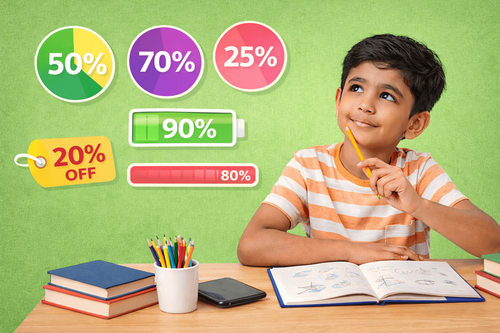

Percentages are everywhere on report cards, in shops, during sports matches, in games, and even while watching videos online. Yet many kids feel confused when they hear the word percentage. It sounds complicated, but the truth is simple: percentages are just another way to show parts of a whole.
In this blog, we’ll break down what percentages are, explore percentage meaning, look at percentage examples, and understand real-life examples of percentage in a fun, stress-free way. Whether you’re a beginner or just starting your maths journey, this guide will help you build strong foundations.
What Are Percentages?
A percentage tells us how much out of 100. The word “percent” actually means per hundred. So whenever you see a percentage, you can imagine it as a part of 100 equal parts.
For example:
- 50% means 50 out of 100
- 25% means 25 out of 100
- 100% means the whole thing
This simple idea makes percentages easy to understand once you connect them to real situations instead of memorising rules.
Percentage Meaning Explained Simply
The percentage meaning becomes clear when we think of everyday things. Imagine a chocolate bar divided into 100 tiny pieces. If you eat 20 pieces, you have eaten 20% of the chocolate.
Percentages help us:
- Compare quantities fairly
- Understand progress
- Measure improvement
- Show changes clearly
That’s why percentages are used in schools, sports, shopping, and even video games.
Why Do We Use Percentages?
Percentages make information easy to compare. Instead of saying “Rahul scored 45 marks out of 60” and “Aanya scored 70 marks out of 100,” percentages help us see who did better at a glance.
They also:
- Make numbers simpler to understand
- Help track growth or improvement
- Show fairness in comparisons
- Explain success, scores, and performance clearly
Sign up now to help your child understand percentages in a simple and fun way.
Percentages for Kids: A Friendly Introduction
When teaching percentage for kids, the key is using familiar objects and situations. Kids don’t need formulas first, they need meaning.
Think about:
- Pizza slices
- Test scores
- Mobile battery percentage
- Game progress bars
Once kids see percentages in their daily lives, maths starts to feel less scary and more fun.
Understanding Percentages Through Stories and Situations
Children understand concepts best when they are told as stories. Percentages become much easier when kids imagine them as part of a story rather than a math problem. For example, imagine a classroom of 100 students. If 60 students bring their lunch from home, we say 60% of the class brings lunch. This mental image helps kids visualize percentages naturally.
Stories help children remember concepts longer because they connect learning with imagination. When percentages are explained using characters, situations, and outcomes, kids stop seeing them as numbers and start seeing them as meaningful information.
Enroll now and make percentage concepts easy, clear, and practical for your child.
Percentages and Fractions: How Are They Connected?
Percentages are closely related to fractions. A percentage is just a fraction with 100 as the denominator.
For example:
- 50% = 50/100
- 25% = 25/100
- 75% = 75/100
This connection helps beginners understand percentages visually and logically instead of memorising rules.
Percentage Examples Kids See Every Day
Let’s look at simple percentage examples that children already understand without realising it:
- A phone battery showing 80% charged
- A game showing 60% completed
- A test result showing 90% score
- A weather app showing 30% chance of rain
These examples show that percentages are not just maths concepts, they are life concepts.
Real-Life Examples of Percentage
Understanding real-life examples of percentage makes learning meaningful and memorable.
Shopping Discounts
If a shop offers 20% off, it means you save 20 out of every 100 units of money spent.
School Results
If a student scores 85%, it means they answered 85 out of 100 questions correctly.
Sports Performance
A batsman with a 50% success rate scores runs in half the matches played.
Food & Nutrition
A juice label may say 10% fruit content, helping us make healthier choices.
Get started today and build strong math foundations with PlanetSpark.
Percentages and Everyday Choices Kids Make
Percentages quietly guide many everyday choices children make without them even realizing it. For instance, when a video loads and shows “90% completed,” kids understand they only need to wait a little longer. This sense of progress comes directly from percentage understanding.
In games, children often see accuracy percentages or completion rates. These indicators help them decide whether they need to practice more or move to the next level. Learning percentages empowers kids to understand feedback instead of feeling confused by it.
Percentage Concept for Beginners
The percentage concept for beginners should focus on three ideas:
- A percentage is always out of 100
- It shows a part of a whole
- It helps compare values easily
Instead of rushing into calculations, beginners should first learn to read, understand, and explain percentages in words.
Sign up now to turn confusing percentages into easy-to-understand ideas.
Percentages vs Whole Numbers
Whole numbers tell us “how many,” while percentages tell us “how much compared to the whole.” For example:
- Saying “5 students passed” gives partial information
- Saying “80% students passed” gives a clearer picture
That’s why percentages are powerful, they provide context.
Visualising Percentages
Kids learn faster when they can see concepts.
Visual ways to understand percentages:
- Colouring 100 squares and shading parts
- Dividing circles or bars
- Using charts and progress bars
- Drawing number lines
Visual learning helps children understand percentages without pressure.
Percentage Meaning in School Life
In school, percentages play an important role beyond math class. Test scores are often shown as percentages to give a clear idea of performance. A score of 85% tells a child that they have done well overall but still have some areas to improve.
Attendance is also measured in percentages. When a school says a student has 95% attendance, it means the child has been present almost every day. Understanding these ideas helps kids take responsibility for their learning journey.
Enroll now and help your child learn percentages through real-life examples.
Percentage Word Problems (Concept-Based)
Percentage word problems don’t have to be scary. When taught the right way, they become stories instead of sums.
For example:
- “If 60% of a class likes football, what does that tell us?”
- “If a bottle is 75% full, how much space is left?”
At PlanetSpark, word problems are taught as thinking exercises, not calculation drills.
Why Kids Struggle with Percentages
Many kids struggle because:
- Percentages are introduced too quickly
- Focus is on solving, not understanding
- Real-life meaning is ignored
Once learning becomes concept-first, confidence automatically improves.
Start learning today and boost your child’s confidence in maths and logic.
How PlanetSpark Teaches Percentages Differently
At PlanetSpark, percentages are taught through:
- Visual explanations
- Real-world storytelling
- Interactive thinking exercises
- Age-appropriate examples
Kids are encouraged to explain percentages in their own words, which builds clarity and confidence.
Building Confidence with Percentages
Confidence grows when children:
- Understand why percentages exist
- Can explain them using examples
- See them in everyday life
- Learn without fear of mistakes
Maths becomes enjoyable when learning feels logical and friendly.
Percentages in Daily Decision-Making
Percentages help kids:
- Decide better while shopping
- Understand grades and feedback
- Track progress in learning
- Evaluate performance in games
These skills go beyond maths, they support logical thinking and reasoning.
Why Percentages Matter for Future Learning
Percentages prepare kids for:
- Advanced maths topics
- Data interpretation
- Financial literacy
- Analytical thinking
A strong foundation now leads to success later.
Encouraging Kids to Talk About Percentages
Asking questions like:
- “What does this percentage mean?”
- “Is this more or less than half?”
- “Where do you see percentages today?”
helps children think independently, not just calculate.
Making Percentages Fun and Stress-Free
Learning should never feel scary. Percentages become fun when:
- Examples are relatable
- Pressure is removed
- Curiosity is encouraged
- Mistakes are treated as learning steps
PlanetSpark believes in learning with joy, not fear.
Sign up now for interactive lessons that make percentages exciting for kids.
Percentages in Sports and Games
Sports are one of the easiest ways to explain percentages to kids. If a football player scores goals in 7 out of 10 matches, we say their success rate is 70%. This instantly makes sense to children who love sports.
In board games or video games, percentages often represent chances or probabilities. When kids understand percentages, they make better decisions during gameplay and learn how numbers influence outcomes.
Percentages and Money Awareness
Money is another powerful real-life area where percentages appear. Discounts, savings, and offers are all shown in percentages. When kids learn what “20% off” means, they begin to understand value and smart choices.
This early exposure helps children develop basic financial awareness. They learn that percentages are tools that help people save money, compare prices, and make better buying decisions.
Why Percentages Are Easier Than They Look
Many children fear percentages because they are introduced too quickly with formulas. However, percentages are actually simpler than many other math concepts. They are based on one fixed idea: everything is out of 100.
Once kids understand this idea, percentages stop feeling unpredictable. Whether the percentage is 10%, 50%, or 90%, the meaning stays consistent, it always refers to parts of a hundred.
Enroll now and help your child move beyond memorization to real understanding.
Connecting Percentages to Visual Thinking
Visual learning plays a major role in helping kids grasp percentages. When children see charts, shaded grids, or progress bars, percentages become easier to understand. Visuals reduce confusion and increase clarity.
For example, shading 25 squares out of 100 instantly shows what 25% looks like. This method helps kids remember concepts without memorization or stress.
Comparing Percentages the Smart Way
Comparing percentages teaches kids logical thinking. When children compare 40% and 60%, they are actually comparing parts of the same whole. This skill helps them understand fairness, improvement, and progress.
For example, if one team wins 60% of matches and another wins 45%, kids can clearly tell which team performed better. This comparison skill is valuable across subjects, not just math.
Get started today and empower your child with essential math thinking skills.
Percentage Word Problems Without Pressure
Percentage word problems don’t need to involve complex solving. They can simply ask children to think and explain. For example, “If a glass is 80% full, what does that mean?” encourages understanding instead of calculation.
At PlanetSpark, word problems are used to improve reasoning skills. Kids learn to explain situations in words, which strengthens comprehension and communication.
Percentages and Logical Thinking
Percentages help children think logically and critically. When kids understand percentages, they can interpret information, analyze results, and make predictions. These thinking skills are useful in every subject.
For example, if a student improves from 60% to 80%, they can understand growth and progress. This builds motivation and self-awareness.
Percentage Concept for Beginners Revisited
For beginners, percentages should be introduced slowly and clearly. The focus should be on understanding, not speed. Kids should feel comfortable explaining what a percentage means in their own words.
Once confidence builds, children naturally become curious and ask deeper questions. This curiosity-driven learning leads to stronger foundations.
Sign up now and make learning percentages simple, engaging, and effective.
Common Misunderstandings About Percentages
Some kids think percentages change based on the situation. Clarifying that percentages always relate to a whole of 100 helps remove confusion. Others believe higher numbers always mean better results, which isn’t always true.
Teaching children to ask “100 of what?” helps them interpret percentages correctly. This simple question builds clarity and prevents misunderstandings.
How Parents Can Support Percentage Learning
Parents can support learning by pointing out percentages in daily life. Grocery bills, TV ads, sports scores, and app updates all offer learning moments.
Discussing percentages casually at home makes learning feel natural and pressure-free. Children learn best when learning continues beyond textbooks.
Why PlanetSpark Focuses on Concept-Based Learning
PlanetSpark believes that children learn best when concepts are explained clearly and practically. Percentages are taught using stories, visuals, and real-life examples so kids truly understand the “why” behind the numbers.
This approach builds confidence, curiosity, and long-term learning success.
The key USPs of PlanetSpark’s maths course include:
- Live interactive sessions led by experienced educators who introduce mental-calculation shortcuts (including Vedic maths tricks) and connect them directly to NCERT/CBSE exam problems.
- Customised practise modules focusing on arithmetic operations, algebraic expressions, quadratic equations, and roots, so students apply the tricks within actual syllabus-aligned questions.
- Performance analytics & error-tracking tools that identify recurring calculation mistakes, helping students focus on improving speed and accuracy.
- Dedicated doubt-resolution and revision-boosters, which means that if any student is lagging on applying the tricks, the mentor provides targeted support and extra practise.
- Board-exam simulators with time-bound mock tests, where students learn to use tricks under realistic exam conditions, building confidence and speed.
Start learning today with interactive and concept-based percentage lessons.
Wrapping It Up
Percentages are not just numbers, they are tools for understanding the world. When kids learn the meaning, explore percentage examples, and see real-life examples of percentages, maths becomes meaningful.
With the right guidance and approach, percentages can become one of the easiest and most enjoyable topics for kids to learn.
Frequently Asked Questions
A percentage tells us how many parts there are out of 100. It helps us understand portions, comparisons, and results easily. Instead of counting different totals, percentages use one common scale. This makes information simple and quick to understand. Kids see percentages every day without realizing it.
Percentages make it easier to compare different things. When everything is shown out of 100, it becomes clearer to understand progress or performance. For example, 80% attendance is easier to understand than 16 out of 20. Percentages give a clear picture at a glance. That’s why they are used everywhere.
Percentage meaning explains how much of a whole is being talked about. It shows how big or small a part is compared to the total. This helps kids understand completion, success, or comparison easily. Percentages are used to measure progress in a simple way. They turn complex data into clear information.
Percentages can be explained using real-life examples like marks, games, or shopping discounts. Visual ideas such as halves and quarters help kids understand better. Talking about everyday situations makes learning stress-free. No heavy calculations are needed in the beginning. Understanding always comes before solving.
Examples include exam results, phone battery levels, and game progress bars. Discounts in stores also show percentages clearly. Weather apps use percentages to show chances of rain. These examples help kids relate percentages to daily life. Learning becomes natural when examples are familiar.
Real-life examples include school attendance, sports scores, and nutrition labels. Percentages are also used in banking, weather forecasts, and health apps. These uses help people make quick decisions. Kids learn that percentages are not just for math class. They are part of everyday life.
Percentage word problems feel difficult at first, but breaking them into steps—identifying part and whole—makes them much simpler. Regular practice builds confidence quickly.
Kids often forget that percentages are always out of 100. Some confuse percentages with marks or scores. Others assume bigger numbers always mean better results. These mistakes reduce with proper explanation. Clear concepts help kids avoid confusion.
Parents can talk about percentages during daily activities. Asking children to explain what a percentage means helps build understanding. Using simple examples like shopping discounts makes learning fun. Encouragement works better than pressure. Learning improves when kids feel confident.
Learning percentages helps kids understand data and make better decisions. It builds logical thinking and problem-solving skills. Percentages are used in academics and real life. Early understanding creates strong foundations. This skill supports learning in many subjects.