
What is Probability? Build Maths Understanding With PlanetSpark


Table of Contents
- What Is Probability in Mathematics?
- Important Terms Used in Probability
- When All Chances Add Up Perfectly
- The Simple Formula That Predicts Possibilities
- Simple Probability Rules Every Student Should Know
- Probability in Maths: Where Logic Meets Real Life
- How Strong Maths Skills Create Winners
- How Students Can Apply These Concepts Effectively
- Why Probability Matters for Students’ Everyday Thinking
- Why PlanetSpark Is the Ultimate Destination for Maths Master
- Unlock Probability, Confidence, and Succeed with PlanetSpark
What is probability? It is the maths of chance, helping us measure uncertainty in everyday moments like rolling a dice or predicting outcomes. This guide breaks probability into simple ideas, clear rules, and relatable examples that make learning feel intuitive. By turning abstract numbers into meaningful insights and guided practice, PlanetSpark supports students in building confidence, sharpening logical thinking, and applying probability concepts accurately across maths problems and real-life situations.
What Is Probability in Mathematics?
To understand what is probability, students must first understand uncertainty. Probability measures how likely or unlikely an event is to occur. Its value always lies between 0 and 1, making it easy to compare chances logically.
In probability in maths, numbers are used to represent possibility:
Probability 0 means the event cannot happen
Probability 1 means the event will definitely happen
Any value between 0 and 1 shows a varying likelihood
Probability is used when outcomes are equally possible, such as tossing a coin or rolling a die. Instead of guessing results, students rely on reasoning and calculations. This helps them develop a systematic approach to problem-solving and improves accuracy in exams. Understanding probability also prepares students for advanced topics like statistics and data interpretation.

Important Terms Used in Probability
Before solving probability questions, students must understand the basic terms used in probability in maths. These terms appear frequently in textbooks and exam questions.
Key Probability Terms
1. Experiment: Any action with an uncertain result, like rolling a dice, tossing coins, drawing cards, or picking objects randomly.
2. Outcome: One possible result of an experiment, such as getting a number, colour, symbol, or side.
3. Sample Space: The complete list of all possible outcomes of an experiment, written clearly as a set.
4. Event: One or more selected outcomes from the sample space that satisfy a given condition.
Probability Examples
Tossing a coin:
Sample space = {Head, Tail}
Event = Getting a headRolling a dice:
Sample space = {1, 2, 3, 4, 5, 6}
Event = Getting an even numberDrawing a card from a deck:
Sample space = All 52 cards
Event = Drawing a heartFlipping two coins:
Sample space = {HH, HT, TH, TT}
Event = Getting exactly one headChoosing a day of the week:
Sample space = {Monday, Tuesday, Wednesday, Thursday, Friday, Saturday, Sunday}
Event = Choosing a weekend dayPicking a marble from a bag:
Sample space = {Red, Blue, Green}
Event = Picking a blue marble
Understanding these terms helps students read questions carefully and avoid confusion while calculating probabilities.
Give your child the advantage of structured maths learning designed for long-term success with PlanetSpark!
When All Chances Add Up Perfectly
The sum of probabilities explains an important idea in probability that every possible outcome together must account for the whole situation. When an experiment includes all outcomes without overlap, their probabilities always add up to one. This rule helps students ensure that no possible result is ignored.
Key Points to Understand
Applies only when all outcomes are included
Works for mutually exclusive events
Helps verify the correctness of answers
Simple Examples
This concept builds logical thinking and accuracy. If the total probability is less than or greater than one, it clearly indicates a mistake, guiding students to recheck their calculations.
The Simple Formula That Predicts Possibilities
The formula of probability helps students calculate how likely an event is to occur clearly and logically. It compares the number of favourable outcomes with the total number of possible outcomes, making probability questions structured and easy to solve. This formula is used only when all outcomes are equally likely.
Probability Formula
Probability of an event = Number of favourable outcomes ÷ Total number of possible outcomes
How It Works
Identify all possible outcomes
Count the outcomes that match the event
Apply the formula step by step
Example of Probability in Maths
Understanding this formula builds confidence, improves accuracy, and helps students approach probability questions logically in exams and real-life situations.
Support your child’s academic growth with engaging and effective maths learning at PlanetSpark!
Simple Probability Rules Every Student Should Know
Probability rules help students understand how chances behave and ensure that answers remain logical and accurate. These rules guide calculations and strengthen conceptual clarity.
Rule 1: Probability Lies Between Zero and One
The value of probability always falls between zero and one. Any value outside this range is not possible and signals a calculation error.
Example 1: The probability of rain tomorrow is 0.3, which is valid.
Example 2: A probability of 1.2 is incorrect because it exceeds the maximum limit.
Rule 2: Impossible Event Has Probability Zero
An impossible event cannot occur under any condition, so its probability is zero.
Example 1: Getting the number 8 on a standard dice has probability zero.
Example 2: Drawing a red ball from a bag containing only blue balls has probability zero.
Rule 3: Certain Event Has Probability One
A certain event will always occur, so its probability is one.
Example 1: When rolling a die, getting a number less than 7 is certain.
Example 2: Picking a card that is either red or black from a deck is guaranteed.
Rule 4: Total Probability Equals One
The sum of probabilities of all possible outcomes of an experiment always equals one.
Example 1: In a coin toss, the probabilities of heads and tails add up to one.
Example 2: While rolling a dice, the probabilities of outcomes one through six together equal one.
Rule 5: Complementary Events Rule
The probability of an event and the probability of it not happening together equal one.
Example 1: If the probability of winning a game is 0.6, losing has probability 0.4.
Example 2: If the probability of getting a head is 0.5, not getting a head is also 0.5.
Probability in Maths: Where Logic Meets Real Life
Probability in maths helps students understand how likely an event is to occur, using numbers, patterns, and logical reasoning. It builds decision-making skills and connects mathematical thinking with everyday situations like games, weather predictions, exams, and data analysis.
Key Points to Understand Probability in Maths:
Explains the likelihood of events using numbers between 0 and 1
Uses fractions, decimals, and percentages to express chances
Helps predict outcomes based on previous data and patterns
Strengthens logical thinking and analytical reasoning skills
Applies to real-life scenarios like tossing coins or rolling dice
Forms a foundation for statistics, data handling, and advanced maths
Understanding probability in maths makes learners more confident in solving real-world problems and interpreting uncertain situations logically.
How Strong Maths Skills Create Winners
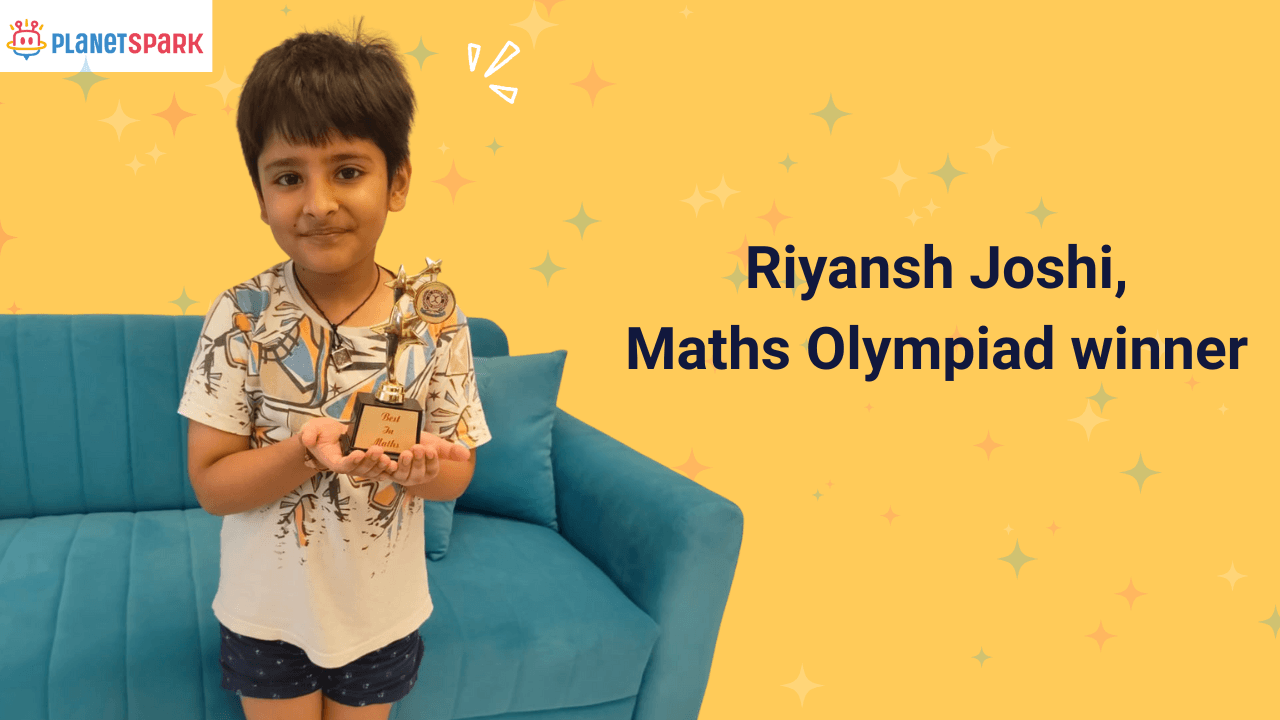
"Riyansh Joshi, a proud Maths Olympiad winner, stands out for his clarity of thought, strong reasoning skills, and confident communication."
Join PlanetSpark and give your child the guidance, confidence and skills needed to shine in maths and achieve academic excellence.
How Students Can Apply These Concepts Effectively
Understanding mathematical ideas becomes easier when students connect learning with practice and daily thinking. This approach builds confidence and reduces fear of problem-solving.
Develop logical thinking by solving a variety of question types regularly and reviewing mistakes carefully for improvement and clarity.
Use visual aids like charts, diagrams, or number lines to strengthen conceptual understanding and improve long-term retention.
Practice step-by-step solutions instead of memorising answers to build strong foundational reasoning skills.
Discuss problems aloud with peers or mentors to improve mathematical language and explanation abilities.
Apply concepts to real-life situations such as games, experiments or data interpretation to make learning engaging.
Revise concepts frequently using short practice sessions rather than long, stressful study hours.
Why Probability Matters for Students’ Everyday Thinking
Probability is not just a classroom topic; it shapes how students think, decide, and predict outcomes in daily life. Learning this concept builds logical reasoning and helps students handle uncertainty with confidence.
Helps students judge chances before making decisions in games, studies, and real life.
Improves analytical thinking by comparing possible outcomes logically.
Supports understanding of subjects like science, economics, and data handling.
Encourages clear thinking instead of guessing or assumptions.
Builds a foundation for advanced maths topics in higher classes.
Makes students comfortable interpreting data, surveys, and results.
Strengthens problem-solving skills through practical examples.
Develops confidence in exams by applying concepts step by step.
This understanding prepares students to think smartly, act wisely, and approach challenges with clarity rather than confusion.
Why PlanetSpark Is the Ultimate Destination for Maths Mastery
PlanetSpark delivers a complete learning experience that strengthens every aspect of a child’s mathematical understanding, accuracy, and confidence. With personalised one-on-one guidance, interactive practice, and real-world learning, students don’t just learn math—they master it.
Services That Build Strong Mathematical Skills
Personal Math Trainers for concept correction, problem-solving support, and skill enhancement
Customised Learning Roadmaps tailored to each child’s strengths and learning gaps
SparkX AI Analysis to assess accuracy, speed, and conceptual clarity
AI Guided Practice Sessions for computation, reasoning, and application-based learning
Spark Diary for daily maths practice and real-life number application
Gamified Learning Tools, including Speed Maths, Number Ninja, Logic Lab, and Fraction Quest
SparkBee Daily Quizzes to strengthen calculations, logic, and numerical fluency
SparkShop eBooks covering arithmetic, geometry, data handling, and reasoning
Progress Reports and PTMs offering clear, actionable insights
With PlanetSpark, your child builds mathematical confidence, logical thinking, and a future-ready foundation that lasts a lifetime.
Unlock Probability, Confidence, and Succeed with PlanetSpark
Probability is not just a maths topic, but a powerful way to understand chance, logical thinking and everyday decisions. When students grasp probability clearly, they build stronger analytical skills, confidence and accuracy. With the right guidance, concepts become simple, enjoyable and practical, helping learners perform better in exams and beyond.
At PlanetSpark, probability is taught through clear explanations, real-life examples and structured practice that matches each learner’s pace. This approach turns confusion into clarity and curiosity into mastery. With consistent support, students develop a strong maths foundation that prepares them for advanced concepts and competitive success.
Also Read
Sequence and Series Formulas Mastery Starts at PlanetSpark
Mean, Mode, Median Fundamentals to Ace Maths with PlanetSpark
Frequently Asked Questions
Probability explains how likely an event is to occur. It is measured between zero and one, where zero means impossible and one means certain, helping students predict outcomes using logical reasoning.
The formula of probability is favourable outcomes divided by the total possible outcomes. It helps calculate chances mathematically and is widely used in exams, games, statistics, science experiments, and real-life decision-making.
Basic probability rules include the total probability equalling one, the probability of an impossible event being zero, and calculating complementary events. These rules ensure accurate calculations and help avoid common mistakes.
Probability is important because it builds logical thinking and decision-making skills. It connects maths with real-life situations like weather forecasts, games, risk analysis, and data interpretation for students.
PlanetSpark helps students master probability through concept clarity, real-life examples, visual explanations, and guided practice. Interactive sessions build confidence, improve exam performance, and make maths enjoyable for learners.
Learning probability with PlanetSpark strengthens reasoning skills and problem-solving abilities. Structured lessons, expert teachers, and personalised feedback help students apply probability concepts accurately and confidently in exams.