
NCERT Solutions for Class 10 English First Flight Chapter 3
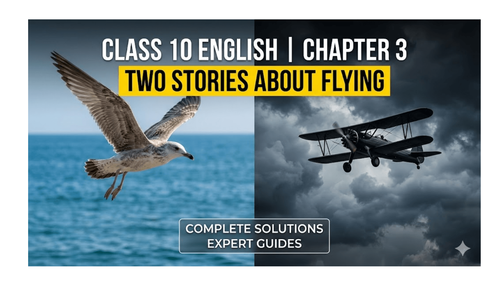

NCERT solutions for Class 10 English Chapter Two Stories about Flying – complete answers & explanations
This blog provides complete NCERT solutions for Chapter 3, *Two Stories About Flying* from Class 10 English. This chapter contains two exciting and insightful stories – one about a seagull overcoming its fear of flying, and the other about a pilot navigating through a terrifying storm. Through these stories, students will learn about facing challenges, the importance of persistence, and overcoming fears. This blog is designed to provide accurate and helpful answers strictly based on the worksheet, without any additions or modifications.
What this NCERT chapter covers?
1. Key concepts taught in the
chapter:
- The challenges of overcoming fears.
- The courage to face difficult situations.
- A story of self-discovery and personal growth.
- The importance of risk-taking and perseverance.
2. Language skills / grammar / themes covered:
- Theme of courage, fear, and personal growth.
- Vocabulary related to flying, courage, and overcoming adversity.
3. How the chapter helps in exams and learning:
- Students will improve their reading comprehension and understanding of narrative themes.
- Helps students develop empathy and learn the value of facing challenges.
- Useful for writing assignments and essays related to personal growth and bravery.
How to use these NCERT solutions?
1. How students should attempt questions first:
- Read the questions carefully and try answering them based on your understanding of the chapter.
- If you are unsure, refer back to the chapter text to find clues.
2. How to use answers for checking:
- Compare your answers with the solutions provided to ensure accuracy.
- Check if your interpretation of the story aligns with the details in the chapter.
3. How parents/teachers can guide students:
- Encourage students to think critically about the themes of the chapter.
- Discuss the significance of the events and how they relate to real-life situations, like overcoming personal fears.
- Guide students to explore their thoughts on facing challenges.
4. That solutions follow the worksheet order exactly:
- The answers are provided in the same sequence as in the worksheet, ensuring easy reference and organization.
Important tips & tricks for students
1. Common mistakes to avoid:
- Avoid misinterpreting the moral of the story. Focus on the key lessons of persistence and bravery.
- Do not skip any questions. Each question is essential for understanding the chapter.
2. NCERT expectations for answers:
- Be concise and stick to the content presented in the chapter.
- Provide detailed answers for descriptive questions, including insights about the characters and the events.
3. How to score full marks:
- Always relate your answers to specific examples from the text.
- Write in simple, clear, and well-structured sentences.
4. How to approach activities and speaking tasks:
- Use these tasks as an opportunity to explore the themes of the chapter in a creative way.
- Practice narrating your experiences of facing fears or challenges, just like the characters in the story.
NCERT solutions – complete answer key
1. Thinking about the Text
1. The young seagull was afraid to fly because he was unsure whether his wings would support him. He was intimidated by the vast sea below. Not all young birds are afraid; some may take to flying quickly, but others may be more timid. A human baby also finds it a challenge to take its first steps, just like the seagull, as both are unsure of their abilities at first.
2. This suggests that the seagull's hunger and desire for food pushed him to overcome his fear of flying. The sight of the food motivated him to take the risk and fly.
3. The seagull’s parents were encouraging him to fly because they wanted him to learn to fend for himself, like his siblings. They used threats and cajoling to motivate him to take the leap and fly.
4. [Open-ended discussion] Success was not guaranteed. Just like the seagull, trying was important regardless of the possibility of failure. It was through trying that success came.
2. Thinking about the Poem
1. No, ‘dyin’ does not perfectly rhyme with ‘lion’. However, by pronouncing ‘dyin’ with a long "i" sound, it can be made to rhyme with ‘lion’.
2. The poet suggests identifying the lion by its roar and the tiger by its black stripes on a yellow ground. According to the poet, you can identify these animals when they are about to attack.
3. The words ‘lept’ and ‘lep’ are non-standard spellings. The poet uses these spellings for comedic effect and to maintain the rhythm of the poem.
4. The correct line would be: "A novice might be nonplussed". The poet’s version ‘nonplus’ is used to fit the rhyme and rhythm of the poem.
3. Writing Tasks
1. Write a short composition on your initial attempts at learning a skill. You could describe the challenges of learning to ride a bicycle or learning to swim. Make it as humorous as possible.
2. Have you ever been alone or away from home during a thunderstorm? Narrate your experience in a paragraph.
Why NCERT solutions help students?
1. Exam readiness:
- These solutions provide students with a clear understanding of the chapter and help them prepare for exams by reinforcing key concepts.
2. Concept clarity:
- The detailed explanations clarify any doubts and ensure a thorough grasp of the material.
3. Importance of NCERT-aligned answers:
- These solutions strictly follow the NCERT framework, making them ideal for exam preparation and understanding the content in the way it is intended.
4. Confidence-building for students:
- Using these solutions helps students feel confident in their understanding of the chapter and enables them to approach similar questions with ease.
Help your child build strong English fundamentals with expert-guided learning support.