
NCERT Solutions for Class 12 English Kaleidoscope Chapter 2


NCERT solutions for Class 12 English Chapter Eveline – complete answers & explanations
This chapter from Class 12 English Kaleidoscope, Eveline, explores the emotional journey of a young girl caught between duty and desire. It highlights her internal conflict as she decides whether to leave her home for a new life or stay back due to family responsibilities. The story is important as it helps students understand themes like family bonds, fear of change, and emotional struggle. These clear and reliable NCERT solutions help students understand the correct approach to answering questions and improve their interpretation skills. Download the worksheet and practice alongside solutions for better clarity. Book a free trial now to get expert guidance and strengthen your understanding of such important chapters.
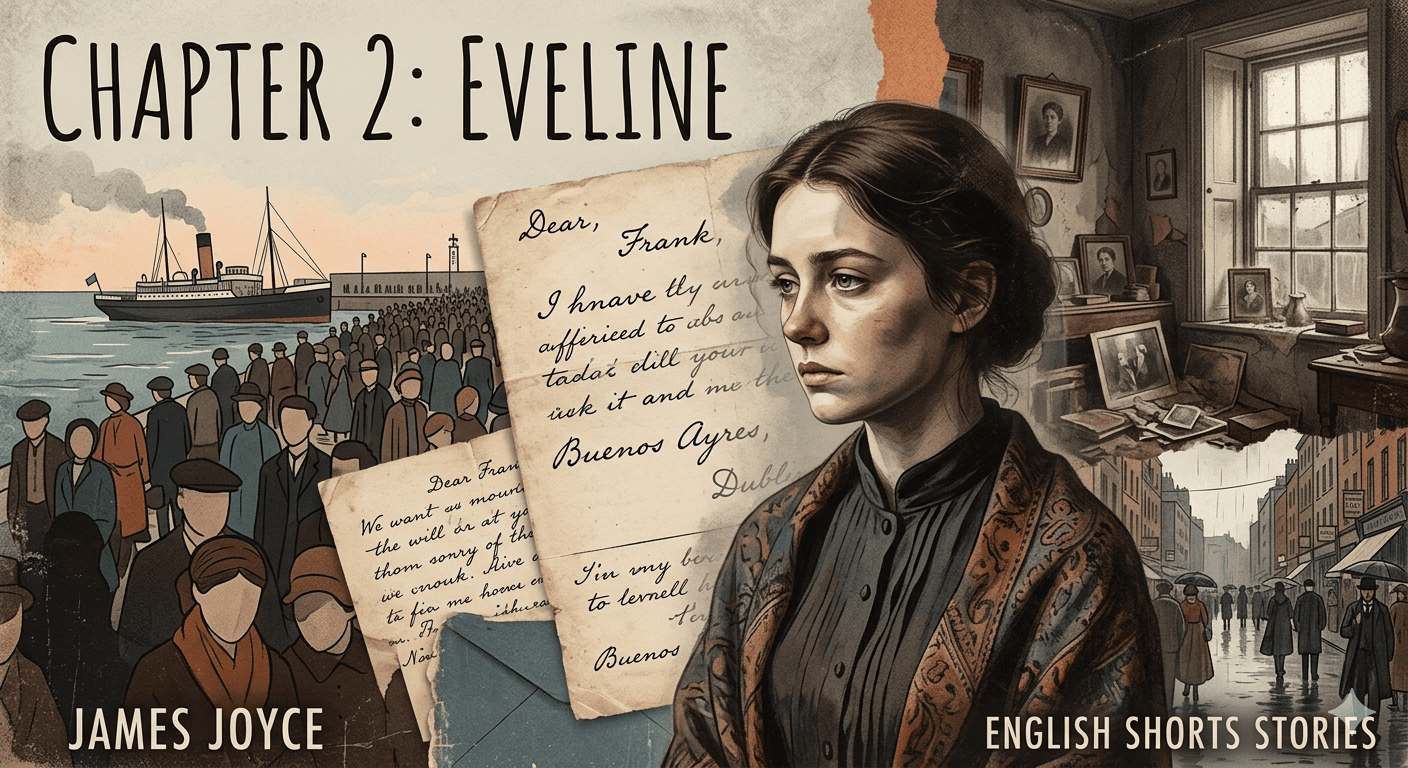
What this NCERT chapter covers?
1. The chapter focuses on Eveline’s
emotional conflict and decision-making process.
2. It explains themes like family responsibility, love, fear, and sacrifice.
3. Students learn how memories influence present decisions.
4. The story builds understanding of character analysis and inner conflict.
5. It improves comprehension skills through detailed reading.
6. It teaches how to interpret symbolic elements like objects and settings.
7. The chapter develops critical thinking about personal choices.
8. It strengthens writing skills through structured answers.
9. It includes grammar concepts like parallelism.
10. Pronunciation and language usage are also practiced.
11. Students learn how to connect literature with real-life situations.
How to use these NCERT solutions?
1. First, read the questions carefully
and try answering them on your own.
2. Compare your answers with the given solutions to check accuracy.
3. Understand how answers are structured and written clearly.
4. Focus on key points used in answers to improve your writing.
5. Use the solutions to revise important concepts before exams.
6. Parents and teachers can guide students by discussing answers.
7. Practice regularly to build confidence in answering literature questions.
8. Follow the exact order of questions to stay aligned with the worksheet.
Important tips & tricks for students
1. Always read the story carefully before attempting questions.
2. Focus on understanding emotions and themes, not just facts.
3. Avoid writing very long or unrelated answers.
4. Stick to the main idea of the question while answering.
5. Use simple and clear language in your responses.
6. Pay attention to symbolic meanings in the story.
7. Practice grammar and pronunciation sections properly.
8. Revise answers regularly to remember key points.
9. Attempt all questions to avoid losing marks.
NCERT solutions – complete answer key
STOP AND THINK
Eveline reviewed all the familiar objects at home because she
was about to leave the house forever. Looking at the objects
made her remember her past life, childhood memories, and the
many years she had spent in that home.
Eveline was planning to go to Buenos Aires with Frank, where
she would marry him and start a new life.
STOP AND THINK
Frank was a sailor with whom Eveline had fallen in love.
Eveline’s father quarrelled with him because he did not trust
sailors and did not want Eveline to have any relationship with
him.
The organ-player’s appearance reminds Eveline of her promise
to her dying mother that she would keep the family together
and take care of the home as long as she could. This memory
makes her feel guilty about leaving.
Eveline loved Frank and her brother Ernest.
- She loved Frank because he was kind, caring, and promised
her a new life.
UNDERSTANDING THE TEXT
Eveline experiences a deep emotional conflict on the day she
plans to leave with Frank. On one hand, she wants to escape her
difficult life, her father’s harsh behaviour, and the heavy
responsibilities at home. She hopes for happiness, respect, and
love in a new country with Frank. On the other hand, she feels
attached to her home, remembers her childhood, worries about
leaving her father and siblings, and feels bound by the promise
she made to her mother to keep the family together.
Eveline lets go of the opportunity to escape because fear, duty,
and emotional attachment overpower her desire for freedom.
The memory of her mother’s suffering and the promise she had
made to her create a strong sense of responsibility. At the final
moment, she becomes terrified of the unknown future and
cannot bring herself to leave.
Several signs show Eveline’s indecision as the hour of departure
approaches:
- She keeps sitting by the window thinking about her past and
her home.
- She repeatedly weighs the advantages and disadvantages of
leaving.
- She loved Ernest because he had been her favourite brother.
Eveline did not like Miss Gavan and her father.
- She disliked Miss Gavan because she was always rude and
bossy at the Stores.
- She feared and disliked her father because he was often
violent, controlling, and quarrelled with her over money.
- She remembers her family, childhood, and her promise to her
mother.
Example answer:
A student may feel a difficult choice when deciding between
pursuing studies in another city or staying close to family.
While moving away may offer better opportunities, the
emotional attachment to family and fear of change can
make the decision challenging.
Choosing between family duty and personal happiness is
often very difficult. Family responsibilities and emotional
bonds can make a person feel obligated to sacrifice
personal desires. In Eveline’s case, she feels responsible for
her family and bound by her promise to her mother. At the
same time, she wants freedom and happiness with Frank.
This conflict makes her unable to decide, showing how
powerful family ties and social expectations can be.
TALKING ABOUT THE TEXT
- At the station she becomes pale, frightened, and prays for
guidance.
- She finally clutches the iron railing and refuses to move.
APPRECIATION
The objects in the story have symbolic meanings:
- The window symbolises Eveline’s position between two
worlds her past life at home and the possibility of a new future.
- The gathering dusk symbolises confusion, uncertainty, and
the approaching moment of decision.
The author does not openly judge Eveline. Instead, he presents
her thoughts and emotions in detail and allows readers to
understand her situation and form their own opinion about her
decision.
The images evoke strong emotions:
(i) “A bell clanged upon her heart” suggests sudden fear and
alarm.
(ii) “All the seas of the world tumbled upon her heart” expresses
overwhelming panic and emotional turmoil.
(iii) “Her hands clutched the iron in frenzy” shows desperation
and resistance.
(iv) “Passive, like a helpless animal” suggests complete
helplessness, fear, and emotional paralysis.
The story is told through Eveline’s thoughts and memories. The
narrative moves between the present moment and her
recollections of childhood, family life, and her mother. This
technique allows readers to understand her inner conflict and
emotions.
LANGUAGE WORK
A. Grammar : Parallelism
Parallel parts in the sentences:
to go away / to leave her home
to direct her / to show her what was her duty
the promise to her mother / her promise to keep the home together
take her in his arms / fold her in his arms
leaning her head against the window curtain / inhaling the odour
of dusty cretonne
read her out a ghost story / made toast for her at the fire
B. Pronunciation
PHO-to-graph
es-CAPE
CHAN-ges
THREAT-en
ex-CITE-ment
FARE-well
il-LU-mined
SAI-lor
SAC-ri-fice
in-VAR-i-a-ble
Why NCERT solutions help students?
NCERT solutions help students prepare effectively for exams by giving them clarity on how to answer questions correctly. They improve understanding of concepts, build confidence, and ensure that students follow the right structure and approach expected in exams.
Help your child master Class 12 English with structured guidance and concept clarity.