
Understand Hyper Personalised Learning for Better Skill Development
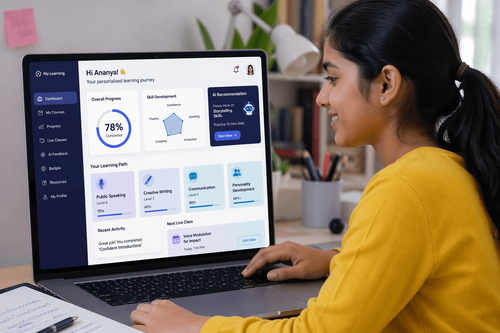

Table of Contents
- What is Hyper-Personalised Learning?
- How Hyper-Personalised Learning Improves Skill Development
- Role of Adaptive Learning Platforms in India
- Digital Badges for Student Skills and Motivation
- Hyper-Personalised Learning vs Traditional and Adaptive Lear
- Connection Between Hyper-Personalised Learning and Business
- How to Implement Hyper-Personalised Learning
- Transform Your Growth with PlanetSpark Personality Developme
- Unlock Your True Learning Potential
What if your learning experience was adapted to you instead of forcing you to adapt to it? Many learners struggle because traditional systems treat everyone the same. This often leads to slow progress, low engagement, and missed potential. Hyper-personalised learning changes this by tailoring content, pace, and feedback to each individual.
In this blog, you will explore how hyper-personalised learning works, its core components, benefits, and how adaptive learning platforms in India are transforming education. You will also learn how tools like digital badges and AI-driven insights improve skill development and connect to business agility.
What is Hyper-Personalised Learning?
Hyper-personalised learning is an advanced, technology-driven approach that uses AI, machine learning, and data analytics to create highly customised learning experiences for every individual. Instead of following a fixed curriculum, this method continuously adapts to a learner’s behaviour, performance, preferences, and goals in real time.
Traditional learning systems often assume that all learners progress at the same pace and understand concepts in the same way. However, in reality, every learner is different. Hyper-personalised learning recognises this difference and builds a unique learning journey for each individual.
It focuses on delivering the right content, at the right difficulty level, at the right time. This ensures that learners are neither overwhelmed nor bored, but consistently challenged in a productive way.

Core Components of Hyper-Personalised Learning
To truly understand how this system works, let’s break down its core components:
Data-Driven Insights
Learning platforms collect and analyse data such as quiz scores, time spent on tasks, and interaction patterns. This helps identify strengths, weaknesses, and learning habits. For example, if a learner struggles with pronunciation, the system detects it early and adjusts the content accordingly.
Tailored Learning Paths
Instead of a fixed syllabus, learners follow a customised path. Some may move faster through certain topics, while others may need more practice. This flexibility ensures efficient learning without unnecessary repetition.
AI-Powered Content Delivery
Artificial intelligence continuously adjusts the difficulty level of content. If a learner performs well, the system introduces more advanced concepts. If they struggle, it provides simpler explanations or additional practice.
Contextualized Training
Learning becomes more effective when it connects to real-life situations. Hyper-personalised systems often include simulations, role-plays, or real-world scenarios to make learning practical and meaningful.
Key Aspects
Beyond the core components, several advanced features make this approach powerful:
- AI-powered adaptation: Constantly tracks learner progress and adjusts instantly
- Predictive learning suggestions: Recommends what to learn next based on future needs
- Multi-format content delivery: Uses videos, quizzes, games, and live sessions
- Continuous feedback loops: Provide instant feedback for improvement
All these elements work together to create a learning experience that feels intuitive, supportive, and highly effective. Learners no longer feel lost or left behind. Instead, they feel guided at every step.
This makes learning not only more relevant but also more enjoyable and outcome-driven.
Feeling stuck with generic learning methods? Book a free trial class today and experience personalised learning that actually works. Limited slots available.
How Hyper-Personalised Learning Improves Skill Development
Hyper-personalised learning significantly enhances skill development by focusing on what truly matters for each learner. Instead of following a broad, generalised curriculum, it identifies specific skill gaps and works directly on them.
This targeted approach saves time, increases efficiency, and leads to faster improvement.
Key Benefits
1. Increased Engagement and Motivation
One of the biggest challenges in learning is staying motivated. When content feels irrelevant or too difficult, learners lose interest.
Hyper-personalised learning solves this by delivering content that matches the learner’s level and interests. When learners see that the material is directly useful to them, they naturally become more engaged.
For example, a learner interested in storytelling may receive speech topics based on real-life situations or personal experiences. This makes practice more meaningful and enjoyable.
2. Accelerated Skill Acquisition
Since learners focus only on areas that need improvement, they progress faster. There is no wasted time on concepts they already understand.
For instance, if a learner is already confident in grammar but struggles with speaking, the system prioritises speaking exercises. This targeted learning helps them improve quickly and efficiently.
3. Improved Retention
People remember information better when they can relate it to real-life situations. Hyper-personalised learning uses contextual and practical examples to strengthen understanding.
Instead of memorising concepts, learners apply them. This leads to deeper learning and long-term retention.
4. Increased Productivity
Traditional learning often involves spending time on unnecessary content. Hyper-personalised learning eliminates this by focusing only on what is needed.
This allows learners to:
- Spend less time searching for relevant resources
- Focus on meaningful practice
- Achieve better results in less time
Practical Example
Let’s take the example of a student learning public speaking:
Instead of following a generic course, the learner receives:
- Personalised speech topics based on their interests
- AI-driven feedback on tone, clarity, and confidence
- Practice sessions tailored to their current skill level
- Suggestions for improvement after every session
Over time, the system tracks progress and adjusts the learning path accordingly.
This targeted and adaptive approach ensures consistent improvement, measurable progress, and a significant boost in confidence.
Want to improve communication skills faster? Book your personalised demo session now before seats fill up. Start your transformation today.
Role of Adaptive Learning Platforms in India
Adaptive learning platforms in India are playing a crucial role in bringing hyper-personalised learning to the mainstream. With the rapid growth of edtech, these platforms are transforming how students, professionals, and lifelong learners acquire new skills.
Unlike traditional systems, adaptive learning platforms use artificial intelligence and data analytics to create dynamic learning experiences. They do not follow a fixed curriculum. Instead, they continuously evolve based on how a learner interacts with the content.
This makes learning more efficient, flexible, and aligned with individual goals.
How Adaptive Learning Platforms Work
To understand their impact, it is important to look at how these platforms function behind the scenes:
- Analyse Learner Data: The platform collects data such as quiz performance, time spent on lessons, error patterns, and engagement levels. This helps create a detailed learner profile.
- Identify Strengths and Weaknesses: Based on the data, the system pinpoints areas where the learner excels and where improvement is needed. For example, a learner may be strong in vocabulary but weak in spoken fluency.
- Deliver Customised Content: The platform adjusts lessons accordingly. It may provide additional practice, simplified explanations, or advanced challenges depending on the learner’s level.
- Provide Instant Feedback: Immediate feedback helps learners understand mistakes and correct them in real time. This reduces confusion and accelerates improvement.
This continuous cycle of analysis and adjustment ensures that learning remains relevant, targeted, and highly effective.
Benefits of Adaptive Learning Platforms in India
Adaptive learning platforms are gaining popularity because they address key challenges faced by modern learners.
- Flexible Learning Schedules: Learners can study anytime, making it ideal for students and working professionals.
- Scalable Learning Solutions: These platforms can cater to thousands of learners while still offering personalised experiences.
- Cost-Effective Education: Compared to traditional methods, adaptive platforms provide high-quality learning at a lower cost.
- Improved Learning Outcomes: Personalised content leads to better understanding, faster progress, and higher retention.
India’s growing digital infrastructure and increasing internet accessibility have further accelerated the adoption of these platforms. As a result, learners from different backgrounds can now access high-quality, personalised education without geographical limitations.
Real-Life Impact
The true value of adaptive learning becomes clear when we examine real-world applications.
A working professional aiming to improve communication skills can:
- Learn at their own pace without disrupting their job
- Practice real-life communication scenarios
- Receive instant, actionable feedback
- Track performance through detailed analytics
Over time, this leads to measurable improvement in confidence, clarity, and overall communication ability.
This approach ensures continuous growth while fitting seamlessly into busy schedules, making it highly practical for modern learners.
Struggling to find time for skill development? Book your trial class now and start learning at your own pace before slots fill up.
Digital Badges for Student Skills and Motivation
Digital badges for student skills are redefining how achievements are recognised in modern learning environments. Instead of traditional certificates that are often static and delayed, digital badges provide instant and visible recognition of progress.
They play a powerful role in motivating learners and encouraging continuous improvement.
What Are Digital Badges
Digital badges are online credentials that represent specific skills, achievements, or milestones. Each badge is linked to verified evidence of the learner's accomplishments.
For example, a badge may indicate that a learner has successfully completed a module on public speaking or demonstrated strong storytelling skills.
Unlike traditional certificates, digital badges are:
- Shareable online
- Easy to track
- Skill-specific
- Continuously updated
This makes them highly relevant in today’s digital-first world.
Why Digital Badges Matter
Digital badges are more than just rewards. They serve as powerful tools for motivation and growth.
- Recognise Progress: Learners can see how far they have come, which builds a sense of achievement.
- Build Confidence: Each badge acts as proof of capability, boosting self-belief.
- Encourage Consistency: Small milestones keep learners motivated to continue their journey.
- Create a Digital Portfolio: Learners can showcase their badges on resumes, LinkedIn profiles, or portfolios.
This combination of recognition and visibility makes digital badges a key component of hyper-personalised learning systems.
Example of Digital Badges in Action
A learner developing communication skills may earn badges such as:
- Confidence Builder: Demonstrating improved speaking confidence
- Effective Speaker: Delivering clear and structured speeches
- Creative Thinker: Showcasing originality in ideas and storytelling
Each badge represents a specific milestone and encourages the learner to aim for the next level.
Impact on Long-Term Growth
Digital badges not only motivate learners in the short term but also contribute to long-term development. They help learners:
- Set clear goals
- Track progress over time
- Build a strong personal brand
- Stay committed to continuous learning
When learners see visible proof of their growth, they are more likely to stay engaged and achieve higher levels of success.
Not seeing real progress in your learning journey? Join a structured program with real milestones. Book your trial class today and stay ahead. Limited seats available.
Hyper-Personalised Learning vs Traditional and Adaptive Learning
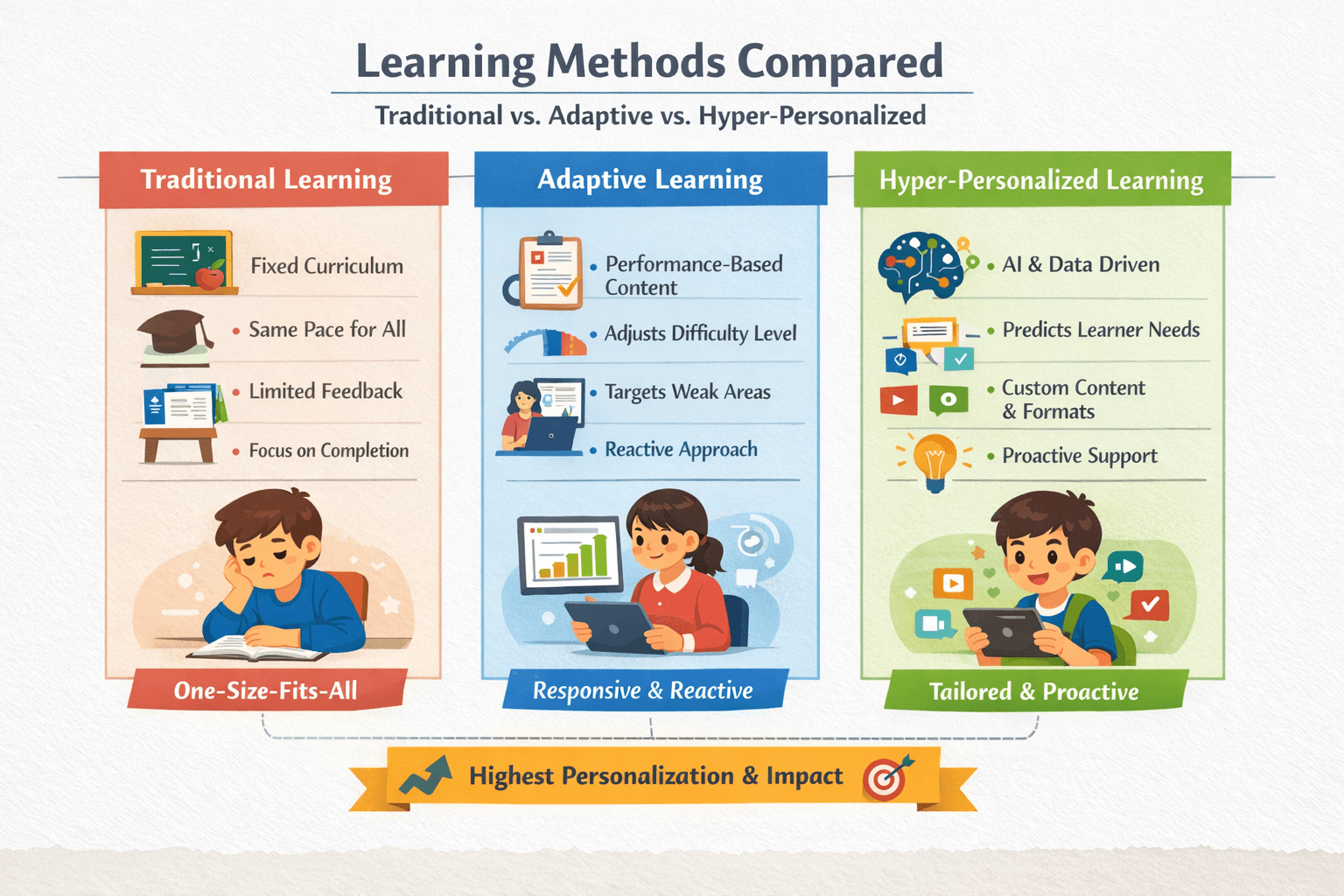
Understanding the differences among traditional, adaptive, and hyper-personalised learning is essential to understanding why the latest approach is far more effective in today’s fast-changing world. Each method has its own structure, but the level of personalisation and impact varies significantly.
Traditional Learning
Traditional learning has been the foundation of education for decades. However, it follows a standardised approach that does not account for individual differences.
- Fixed curriculum for all learners
- Same pace regardless of understanding
- Limited or delayed feedback
- Focus on completion rather than mastery
In this system, learners who grasp concepts quickly may feel bored, while those who need more time may feel left behind. This often leads to reduced engagement and uneven skill development.
Adaptive Learning
Adaptive learning improves upon traditional methods by introducing some level of personalisation. It adjusts content based on a learner’s performance.
- Content changes based on test results
- Difficulty level adjusts after assessments
- Provides targeted practice in weaker areas
- Still largely reactive in nature
While adaptive learning is a step forward, it mainly responds to past performance rather than anticipating future needs. It does not fully consider factors like learning preferences, goals, or behaviour patterns.
Hyper-Personalised Learning
Hyper-personalised learning takes personalisation to the next level by using multiple data points and advanced technologies.
- Uses behavioural, performance, and preference data
- Predicts learner needs using AI
- Offers proactive customisation instead of reactive adjustments
- Delivers content in preferred formats such as video, audio, or interactive sessions
For example, instead of waiting for a learner to struggle, the system predicts potential challenges and provides support in advance.
This proactive and holistic approach makes hyper-personalised learning more comprehensive, efficient, and impactful compared to other methods.
Still stuck with outdated learning methods? Upgrade your learning experience today. Book your personalised trial class now before the limited seats fill up.
Connection Between Hyper-Personalised Learning and Business Agility
To understand the real-world impact of hyper-personalised learning, it is important to explore the definition of business agility. Business agility refers to the ability of individuals and organisations to quickly adapt to changing environments, technologies, and challenges.
In today’s fast-paced world, where industries evolve rapidly, this ability is no longer optional. It is a necessity. Hyper-personalised learning plays a critical role in building this capability.
How Hyper-Personalised Learning Supports Business Agility
Hyper-personalised learning equips individuals with the skills needed to stay flexible and future-ready.
- Encourages Continuous Learning: Learners continually update their skills rather than rely on outdated knowledge.
- Builds Adaptable Skill Sets: Focuses on transferable skills like communication, critical thinking, and problem-solving.
- Enhances Communication and Leadership: Personalised training improves how individuals express ideas and collaborate.
- Prepares Individuals for Change: Learners become comfortable with new challenges and environments.
Workplace Example
Consider a professional working in a rapidly evolving industry. With hyper-personalised learning, they can:
- Quickly adapt to new tools and technologies
- Improve collaboration with diverse teams
- Solve problems using structured thinking
- Communicate ideas clearly and confidently
Instead of struggling to keep up, they stay ahead of change.
This makes hyper-personalised learning not just an educational tool but a key driver of career growth and organisational success.
How to Implement Hyper-Personalised Learning
Implementing hyper-personalised learning may seem complex, but with the right approach, it can be integrated smoothly into any learning journey. The key is to start small and build gradually.
Step-by-Step Guide
1. Build Learner Profiles
Start by understanding the learner deeply.
- Identify strengths and weaknesses
- Define short-term and long-term goals
- Track learning preferences and habits
A strong learner profile forms the foundation of personalisation.
2. Use AI-Powered Tools
Choose platforms that support adaptive and AI-driven learning. These tools help:
- Analyse performance data
- Deliver customised content
- Provide instant feedback
This ensures learning remains dynamic and responsive.
3. Start Incrementally
Instead of making drastic changes, begin with small steps.
- Personalise one subject or skill first
- Test and refine the approach
- Gradually expand to other areas
This makes the transition manageable and sustainable.
4. Integrate Simulations
Practical application is essential for skill development.
- Use role-plays and real-life scenarios
- Practice decision-making in safe environments
- Apply knowledge to real-world situations
This bridges the gap between theory and practice.
5. Track Progress
Monitoring progress helps maintain motivation and direction.
- Use tools like digital badges
- Set measurable milestones
- Review performance regularly
Tracking ensures learners stay on the right path.
Tips for Successful Implementation
- Stay consistent with practice
- Actively seek feedback
- Focus on gradual improvement
- Celebrate small wins to stay motivated
When implemented correctly, hyper-personalised learning creates a powerful and sustainable system for long-term skill development.
Ready to take control of your learning journey? Book your demo class now and experience a smarter, faster way to build skills. Limited seats available.
Transform Your Growth with PlanetSpark Personality Development Classes
PlanetSpark personality development classes are designed to help learners build confidence, communication skills, and leadership abilities through structured and personalised learning.
These classes are ideal for students and professionals who want to overcome hesitation, improve speaking skills, and develop a strong personality.
Why Choose PlanetSpark
- Live, interactive classes
- Expert teachers with global experience
- Real-world communication practice
- Personalised feedback for improvement
- Confidence-building framework
- Structured curriculum aligned to learner goals
PlanetSpark combines hyper-personalised learning with expert mentorship to ensure every learner progresses effectively.
Unlock Your True Learning Potential
Learning is most powerful when it adapts to you. Hyper-personalised learning allows you to focus on what truly matters, helping you grow faster and smarter.
When you take control of your learning journey and stay consistent, you build confidence, skills, and the ability to adapt to any challenge. Your growth is in your hands, and every step forward brings you closer to success.
Frequently Asked Questions
At PlanetSpark, it means learning tailored to your pace, goals, and strengths using AI and expert feedback.
Adaptive learning reacts to performance, while PlanetSpark’s approach predicts needs and personalises learning more deeply.
Yes, PlanetSpark enhances them with live classes and expert guidance to achieve better results.
They are achievements that show skill progress. PlanetSpark tracks progress through structured milestones and feedback.
It delivers relevant content and personalised support, keeping learners motivated and involved.
It means adapting quickly to change. PlanetSpark builds skills that help learners stay flexible and confident.
Students and professionals who want faster, focused skill improvement can benefit the most.
PlanetSpark uses assessments, feedback, and live sessions to tailor learning for each student.
Yes, through structured practice, expert feedback, and real-life speaking exercises.
Because it combines technology with expert instruction for faster, more effective skill development.