
Understand Leadership Goals Examples to Lead Better at Work


Table of Contents
- What Are Leadership Goals and Why They Matter
- 10 Leadership Goals Example for Workplace Success
- SMART Leadership Goals for Professionals
- Leadership Goals for Performance Review
- Development Goals for Leaders
- Leadership Goal Setting Examples for Career Growth
- Common Mistakes in Leadership Goal Setting
- Strategies to Achieve Leadership Goals Successfully
- Transform Your Leadership Skills with PlanetSpark Personalit
- Build Leadership That Creates Real Impact
Have you ever been in a leadership role where you were busy all day but still unsure if you were truly leading or just managing tasks?
This is one of the biggest challenges professionals face today. Many people step into leadership positions without clear direction, measurable goals, or a growth strategy. This is where understanding a leadership goals example becomes essential.
Without structured leadership goals, it becomes difficult to improve team performance, build confidence, or grow in your career. In this blog, you will explore powerful leadership goals, SMART goal frameworks, real-world workplace applications, and practical strategies to become a more effective leader.
Let’s begin by understanding what leadership goals really mean.
What Are Leadership Goals and Why They Matter
Leadership goals are structured objectives that help professionals improve their ability to guide teams, influence decisions, and achieve business outcomes.
Unlike general goals, leadership goals focus on impact, influence, and long-term growth. They help professionals transition from executing tasks to leading people and strategy.
Why Leadership Goals Are Important
Leadership goals play a critical role in shaping both individual performance and team success. They provide direction and ensure that efforts are aligned with organisational objectives.
Some key benefits include:
- Provide clarity in leadership vision and direction: When leaders set clear goals, they have a better understanding of what they want to achieve and how to guide their teams effectively.
- Improve decision-making and accountability: Structured goals help leaders make informed decisions and take responsibility for outcomes, which builds trust within the team.
- Strengthen team performance and collaboration: Clear leadership goals create alignment across teams, ensuring everyone works towards shared objectives.
- Build confidence and communication skills: As leaders work towards their goals, they naturally improve their communication, presentation, and interaction with others.
- Support career growth and leadership presence: Consistent progress in leadership goals prepares professionals for higher roles and greater responsibilities.
For example, a leader who sets a goal to improve communication will start focusing on clarity in conversations, active listening during meetings, and giving constructive feedback. Over time, this not only improves team understanding but also creates a more collaborative and productive work environment.
In simple terms, leadership goals transform potential into performance and effort into measurable impact.
Struggling to communicate your ideas clearly in meetings? Book a FREE trial class now and start building leadership communication skills before your next big opportunity. Limited slots available.
10 Leadership Goals Example for Workplace Success
Understanding a leadership goals example becomes far more effective when you see how these goals apply in real workplace situations. Strong leaders do not rely on vague intentions. They set clear, actionable goals that directly improve team performance, communication, and long-term business outcomes.
Below are 10 detailed, practical leadership goals used by high-performing professionals, along with deeper insights into how they create real impact.
1. Develop People and Mentorship
Goal: Build stronger team capability and long-term talent
Example: Conduct monthly one-on-one mentoring sessions to guide team members
This goal focuses on developing individuals rather than just managing tasks. Leaders who actively mentor their teams help employees identify their strengths, overcome challenges, and grow professionally.
Over time, mentoring builds trust, improves retention, and creates future leaders within the organisation. It also reduces dependency on the leader, as team members become more confident and capable.
2. Improve Delegation Skills
Goal: Reduce dependency and build team ownership
Example: Delegate two high-impact tasks weekly to team members
Delegation is one of the most important leadership skills. Many leaders struggle because they try to do everything themselves. This not only limits their productivity but also prevents team growth.
Effective delegation allows leaders to focus on strategic work while empowering team members to take responsibility. It also builds accountability, confidence, and decision-making skills within the team.

3. Strengthen Communication and Transparency
Goal: Improve clarity, alignment, and trust
Example: Conduct weekly updates and bi-weekly open Q&A sessions
Clear communication ensures that everyone understands expectations, goals, and progress. When leaders communicate transparently, it reduces confusion and builds trust within the team.
Regular updates and open discussions also foster a culture in which employees feel comfortable sharing ideas and concerns. This leads to better collaboration and faster problem-solving.
4. Build Emotional Intelligence
Goal: Improve interpersonal relationships and team dynamics
Example: Practice active listening and summarise team inputs before responding
Emotional intelligence is a key leadership trait that helps leaders understand and manage both their own emotions and those of others.
Leaders with strong emotional intelligence handle conflicts more effectively, build stronger relationships, and create a positive work environment. Active listening, empathy, and self-awareness are essential components of this goal.
5. Improve Feedback Delivery
Goal: Provide constructive, timely, and actionable feedback
Example: Give real-time feedback after every project or task
Feedback is essential for growth, but many leaders either avoid it or deliver it poorly. Effective leaders focus on specific behaviours, provide clear suggestions, and maintain a supportive tone.
When feedback is given regularly and constructively, it helps employees improve performance, build confidence, and stay aligned with expectations. It also creates a culture of continuous learning.
Want to sound confident and impactful while giving feedback? Join a FREE demo session and learn real-world communication skills before your next review cycle. Limited seats available.
6. Enhance Strategic Thinking
Goal: Focus on long-term planning and business growth
Example: Dedicate 2 hours weekly to strategic planning instead of daily operations
Many professionals get stuck in day-to-day tasks and fail to think strategically. This goal helps leaders step back and focus on bigger objectives, future opportunities, and long-term impact.
Strategic thinking enables leaders to anticipate challenges, identify opportunities, and make decisions that drive sustainable growth. It is a critical skill for moving into senior leadership roles.
7. Improve Team Collaboration
Goal: Strengthen teamwork and cross-functional alignment
Example: Organise weekly cross-functional meetings to improve coordination
Collaboration is essential in modern workplaces where multiple teams work together. Leaders who prioritise collaboration ensure smoother workflows and better outcomes.
Encouraging open communication between departments also reduces silos, improves efficiency, and fosters innovation.
8. Drive Innovation
Goal: Encourage creativity and new ideas
Example: Conduct monthly brainstorming sessions for process improvement
Innovation-focused leaders create an environment where team members feel encouraged to share ideas without fear of criticism.
This not only improves processes but also keeps the organisation competitive in a rapidly changing market. Small improvements driven by innovation can lead to significant long-term results.
9. Build Accountability Systems
Goal: Improve ownership, responsibility, and performance tracking
Example: Create project dashboards to track progress and responsibilities
Accountability ensures that tasks are completed efficiently and on time. When roles and expectations are clearly defined, employees take ownership of their work.
Tools such as dashboards, progress trackers, and regular check-ins help leaders monitor performance and identify gaps early. This leads to better results and improved team discipline.
10. Promote Inclusivity and Culture
Goal: Build a positive, inclusive, and engaging work environment
Example: Encourage participation from all team members during meetings
Inclusive leadership ensures that every team member feels valued and heard. Leaders who actively involve quieter employees and appreciate diverse perspectives create a stronger and more engaged team.
A positive work culture improves employee satisfaction, retention, and overall productivity. It also fosters innovation by bringing together different viewpoints and ideas.
SMART Leadership Goals for Professionals
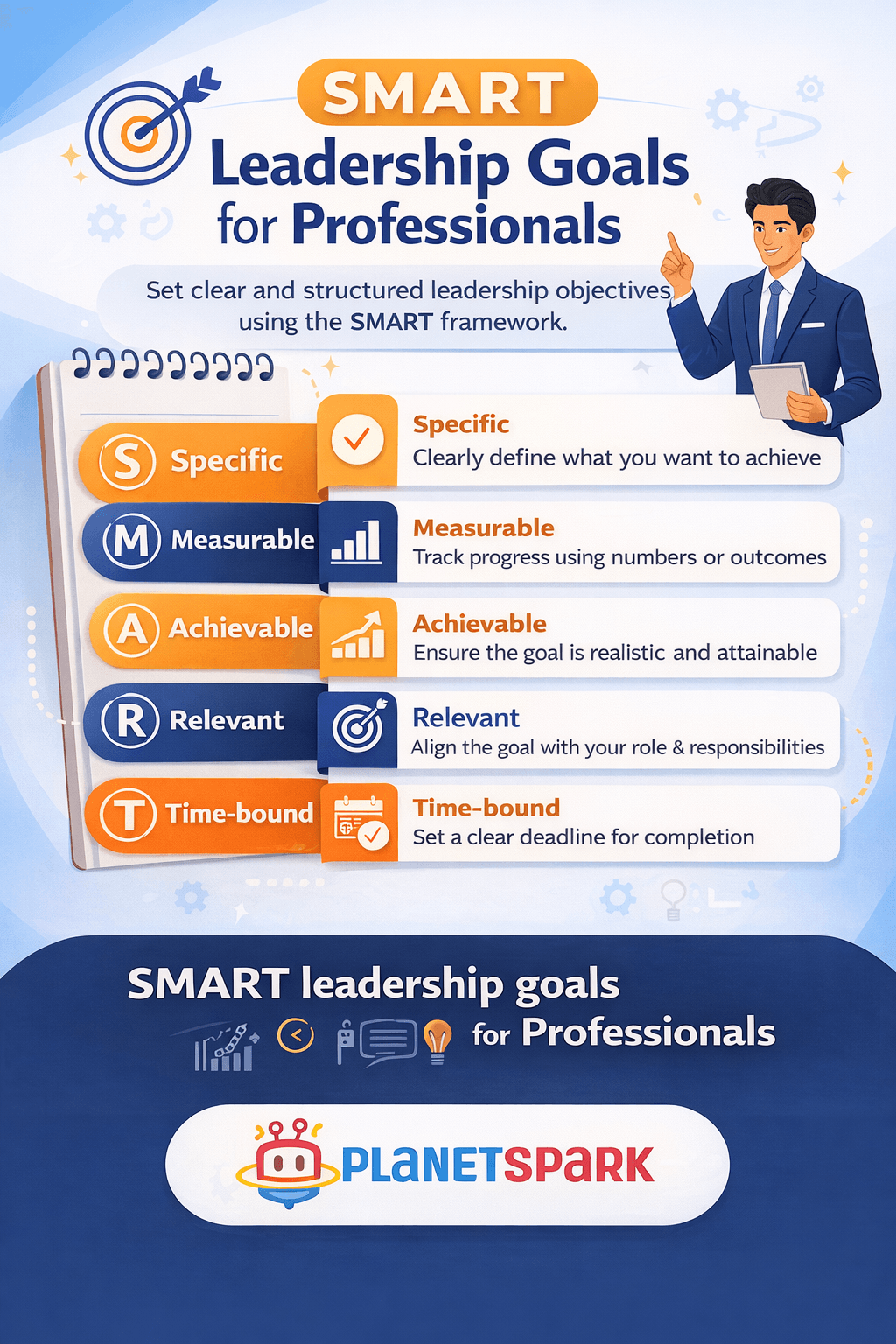
SMART leadership goals provide a structured and practical approach to setting clear objectives and achieving measurable results. Without a defined framework, leadership goals often remain vague and difficult to track. The SMART method helps leaders convert intentions into actionable plans that drive real improvement.
SMART Framework
- Specific: Clearly define what you want to achieve
- Measurable: Track progress using numbers or outcomes
- Achievable: Ensure the goal is realistic and attainable
- Relevant: Align the goal with your role and responsibilities
- Time-bound: Set a clear deadline for completion
Using this framework ensures that leadership goals are not just ideas but structured commitments that can be evaluated over time.
Example
Instead of saying:
“I want to improve leadership skills”
Say:
“I will conduct weekly team check-ins and reduce communication gaps by 30 per cent within the next 3 months.”
This version is specific, measurable, and time-bound, making it easier to track progress and stay accountable.
SMART leadership goals help professionals focus on outcomes, maintain consistency, and achieve meaningful growth in their leadership journey.
Leadership Goals for Performance Review
Leadership goals play a crucial role in performance reviews, providing clear benchmarks to evaluate progress and effectiveness. Without measurable goals, performance discussions can become subjective and unclear.
When leaders set defined objectives, it becomes easier to assess achievements, identify gaps, and plan future improvements.
Example of Leadership Goals for Performance Review
- Improve team productivity by 15 per cent within a quarter
- Reduce project delays by improving planning and communication
- Improve communication clarity in meetings and reports
- Increase employee engagement through regular feedback sessions
- Enhance decision-making speed while maintaining quality
These goals help both employees and managers understand performance expectations and measure outcomes objectively.
Clear leadership performance goals also make feedback more constructive, as they are based on measurable results rather than opinions.
Not confident about presenting your achievements in performance reviews? Book your FREE trial today and learn how to communicate your impact clearly before your next review. Limited seats available.
Development Goals for Leaders
Development goals focus on continuous improvement and long-term growth. In today’s fast-changing work environment, leaders must constantly upgrade their skills to remain effective and relevant.
These goals are not limited to technical abilities but also include behavioural and interpersonal skills that influence leadership success.
Key Development Goals
- Improve communication and presentation skills to express ideas clearly and confidently
- Learn conflict resolution techniques to handle disagreements professionally
- Build emotional intelligence to understand and manage team dynamics
- Strengthen decision-making abilities to make informed and timely choices
- Improve leadership mindset by developing adaptability and resilience
Leaders who consistently work on development goals become more confident, adaptable, and capable of handling complex situations.
Leadership growth goals ensure that professionals do not remain stagnant but continue evolving with changing workplace demands.
Leadership Goal Setting Examples for Career Growth
Leadership goals are essential for professionals aiming to advance in their careers. These goals help individuals move from operational roles to strategic and leadership positions.
By focusing on growth-oriented objectives, professionals can build the skills required for higher responsibilities and leadership roles.
Examples
- Take ownership of cross-functional projects to build leadership experience
- Improve public speaking and presentation skills for better visibility
- Build leadership presence through confident communication and decision-making
- Develop strategic thinking to contribute to long-term business goals
These professional leadership goals not only improve performance but also prepare individuals for promotions and leadership opportunities.
Consistent progress in these areas helps professionals stand out and gain recognition within their organisation.
Common Mistakes in Leadership Goal Setting
Many professionals struggle to achieve their leadership goals due to common but avoidable mistakes. Recognising these errors is the first step toward improvement.
Common Mistakes
- Setting vague goals without clear outcomes
- Lack of consistency in effort and follow-up
- Ignoring feedback from peers and managers
- Not tracking progress regularly
- Setting unrealistic expectations that lead to frustration
These mistakes often result in a lack of progress and reduced motivation.
Avoiding them ensures that leadership goals remain practical, achievable, and impactful.
Strategies to Achieve Leadership Goals Successfully
Setting leadership goals is only the first step. Achieving them requires discipline, consistency, and the right approach.
Practical Strategies
- Break goals into smaller, manageable tasks
- Track progress weekly to stay accountable
- Seek feedback to identify areas of improvement
- Practice communication and leadership skills daily
- Stay adaptable and open to change
One of the most important strategies is self-awareness. Understanding your strengths and weaknesses allows you to focus on areas that need improvement.
Leadership training goals should always be supported by real-world practice. The more you apply what you learn, the faster you improve.
Feel like you have leadership potential but lack confidence to express it? Start your FREE demo class today and build real-world leadership skills before your next big opportunity. Seats are filling fast.
Transform Your Leadership Skills with PlanetSpark Personality Development Classes
PlanetSpark is a global edtech platform that offers AI-powered, live 1:1 classes designed to build communication, leadership, and personality development skills for both children and working professionals across more than 13 countries.
In today’s professional environment, leadership is no longer limited to managing tasks. It requires strong communication, emotional intelligence, confidence, and the ability to influence others effectively. However, many professionals struggle with expressing ideas clearly, handling workplace interactions, and leading with confidence.
PlanetSpark addresses these challenges through structured, practical learning that focuses on real-life applications rather than theoretical concepts.
Who Is It For
- Working professionals looking to improve leadership skills
- Aspiring leaders aiming for career growth
- Entrepreneurs who need strong communication and influence
- Students preparing for leadership roles
Why Structured Learning Matters
Leadership skills do not develop overnight. Without proper guidance, improvement can be slow and inconsistent. PlanetSpark provides a step-by-step learning approach that helps individuals build confidence and leadership abilities in a structured manner.
Key Features
- Live 1:1 interactive classes with expert trainers
- Trainers with real-world communication and leadership experience
- Practical exercises based on real workplace scenarios
- Personalised feedback and progress tracking
- Confidence-building framework for long-term growth
- Structured curriculum aligned with professional needs
- AI-powered performance insights for continuous improvement
These programs help professionals improve clarity of communication, decision-making, and leadership presence in real-world situations such as meetings, presentations, and team discussions.
By focusing on practical learning and consistent improvement, PlanetSpark enables individuals to transform their leadership potential into real-world success.

Build Leadership That Creates Real Impact
Leadership is not about position. It is about influence, clarity, and the ability to inspire others. When you set the right leadership goals, you gain direction, build confidence, and create meaningful impact in your workplace.
Consistent improvement is the key. Small actions like better communication, thoughtful decisions, and active listening gradually shape you into a strong and reliable leader. Over time, these habits help you build trust, drive results, and lead high-performing teams.
Stay committed to your growth journey and keep learning from every experience. With structured guidance from platforms like PlanetSpark, you can strengthen your communication and leadership skills faster and become the confident leader your organisation needs.
Also Read:
https://www.planetspark.in/personality-development/goal-setting-training
https://www.planetspark.in/communication-skills/leadership-presence-and-authentic-influence
Frequently Asked Questions
You can book a free trial session and begin your leadership development journey with expert guidance.
Yes, PlanetSpark programs are designed specifically for professionals to improve workplace communication and leadership skills.
These goals focus on improving productivity, communication, and team performance to measure leadership effectiveness.
PlanetSpark offers live 1:1 sessions, real-world practice, and expert feedback to build confidence in communication and leadership.
SMART leadership goals are structured as specific, measurable, achievable, relevant, and time-bound.
PlanetSpark believes leadership goals provide clarity, improve performance, and help professionals grow into confident leaders.
Leadership goals examples are practical objectives that help professionals improve communication, decision-making, and team management skills.
Personalized Communication Roadmaps
Record a video to get a AI generated personalized communication reports