
How Remote Leaders Build Strong Teams


Table of Contents
- The Biggest Challenges Remote Leaders Face
- Why Communication is the Foundation of Strong Remote Teams
- Commanding a Virtual Room as a Remote Leader
- Understanding Digital Body Language for Leaders
- Improving Video Call Presence for Executives
- Appearing Confident on Camera
- Building Trust and Accountability in Remote Teams
- Creating a Strong Remote Team Culture
- Leveraging Technology for Smarter Collaboration
- Prioritizing Well-Being and Preventing Burnout
- Developing Emotional Intelligence as a Remote Leader
- Continuous Learning and Growth for Remote Leaders
- Build Confident Leaders with PlanetSpark Personality Develop
- Lead with Confidence, No Matter Where You Are
Managing teams remotely is no longer a temporary shift. It is the new normal for many professionals. Yet, leading without physical presence often leads to communication gaps, low engagement, and trust issues. Remote Leaders must rethink how they connect, guide, and inspire their teams.
What if your leadership impact could feel just as powerful through a screen as it does in person?
This blog explains how Remote Leaders can build strong, high-performing teams using intentional communication, trust-building, and modern leadership skills. You will learn how to master commanding a virtual room, improve digital body language for leaders, enhance video call presence for executives, and start appearing confident on camera.
Let us begin by understanding the biggest challenges.
The Biggest Challenges Remote Leaders Face
Remote leadership is not just about managing tasks from a distance. It is about leading people without the advantage of physical connection. This creates challenges that many professionals underestimate.
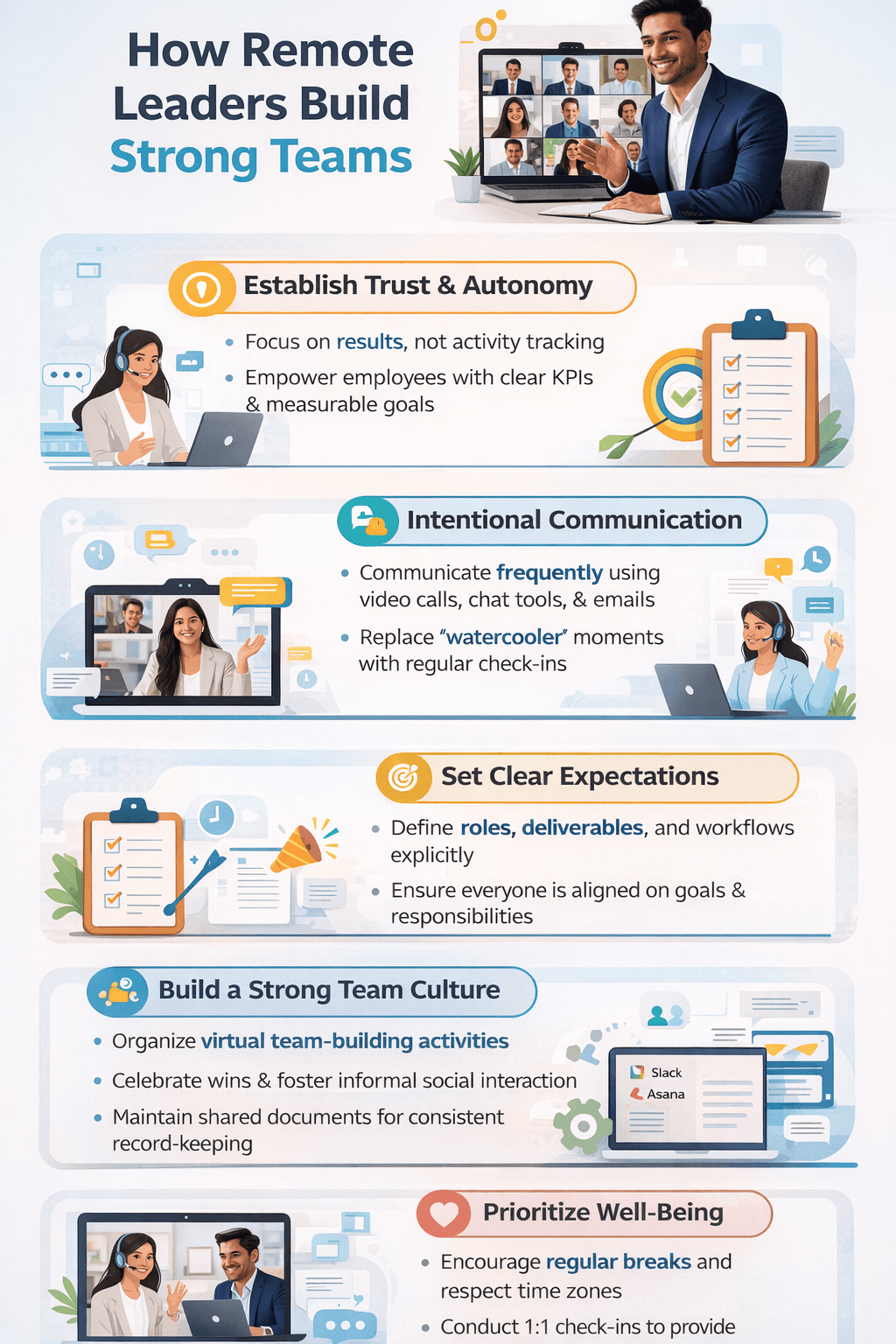
One major issue is lack of visibility. Leaders cannot observe daily work patterns, which often leads to over-monitoring or reduced trust. Instead of focusing on outcomes, some leaders fall into the trap of tracking activity.
Another critical challenge is communication breakdown. Without face-to-face interaction, tone and intent can easily be misunderstood. This is where digital body language for leaders becomes essential. Even small delays in responses can affect team morale.
Isolation is another hidden challenge. Employees working remotely may feel disconnected from the team. Over time, this impacts engagement and productivity.
Common challenges include:
- Limited non-verbal communication
- Difficulty in building trust
- Misaligned expectations
- Time zone differences
- Increased risk of burnout
Successful remote leaders shift from supervision to outcome-based leadership. They focus on measurable results instead of constant monitoring.
To overcome these challenges, leaders must adopt intentional strategies.

Why Communication is the Foundation of Strong Remote Teams
Communication is not just important in remote teams. It is everything. Without clear communication, even the most skilled teams can fail.
Remote Leaders must embrace intentional communication. This means being deliberate about how, when, and what you communicate.
Unlike office environments, remote work lacks spontaneous interactions. Leaders must recreate these moments through structured communication.
Key communication practices include:
- Over-communicating expectations and updates
- Using both synchronous and asynchronous communication
- Encouraging open feedback loops
- Conducting regular check-ins
Experts recommend increasing communication frequency to replace informal workplace interactions like quick desk conversations.
Effective communication also builds trust. When team members feel heard and informed, they are more engaged and confident.
Struggling to communicate clearly in virtual teams?
Book your FREE trial class now and build powerful leadership communication skills before others do.
Commanding a Virtual Room as a Remote Leader
Commanding a virtual room is one of the most critical skills for Remote Leaders. Without physical presence, attention must be earned through clarity, structure, and energy.
Start with preparation. A clear agenda ensures that meetings stay focused and productive. Participants should know their roles and expected outcomes.
During meetings, your delivery matters. Speak with clarity and confidence. Avoid long explanations and encourage participation.
Effective strategies include:
- Starting meetings with a strong opening statement
- Using participant names to create engagement
- Asking interactive questions
- Keeping discussions outcome-driven
Research shows that interactive meetings significantly improve engagement and retention in remote teams.
Eye contact is equally important. Looking into the camera creates a sense of connection.
Mastering this skill transforms your meetings from passive discussions into impactful leadership moments.
Understanding Digital Body Language for Leaders
In remote settings, communication goes beyond words. Digital body language for leaders plays a crucial role in how messages are perceived.
This includes response time, tone, clarity, and participation. Even small actions can send strong signals.
For example:
- Delayed responses may signal disinterest
- Short replies can seem dismissive
- Lack of video presence may reduce connection
Strong digital body language builds trust, while poor signals can create confusion and disengagement.
To improve:
- Respond promptly and thoughtfully
- Use clear and structured messages
- Show engagement during meetings
- Maintain consistent communication habits
Leaders should also be mindful of visual cues. Nodding, smiling, and maintaining eye contact during video calls enhance connection.
When used effectively, digital body language becomes a powerful leadership tool.
Want to improve your digital presence and influence instantly?
Secure your demo session today and start leading with confidence before your next meeting.
Improving Video Call Presence for Executives
Video calls are now the primary stage for leadership. Your video call presence for executives determines how your team perceives your authority and confidence.
Start with your environment. A professional setup creates a strong first impression.
Key elements include:
- Good lighting: Ensure that your face is clearly visible with soft, front-facing light. Poor lighting can make you look unprepared or disengaged, while good lighting enhances clarity and professionalism. Natural light works best, but a simple desk light placed in front of you can also make a big difference.
- Clean background: A clutter-free background helps maintain focus on you. Avoid distracting elements behind you, as they can reduce your credibility. A neutral or minimal background creates a polished and professional image.
- Proper camera positioning: Your camera should be at eye level. This creates a natural line of sight and simulates real eye contact. A low camera angle can appear unflattering, while a high angle may feel distant or disconnected.
- Clear audio: Audio quality is often more important than video. Use a good microphone or headphones to ensure your voice is clear. Background noise can distract listeners and reduce the impact of your message.
Your delivery matters just as much. Speak clearly, maintain a steady pace, and use natural gestures.
Avoid speaking too fast, as it can make your message hard to follow. A steady pace with slight pauses helps your audience absorb information better.
Executives with strong video presence are often perceived as more credible and trustworthy.
This perception comes from a combination of clarity, confidence, and consistency. When your presence is strong, your team is more likely to trust your decisions and follow your direction.
To improve:
- Sit upright with confident posture: Good posture signals confidence and attentiveness. Slouching can make you appear tired or uninterested, while sitting upright projects energy and authority.
- Look directly into the camera: Looking into the camera instead of the screen creates the feeling of direct eye contact. This helps build connection and trust with your audience.
- Avoid distractions: Turn off notifications, silence your phone, and close unnecessary tabs. Even small distractions can break your focus and reduce your professionalism.
- Engage actively with participants: Acknowledge inputs, ask questions, and respond thoughtfully. Engagement keeps participants involved and makes meetings more interactive and productive.
A strong video presence enhances both communication and leadership impact.
Over time, improving your video call presence can significantly boost your influence, help you communicate ideas more effectively, and position you as a confident and reliable leader in remote environments.
Appearing Confident on Camera
Appearing confident on camera is not about personality. It is a skill that can be learned and improved with practice.
Confidence starts with preparation. Knowing your content reduces anxiety and improves delivery.
Body language plays a major role. Maintain eye contact, sit upright, and use controlled gestures.
Practical tips include:
- Practising in front of a camera
- Recording and reviewing your performance
- Using pauses effectively
- Smiling naturally
Professionals who practise regularly show significant improvement in confidence and clarity within weeks.
Voice modulation is equally important. Avoid monotone delivery and use variation to keep your audience engaged.
With time and practice, appearing confident on camera becomes effortless.
Building Trust and Accountability in Remote Teams
Trust is the foundation of strong teams. Without it, collaboration and performance suffer.
Remote Leaders must focus on trust over supervision. Instead of tracking every activity, they should measure outcomes and results.
Clear expectations are essential. Define roles, responsibilities, and deliverables clearly.
Best practices include:
- Setting measurable goals: Define specific and achievable goals using clear metrics. This helps employees understand how success is measured and keeps everyone aligned with team objectives.
- Conducting regular one-on-one check-ins: These check-ins create a safe space for employees to discuss progress, challenges, and concerns. They also help leaders provide guidance without micromanaging.
- Providing constructive feedback: Feedback should be timely, specific, and actionable. Instead of focusing only on mistakes, leaders should highlight strengths and guide improvements.
- Recognizing achievements: Acknowledging efforts and successes boosts morale and motivation. Even small recognition can make employees feel valued and appreciated.
It is said that teams with high trust levels are more productive and innovative.
Accountability should feel empowering, not restrictive. When employees understand expectations, they take ownership of their work.
Creating a Strong Remote Team Culture
Culture is what keeps teams connected. In remote environments, it must be built intentionally.
Remote Leaders should focus on connection, recognition, and collaboration.
Effective culture-building strategies include:
- Virtual team-building activities
- Informal social interactions
- Celebrating milestones and achievements
- Encouraging peer recognition
Creating informal spaces for interaction helps replace the "watercooler" conversations of physical offices.
Consistency is key. Culture develops over time through repeated actions and shared experiences.
A strong culture improves engagement, morale, and retention.
Feeling disconnected from your team despite daily meetings?
Join a live PlanetSpark session and learn how to build real connections in remote teams today.
Leveraging Technology for Smarter Collaboration
Technology is the backbone of remote work. However, tools must be used strategically.
Remote Leaders should choose tools that simplify communication and collaboration.
Common tools include:
- Slack for communication
- Asana for project management
- Zoom for video conferencing
Experts recommend using a balanced mix of synchronous and asynchronous tools to improve efficiency.
Best practices:
- Avoid tool overload
- Set clear communication guidelines
- Use shared documentation for transparency
Technology should enhance teamwork, not complicate it.
Prioritizing Well-Being and Preventing Burnout
Remote work can blur the line between personal and professional life. This increases the risk of burnout.
Remote Leaders must prioritize well-being.
Key strategies include:
- Encouraging regular breaks
- Respecting time zones
- Setting clear boundaries for work hours
- Conducting regular check-ins
Leaders who model healthy work habits create a more balanced and productive team environment.
Supporting mental health is not optional. It is essential for long-term success.
Developing Emotional Intelligence as a Remote Leader
Emotional intelligence is a critical skill for Remote Leaders. It helps in understanding team dynamics and managing relationships effectively.
Key components include:
- Self-awareness
- Empathy
- Active listening
- Adaptability
Leaders with high emotional intelligence build stronger connections and resolve conflicts more effectively.
Empathy is especially important in remote settings. Understanding your team’s challenges helps build trust and loyalty.
Continuous Learning and Growth for Remote Leaders
Leadership is an ongoing journey. Remote environments continue to evolve, and leaders must adapt.
Growth requires consistent effort.
Effective growth strategies include:
- Seeking feedback
- Learning new communication techniques
- Staying updated with industry trends
- Reflecting on leadership style
Small improvements over time lead to significant transformation.
Build Confident Leaders with PlanetSpark Personality Development Programs
PlanetSpark personality development programs are designed for learners who want to improve communication, confidence, and leadership skills in real-world scenarios. Whether you are a working professional or a student, these programs help you become a confident speaker and impactful leader.
Structured learning plays a crucial role in developing communication skills. Without proper guidance, progress can be slow and inconsistent. PlanetSpark offers a clear, step-by-step learning approach that builds clarity, confidence, and strong leadership presence.
What makes PlanetSpark effective:
- Live, interactive classes with expert trainers
- Personalized 1:1 attention and feedback
- Real-world speaking and communication practice
- Structured curriculum tailored to individual needs
- Confidence-building framework for long-term growth
Advanced features enhance learning further. SparkX AI tool analyzes speech, body language, and confidence. AI-led practice sessions allow independent learning with instant feedback. Spark Diary builds writing habits, while gamified modules like SparkBee make learning engaging.
Learners also benefit from clubs, contests, and Sparkline, a safe platform to showcase skills. Regular progress reports and sessions ensure continuous improvement, making learning measurable and impactful.

Lead with Confidence, No Matter Where You Are
Strong leadership is not limited by location. Remote Leaders who focus on communication, trust, and continuous improvement can create powerful and connected teams.
When you consistently practise these skills, your confidence grows, your communication becomes clearer, and your leadership impact becomes stronger. Over time, these improvements shape not just your career, but the success of your entire team.
Also Read: Join a Virtual Leadership Training Program for Growth
Understand Hyper Personalized Learning for Better Skill Development
Frequently Asked Questions
Remote Leaders build strong teams by focusing on trust, clear communication, and outcome-based performance instead of micromanagement.
It is the ability to lead virtual meetings with confidence, clarity, and engagement.
It helps convey clarity, intent, and professionalism in remote communication.
Focus on posture, eye contact, clear speech, and professional setup.
Practice regularly, prepare well, and focus on body language and voice modulation.
Tools like Slack, Zoom, and Asana improve communication and collaboration.
It helps build trust, manage conflicts, and create a supportive team environment.
Personalized Communication Roadmaps
Record a video to get a AI generated personalized communication reports