
What Is Coffee Badging at Work? Explained Easily


Table of Contents
- What Is Coffee Badging at Work
- Why Coffee Badging Is Becoming So Popular
- Coffee Badging vs Quiet Quitting vs Job Hugging
- Hybrid Work Etiquette 2026: What Professionals Must Know
- Career Cushioning for Remote Workers and Coffee Badging
- Is Coffee Badging Good or Bad for Your Career
- Practical Office Mandate Workarounds That Actually Work
- How to Use Coffee Badging Without Damaging Your Reputation
- Improve Workplace Confidence with PlanetSpark Personality De
- Build a Career That Balances Flexibility and Growth
Ever walked into the office just for a coffee, quick chats, and then logged in from home? You are not alone.
Many working professionals today are trying to balance strict office policies with the flexibility they experienced during remote work. This has led to a growing trend known as coffee badging. If you are wondering what coffee badging is at work and whether it is helping or hurting your career, this guide will give you clarity.
In this blog, you will learn what coffee badging really means, why employees are adopting it, how it compares to job hugging vs quiet quitting, and what hybrid work etiquette 2026 expects from professionals. You will also discover practical workarounds for office mandates and smart career strategies.
Let us break it down clearly.
What Is Coffee Badging at Work
Coffee badging is a modern workplace trend where employees visit the office for a short duration, usually just long enough to swipe their badge, grab coffee, interact briefly with colleagues, and then leave to continue working remotely for the rest of the day.
This behaviour has gained popularity in hybrid work environments, where companies expect employees to maintain some physical presence in the office. Instead of spending a full day at the workplace, employees choose to fulfil the requirement in a minimal yet visible way.
The concept became widely recognised after being highlighted in studies of hybrid work as a form of symbolic presence. In simple terms, employees are physically present but only for a limited time, while most of their productive work happens outside the office.

Key characteristics of coffee badging
Short office visits
Employees typically spend only 1 to 2 hours in the office, just enough to mark attendance and be seen.
Visible interactions
They engage in quick conversations, attend a meeting, or greet managers to ensure their presence is noticed.
Remote completion of work
The majority of tasks, deep work, and focused activities are completed from home or another preferred location.
Focus on compliance over duration
The goal is to meet attendance expectations rather than spend a full workday in the office.
Do you hesitate while speaking in professional settings? Book your trial class now and transform your confidence fast.
Example scenario
Imagine an employee who reaches the office at 10 AM, attends a team meeting, chats briefly with colleagues over coffee, and leaves by noon. The rest of the day is spent working from home where they can focus better without interruptions.
This pattern is becoming increasingly common in organisations that enforce hybrid work policies but do not strictly monitor hours spent in the office.
Why is it called “symbolic presence”
Coffee badging is often referred to as symbolic presence because it prioritises visibility over physical commitment. Employees are not avoiding work. Instead, they are adapting to workplace rules while maintaining flexibility.
It reflects a broader shift in how professionals define productivity. Earlier, being present in the office was equated with working effectively. Today, output, efficiency, and results matter more than where the work happens.
Why Coffee Badging Is Becoming So Popular
Coffee badging is not just a passing trend. It represents a deeper transformation in workplace culture, driven by changing employee expectations and evolving work models.
1. Resistance to strict return-to-office policies
After experiencing the flexibility of remote work, many professionals question the need for full-time office attendance. They have already demonstrated that they can meet deadlines and deliver results without being physically present every day.
As a result, coffee badging becomes a subtle way to comply with company policies while expressing dissatisfaction with rigid mandates.
2. Better productivity at home
For many employees, home offers a more controlled and distraction-free environment. Open office spaces can often be noisy, filled with interruptions, and not ideal for deep work.
By limiting office time and completing tasks remotely, professionals can focus better and improve the quality of their output.
3. Saving time and money
Daily commuting consumes both time and financial resources. Travel costs, fuel expenses, parking fees, and even meals add up significantly over time.
Coffee badging allows employees to reduce these costs while still fulfilling workplace expectations. It also helps save valuable hours that can be used for productive work or personal well-being.
4. Office mandate workarounds
Many organisations have introduced mandatory office days, but not all employees see value in staying for long hours. Coffee badging has emerged as one of the most practical workarounds for office mandates.
It allows employees to technically comply with policies without compromising their preferred work style. This approach reflects how professionals are creatively adapting to organisational rules.
5. Maintaining visibility without full commitment
In many workplaces, visibility still plays an important role in career growth. Being seen by managers and peers can influence performance reviews, promotions, and opportunities.
Coffee badging helps employees maintain that visibility while avoiding the downsides of spending an entire day in the office. It is a strategic way to balance perception and productivity.
Deeper insight
At its core, coffee badging highlights a disconnect between employers and employees. While organisations often emphasise presence, employees prioritise flexibility, efficiency, and work-life balance.
This trend signals that the future of work is moving toward outcome-based performance rather than time-based presence.
Struggling to communicate your work style clearly to your manager? Book your free demo class now and learn how to present yourself confidently before others do.
Coffee Badging vs Quiet Quitting vs Job Hugging
Understanding coffee badging becomes clearer when compared with other popular workplace behaviours, such as quiet quitting and job hugging. These trends reflect how professionals are responding to changing expectations, workload pressures, and evolving work cultures.
Coffee Badging vs Quiet Quitting
Quiet quitting refers to doing only what is required in your job role without going beyond expectations or taking on additional responsibilities. Employees who follow this approach prioritise boundaries and avoid overwork.
Coffee badging, however, operates differently. It is not about reducing effort but about changing where and how work is done.
Key differences include:
Work output
In quiet quitting, effort is minimised. In coffee badging, employees often continue delivering full output.
Intent
Quiet quitting is about disengagement from extra work, while coffee badging is about maintaining flexibility in a hybrid setup.
Perception
Quiet quitting may be seen as a lack of initiative, whereas coffee badging may be viewed as strategic or, in some cases, as avoidance depending on how it is executed.
Focus area
Quiet quitting focuses on effort levels. Coffee badging focuses on physical presence versus remote productivity.
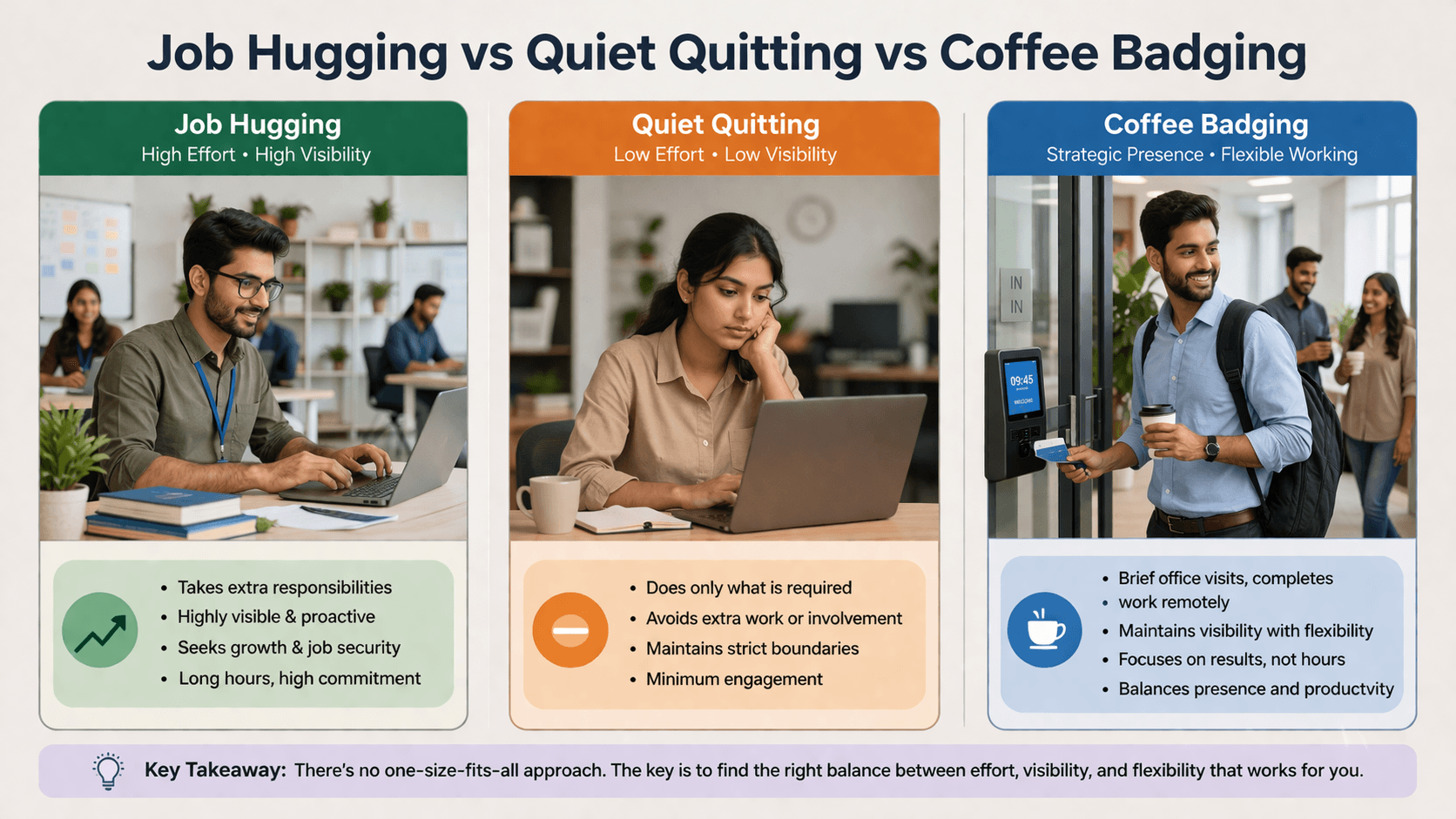
Job-Hugging vs Quiet Quitting
Job-hugging represents the opposite end of the spectrum. It involves employees taking on additional responsibilities, going beyond their defined roles, and actively seeking visibility to secure their position, especially in uncertain job markets.
Here is a clearer comparison:
Job hugging
High effort, high visibility, strong desire for job security
Quiet quitting
Minimum effort, clear boundaries, focus on work-life balance
Coffee badging
Balanced effort, strategic visibility, flexible work location
What professionals should learn
These behaviours show that the traditional definition of “hard work” is changing. Simply being present in the office no longer guarantees success, and working extra hours does not always ensure growth.
The key takeaway for professionals is to find a balanced approach:
- Maintain strong performance
- Stay visible in meaningful ways
- Communicate clearly with stakeholders
- Align your work style with team expectations
Instead of blindly following trends, professionals should focus on building credibility through consistent results and effective communication.
Hybrid Work Etiquette 2026: What Professionals Must Know
As organisations continue to adapt to hybrid models, hybrid work etiquette 2026 is becoming more structured and clearly defined. Employees are now expected to balance flexibility and responsibility to support both individual productivity and team collaboration.
New workplace expectations
The modern workplace is shifting from time-based evaluation to outcome-based performance. However, this does not mean that physical presence has lost all importance.
Results matter more than presence
Employers increasingly value output, quality, and efficiency over hours spent in the office.
Collaboration is prioritised during office visits
Office days are now seen as opportunities for teamwork, brainstorming, and relationship-building rather than for solo work.
Proactive communication is essential
Managers expect employees to keep them informed about their schedules, progress, and availability.
Flexibility with accountability
While employees are given flexibility, they are also expected to take ownership of their responsibilities.
Are you missing opportunities due to poor communication? Start your free class today and unlock your potential.
When coffee badging works
Coffee badging can fit well within hybrid etiquette when used responsibly.
It works when:
- You consistently deliver high-quality results
- You attend important meetings and contribute meaningfully
- You remain accessible during working hours
- Your team does not feel your absence negatively
In such cases, your work speaks louder than your physical presence.
When it fails
Coffee badging can backfire if it creates a perception problem or disrupts team dynamics.
It fails when:
- It appears as an attempt to avoid responsibilities
- Collaboration suffers due to your absence
- Managers feel you are not fully engaged
- Communication gaps begin to appear
In these situations, even strong performance may not fully offset negative impressions.
Best practices for professionals
To navigate hybrid work successfully, professionals should adopt intentional habits:
Communicate your schedule clearly
Let your team know when you will be in the office and when you will work remotely.
Be present where it matters
Prioritise important meetings, team discussions, and collaborative tasks.
Engage actively during office time
Use your time in the office to build relationships and contribute meaningfully.
Build trust consistently
Deliver on commitments and maintain transparency in your work.
Reality check
Hybrid work is not about avoiding the office or maximising remote time. It is about using both environments strategically to enhance productivity, collaboration, and professional growth.
Professionals who understand this balance will be better positioned to succeed in the future of work.
Career Cushioning for Remote Workers and Coffee Badging
Career cushioning for remote workers is another emerging workplace trend that is closely connected to coffee badging. As job market uncertainty increases, professionals are becoming more proactive about securing their futures while still performing in their current roles.
What is Career Cushioning?
Career cushioning refers to preparing for potential job changes or uncertainties while still employed. Instead of waiting for a crisis, professionals actively build backup options, strengthen their skills, and expand their network.
It is not about disloyalty. It is about being prepared and adaptable in a fast-changing work environment.
How it Connects to Coffee Badging
Coffee badging and career cushioning often go hand in hand because both reflect a strategic approach to work. Employees who practice coffee badging are usually trying to balance visibility and flexibility, which also supports their long-term career security.
For example:
- By briefly visiting the office, they maintain visibility with managers
- By working remotely, they optimise productivity and time
- By saving time, they invest in upskilling or networking
Signs you are Career Cushioning
You may already be practising career cushioning if you are:
Learning new skills regularly
Enrolling in courses, certifications, or self-learning programs
Networking actively
Building relationships both within and outside your organisation
Exploring opportunities quietly
Keeping an eye on the job market without making immediate changes
Staying adaptable
Being open to new roles, responsibilities, or industries
Why it matters today
The modern job market is dynamic and sometimes unpredictable. Layoffs, restructuring, and rapid technological changes have made it important for professionals to stay prepared.
Career cushioning gives you both confidence and control. Instead of reacting to change, you stay ahead of it.
Action steps to start career cushioning
- Improve your communication and presentation skills
- Build strong relationships with peers and leaders
- Stay consistent in delivering high-quality work
- Invest time in learning new and relevant skills
Worried your communication is holding you back at work? Book your demo session today and get ahead before your next appraisal cycle.
Is Coffee Badging Good or Bad for Your Career
Coffee badging is neither entirely positive nor entirely negative. Its impact depends on how thoughtfully and responsibly you use it within your work environment.
Benefits of Coffee Badging
When used correctly, coffee badging can offer several advantages:
Better work-life balance
Reduced commuting time allows more time for personal well-being and productivity
Increased productivity
Many professionals perform better in a quieter and more controlled home environment
Reduced burnout
Flexibility helps prevent exhaustion caused by long office hours and daily travel
Greater control over the work environment
Employees can choose where they work best, leading to improved output
Risks of Coffee Badging
However, there are also potential downsides if it is not managed properly:
Misinterpretation by managers
Some leaders may see it as a lack of commitment or engagement
Reduced networking opportunities
Spending less time in the office can limit spontaneous interactions and relationship building
Perception challenges
Colleagues may assume you are less involved or less dedicated
Weak team bonding
Limited in-person interaction can affect team cohesion

How to stay on the safe side
To ensure coffee badging supports rather than harms your career:
- Deliver high-quality work consistently
- Communicate proactively with your team and manager
- Be present during important meetings and discussions
- Show ownership, initiative, and reliability in your role
Your career growth is driven more by your performance, communication, and reliability than by the number of hours you spend in the office.
Practical Office Mandate Workarounds That Actually Work
While coffee badging is one approach, there are more effective and sustainable office mandate workarounds that professionals can adopt. These strategies help you balance organisational expectations with personal productivity.
Smart strategies to follow
1. Plan your office days strategically
Choose days when important meetings, brainstorming sessions, or team collaborations are scheduled. This ensures your presence adds value.
2. Focus on meaningful visibility
Instead of simply being seen, engage in conversations, share ideas, and contribute actively. Quality of interaction matters more than quantity of time spent.
3. Align with team goals
Your schedule should support your team’s workflow. Being available when your team needs you builds trust and credibility.
4. Communicate clearly and consistently
Keep your manager and team informed about your work schedule, availability, and progress. Clear communication reduces misunderstandings.
5. Deliver measurable outcomes
Focus on results that can be tracked and evaluated. Strong performance builds trust regardless of where you work from.
Pro tip
Consistency in performance and communication builds trust much faster than physical presence alone.
Still unsure how to stand out in hybrid workplaces? Book your free trial now and gain the confidence others already have.
How to Use Coffee Badging Without Damaging Your Reputation
Coffee badging can be a useful strategy if applied thoughtfully. The key is to ensure that it enhances your professional image rather than weakening it.
Do’s
Use office time for collaboration
Engage in team discussions, brainstorming sessions, and relationship building
Build strong workplace relationships
Connect with colleagues and managers to maintain visibility and trust
Stay transparent with your manager
Clearly communicate your schedule and work approach
Maintain consistent output
Ensure your performance remains strong regardless of your location
Don’ts
Avoid disappearing without communication
Lack of visibility and updates can create trust issues
Do not miss key meetings or deadlines
This can negatively impact your reputation quickly
Do not rely only on being seen
Visibility without performance does not create long-term value
Avoid appearing disengaged
Stay active in conversations, updates, and team interactions
What leaders expect from professionals
- Accountability for tasks and outcomes
- Reliability in meeting commitments
- Clear and consistent communication
- Initiative in taking responsibility and contributing ideas
The future of work is not about choosing between office and remote setups. It is about finding the right balance between flexibility and responsibility.
Professionals who can combine strong performance with effective communication and smart workplace strategies will continue to grow and succeed in any work environment.
Improve Workplace Confidence with PlanetSpark Personality Development
PlanetSpark personality development classes are designed for working professionals who want to communicate confidently, adapt to modern workplace trends, and build a strong professional presence. Many professionals struggle to express ideas, navigate hybrid environments, and build visibility at work. Structured learning helps bridge this gap.
With expert guidance, learners develop clarity, confidence, and effective communication skills that directly impact career growth.
Key features include:
- Live, interactive classes
- Expert teachers
- Real-world communication practice
- Personalized feedback
- Confidence-building framework
- Structured curriculum aligned to professionals

Build a Career That Balances Flexibility and Growth
Modern workplaces are changing rapidly, and trends like coffee badging reflect a deeper shift in how we work. What truly matters is not where you work, but how effectively you communicate, collaborate, and deliver results.
By understanding workplace behaviours and adapting thoughtfully, you can create a career that offers both flexibility and stability. Focus on building strong communication skills, staying accountable, and continuously improving yourself.
Consistent effort and clarity in your approach will help you grow with confidence in any work environment.
Frequently Asked Questions
Coffee badging focuses on physical presence, while quiet quitting involves doing minimal work.
Job-hugging involves taking on more work to secure a role, while quiet quitting limits effort to only basic responsibilities.
Yes, if they do not affect productivity or team collaboration. Transparency is important.
Coffee badging is when employees briefly visit the office to be seen and then return to work remotely.
It depends on performance and communication. If work quality remains high, it may not harm your career.
It refers to evolving workplace norms that balance flexibility, collaboration, and accountability in hybrid setups.
It means preparing backup career options while staying employed, often through upskilling and networking.
Personalized Communication Roadmaps
Record a video to get a AI generated personalized communication reports