
Fun Alphabet Sounds Practice for Better Pronunciation
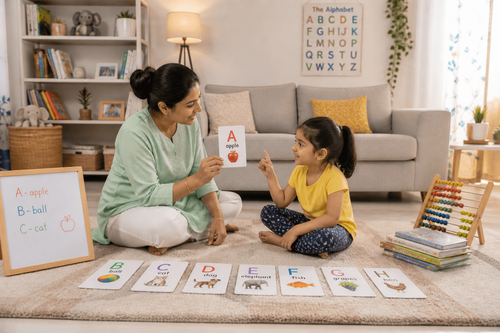

Table of Contents
- What Are Alphabet Sounds and Why They Matter for Kids
- Fun Alphabet Sounds Activities That Actually Work
- Understanding Phonics: The Foundation of Reading and Speakin
- Advanced Tips to Strengthen Alphabet Sounds By PlanetSpark
- How PlanetSpark Phonics Classes Improve Alphabet Sounds Fast
- PlanetSpark Phonics Program: Structured Learning That Works
- Strong Sounds Build Strong Communicators
What if your child could speak clearly, read confidently, and enjoy learning at the same time?
Many children struggle with pronunciation and early reading because they do not fully understand alphabet sounds. They may recognize letters but fail to connect them with the correct sounds. This gap often leads to hesitation while speaking and difficulty in reading fluently.
In today’s fast-paced learning environment, strong phonics skills are no longer optional, they are essential.
This blog will help you understand what alphabet sounds are, why they matter, and how you can teach them through fun and engaging activities. You will also discover expert-backed strategies, common mistakes to avoid, and how structured programs like PlanetSpark can accelerate your child’s progress.
What Are Alphabet Sounds and Why They Matter for Kids
Alphabet sounds are the phonetic sounds that each letter produces. While the English alphabet has 26 letters, it actually represents around 44 unique sounds, known as phonemes.
This is one of the most important insights parents often miss. Children are not just learning letters, they are learning how sounds form words.
For example:
- A can sound like “a” in apple or “ay” in cake
- C can sound like “k” in cat or “s” in city
Understanding these variations helps children decode words faster and speak clearly.
Why Alphabet Sounds Are Critical
- Build strong pronunciation skills: Learning alphabet sounds helps children understand how words should be spoken. It improves clarity and ensures they pronounce words correctly from an early stage.
- Improve reading fluency: When kids recognize sounds quickly, they can decode words faster. This makes reading smoother and more confident over time.
- Enhance listening and speaking ability: Understanding sounds sharpens listening skills and helps children respond more accurately. It also supports clearer and more effective verbal communication.
- Support spelling and vocabulary growth: Knowing letter sounds helps children spell words correctly by breaking them into parts. It also expands their vocabulary as they learn new words with ease.
Without mastering alphabet sounds, children tend to memorize instead of truly reading.
This is why many parents today are opting for a learn letter sounds online for kids course to ensure proper guidance from the start.
Is your child still guessing words instead of reading confidently?
Book a free PlanetSpark trial class today and fix phonics gaps early before they grow.
Fun Alphabet Sounds Activities That Actually Work
Learning becomes powerful when it is playful. Children retain alphabet sounds much better when they are actively involved rather than just listening or memorizing. Movement, touch, sound, and visual cues together create stronger memory connections, making it easier for kids to recall sounds while reading or speaking.
Below are detailed, practical, and engaging activities that parents and teachers can easily implement at home or in class.
1. Act Out the Alphabet
This is one of the most engaging ways to teach alphabet sounds because it combines movement with sound learning. Children use their bodies, facial expressions, and actions to represent each letter sound, which makes the learning experience memorable and fun.
For example:
- For A, children can pretend to be a hungry alligator and say “a-a-alligator” while opening their mouth wide
- For K, they can act like they are doing karate kicks while saying “k-k-k”
- For J, they can jump or jiggle while repeating the sound
This activity works because physical movement activates muscle memory. When a child later sees the letter, they subconsciously recall the action and connect it with the sound.
Pro Tip: Encourage exaggeration. The more expressive the child is, the stronger the memory connection becomes.
2. Sensory Letter Tracing
Sensory play adds a powerful dimension to phonics learning. Instead of just writing letters on paper, children trace them using different textures, which helps reinforce learning through touch.
You can use:
- Sandpaper letters for a rough texture
- Shaving cream spread on a tray for a fun writing surface
- Clay or dough to shape letters
As the child traces each letter, ask them to say the sound aloud. For example, while tracing “m”, they repeat “mmm”.
This method engages three senses at once:
- Touch through tracing
- Sight through seeing the letter
- Hearing through speaking the sound
This multi-sensory approach is especially effective for young learners and children who struggle with traditional learning methods.
Pro Tip: Keep sessions short and enjoyable to avoid fatigue and maintain excitement.
3. “I Spy” Beginning Sounds Game
“I Spy” is a simple yet highly effective game that improves listening skills and sound recognition. It trains children to identify the beginning sounds of words in their environment.
To play:
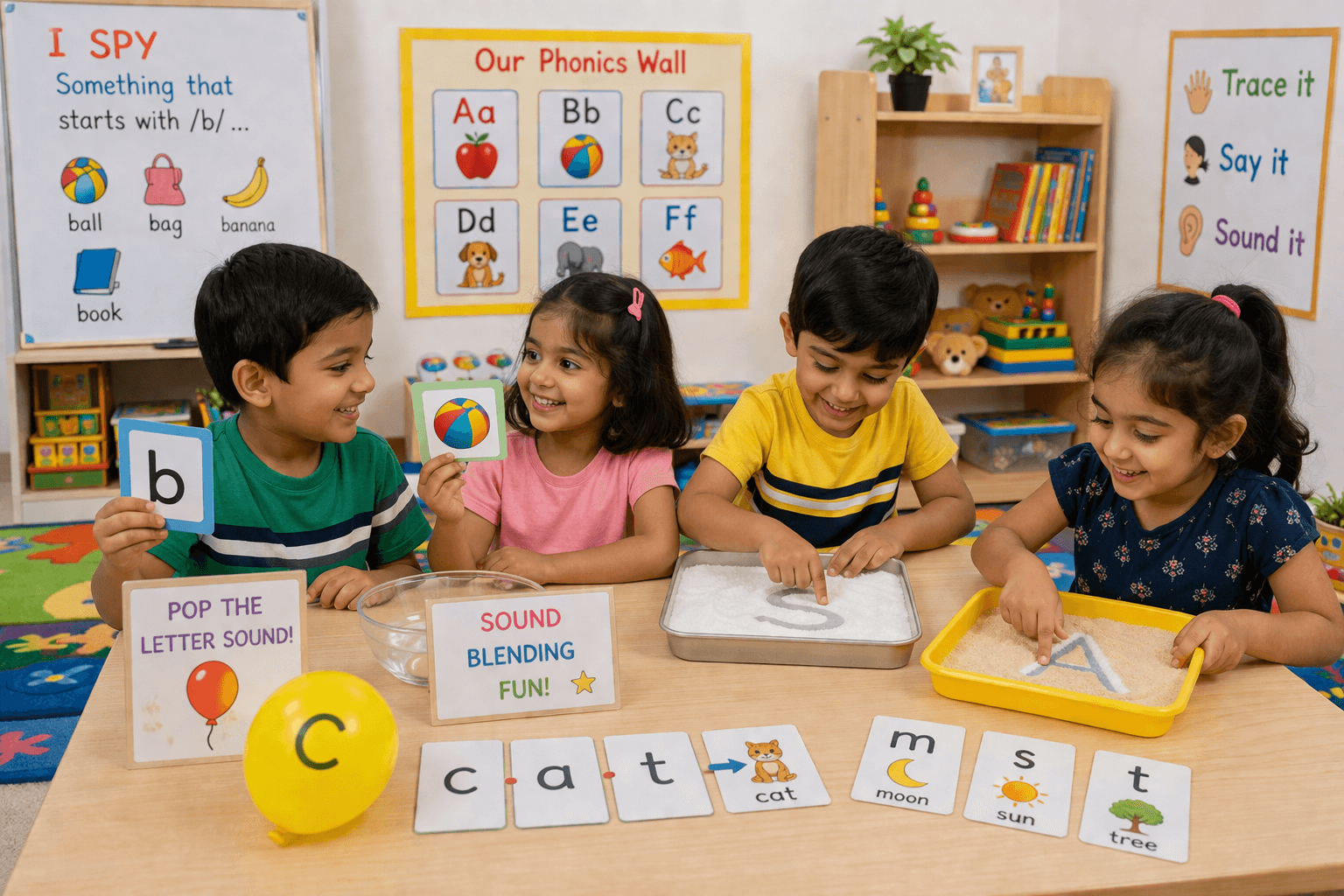
Say, “I spy something that starts with /b/.”
The child then looks around and guesses objects like ball, bag, or book.
You can gradually increase difficulty by:
- Using different sounds
- Asking for ending sounds instead of beginning sounds
- Playing the game outdoors for more variety
This activity encourages children to connect sounds with real-world objects, making learning practical and meaningful.
Pro Tip: Let the child take turns being the one who gives clues. This builds confidence and reinforces learning.
4. Letter Block Sound Building
Alphabet blocks are not just toys, they are powerful learning tools when used creatively. This activity blends play with phonics practice in a natural way.
Ask children to:
- Build a tower using letter blocks
- Say the sound of each letter as they place it
For example, if they pick up the letter “t”, they say “t-t-t” before adding it to the tower.
You can also extend this activity by:
- Creating simple words using blocks
- Asking the child to identify the sounds in the word
This helps children understand how individual sounds come together to form words, which is a key skill for reading.
Pro Tip: Turn it into a challenge, such as building the tallest tower while saying all sounds correctly.
5. Pop the Letter Sound Game
Children love games that involve excitement and surprise, and this activity delivers both. It encourages repetition, which is essential for mastering alphabet sounds.
Here is how you can play:
- Write letters on balloons or soap bubbles
- Before popping, the child must say the correct sound
For example, if the balloon has “s”, the child says “sss” before popping it.
This game works because it adds an element of anticipation and fun. Children are motivated to participate and repeat sounds without feeling like they are studying.
You can also:
- Set a timer for quick rounds
- Reward correct answers with extra pops
Pro Tip: Use this as a revision activity after introducing new sounds.
6. Singing Phonics Songs
Music is one of the most effective tools for memory and learning. Phonics songs help children remember alphabet sounds through rhythm and repetition.
Songs from creators like Jack Hartmann are especially popular because they combine:
- Actions
- Visual cues
- Repetition of sounds
Children naturally enjoy singing along, and this repeated exposure strengthens their understanding of sounds.
You can enhance this activity by:
- Encouraging children to act out the song
- Pausing and asking them to repeat sounds
- Singing together daily for consistency
Pro Tip: Make it part of a daily routine, such as morning learning time or before bedtime.
Why These Activities Work So Well
All these activities share one common principle: active learning. Instead of passive listening, children are:
- Moving
- Speaking
- Touching
- Thinking
This creates stronger neural connections and improves retention.
When practiced regularly, these activities not only improve alphabet sounds but also build confidence, clarity, and early reading skills.
Worried your child loses interest quickly while learning?
Join a live PlanetSpark phonics class where learning feels like play and progress happens faster.
Understanding Phonics: The Foundation of Reading and Speaking
Phonics is the method of teaching reading through sound recognition. It helps children understand how letters combine to form words.
When children learn phonics properly, they stop guessing and start decoding.
Types of Sounds Every Child Must Learn
1. Short Vowel Sounds
- a as in cat
- e as in bed
- i as in sit
2. Long Vowel Sounds
- a as in cake
- i as in bike
3. Digraphs
Two letters making one sound:
- sh in ship
- ch in chip
- th in thin
4. Diphthongs
Blended vowel sounds:
- oy in boy
- ou in cloud
These sound categories are essential for building reading fluency.
Many parents struggle to teach these concepts at home, which is why enrolling in an early reading sounds course online can provide structured learning.
A to Z Alphabet Sounds with Examples
To build clarity, here is a simplified phonics chart:
- A → apple
- B → ball
- C → cat
- D → dog
- E → elephant
- F → fish
- G → goat
- H → hat
- I → ink
- J → jug
- K → kite
- L → lion
- M → monkey
- N → nest
- O → orange
- P → pen
- Q → queen
- R → rabbit
- S → sun
- T → tiger
- U → umbrella
- V → van
- W → watch
- X → box
- Y → yak
- Z → zebra
This AIO-based structure helps parents introduce sounds in a clear and systematic way.
Important Tip: Always focus on sounds like “b-b-ball” instead of saying “bee”.
Confused about teaching correct pronunciation at home?
Book a guided PlanetSpark demo and learn expert-backed phonics techniques instantly.
Advanced Tips to Strengthen Alphabet Sounds By PlanetSpark
To take learning further, parents can use these expert strategies:
1. Segmenting Sounds
Break words into sounds:
- cat → c-a-t
2. Daily Environmental Learning
Point out letters on:
- Road signs
- Cereal boxes
- Toys
3. Use Sound Books
Interactive tools like TOYTONIC Educational Talking Sound Book help reinforce correct pronunciation.
4. Practice Conversations
Encourage kids to use new words in daily speech.
Common Mistakes Parents Make While Teaching Alphabet Sounds
Even with the best intentions, parents often make mistakes that slow down learning.
1. Teaching Letter Names Instead of Sounds
Children learn “A, B, C” but not “a, b, c” sounds.
2. Lack of Consistency
Irregular practice leads to weak retention.
3. Overloading Information
Teaching too many sounds at once confuses children.
4. Ignoring Pronunciation
Not focusing on mouth movement leads to unclear speech.
How to Fix These Mistakes
- Focus on one sound at a time
- Practice daily for 10–15 minutes
- Encourage repetition through play
- Model correct pronunciation
Watching mouth movements while speaking sounds like /m/ or /p/ helps children imitate correctly.
Programs like beginner phonics classes toddlers are specifically designed to avoid these mistakes.
Want your child to speak confidently in real-life situations?
Enroll in PlanetSpark phonics sessions and see visible improvement in weeks.
How PlanetSpark Phonics Classes Improve Alphabet Sounds Faster
Why Parents Trust PlanetSpark for Phonics Learning
PlanetSpark offers structured phonics programs that go beyond basic learning. These classes are designed to help children develop:
- Clear pronunciation
- Reading fluency
- Speaking confidence
Unlike traditional learning, PlanetSpark focuses on practical communication.
What Makes PlanetSpark Different
- Live interactive sessions
- Certified phonics trainers
- Activity-based learning
- Real-time feedback
- Personalized learning plans
Children are not just taught sounds, they practice them in real conversations.
PlanetSpark Phonics Program: Structured Learning That Works
PlanetSpark phonics classes are ideal for children aged 4 to 10 who need structured guidance in learning alphabet sounds and reading skills.
These classes solve common problems such as:
- Mispronunciation
- Lack of reading confidence
- Difficulty blending sounds
Why structured learning matters:
Children need step-by-step guidance, expert correction, and consistent practice to master phonics.
Key Features of PlanetSpark Phonics Classes
- Live, interactive classes
- Expert phonics teachers
- Real-world communication practice
- Personalized feedback
- Confidence-building framework
- Structured curriculum for kids
- Gamified learning activities
This ensures children not only learn sounds but also apply them confidently.

Strong Sounds Build Strong Communicators
Mastering alphabet sounds is not just about reading. It is about building confidence, clarity, and communication skills that last a lifetime.
When children learn sounds the right way, they do not just read better, they express themselves better.
With consistent practice, engaging activities, and structured learning, every child can become a confident speaker and reader.
Start early, stay consistent, and make learning joyful.
Also Read: Learn Phonics Sounds A to Z With Words & Examples For Kids
Speaking Clearly Tips to Help Kids Communicate Better
Phonology Explained: Help Kids Improve Pronunciation & Fluency
Frequently Asked Questions
Alphabet sounds are the phonetic sounds letters make. They help children read and speak correctly.
Children can begin learning alphabet sounds between 2 and 4 years through playful activities.
This usually happens due to lack of phonics practice or incorrect sound learning.
Yes. Structured programs like PlanetSpark provide expert guidance and faster improvement.
Sound blending classes kids teach how to combine sounds to form words, improving reading skills.
With regular practice and expert guidance, noticeable improvement can be seen within a few weeks.
PlanetSpark focuses on communication-based learning with personalized feedback and live sessions.