
Assessing Psychological Safety in Teams: A Guide for Professionals

How to Map Psychological Safety Levels Across Teams for High Performance and Innovation
Most teams don’t fail because of lack of talent, strategy, or resources. They fail because people stop speaking up. Ideas go unshared, concerns stay hidden, and innovation quietly disappears. On the surface, everything may look functional—but underneath, performance is slowly eroding.
This invisible issue is psychological safety. It determines whether your team feels safe to take risks, ask questions, challenge ideas, and contribute meaningfully. Yet, despite being one of the strongest predictors of team success, it remains one of the least measured and most misunderstood aspects of leadership.
Without a clear system to diagnose and improve psychological safety, managers often solve the wrong problems—focusing on productivity metrics instead of the environment that drives them. This guide provides a practical scorecard and framework to help you assess your team’s psychological safety levels and take targeted action to improve them.
Download these resources and apply them alongside your daily work for improved clarity, productivity, and professional growth. You can also book a free trial to gain expert guidance and enhance your communication, problem-solving, and decision-making skills. The materials are designed in a clear, structured format to help professionals learn efficiently and implement insights with confidence.
Who Is This Blog For
- Managers and team leaders responsible for team performance and culture
- Consultants and advisors working with team dynamics and organisational change
- HR professionals focused on engagement and retention
- Startup founders building high-performing teams
- Working professionals who want to improve collaboration and communication
Why This Topic Matters Today
Psychological safety is not a “nice-to-have”—it is a proven performance driver.
Research highlights its impact:
- Identified as the number one factor in high-performing teams
- 74% of employees admit they have withheld concerns due to fear
- Psychologically safe teams generate significantly more innovative ideas
- Teams with high safety experience lower turnover rates
Despite this, most organisations fail to actively measure or manage it. Leaders notice symptoms like silence in meetings, lack of innovation, and disengagement—but rarely connect them to psychological safety.
This disconnect leads to:
- Poor decision-making due to lack of input
- Reduced innovation and creativity
- Increased employee turnover
- Leadership burnout from solving surface-level issues
Core Concept or Framework Explained
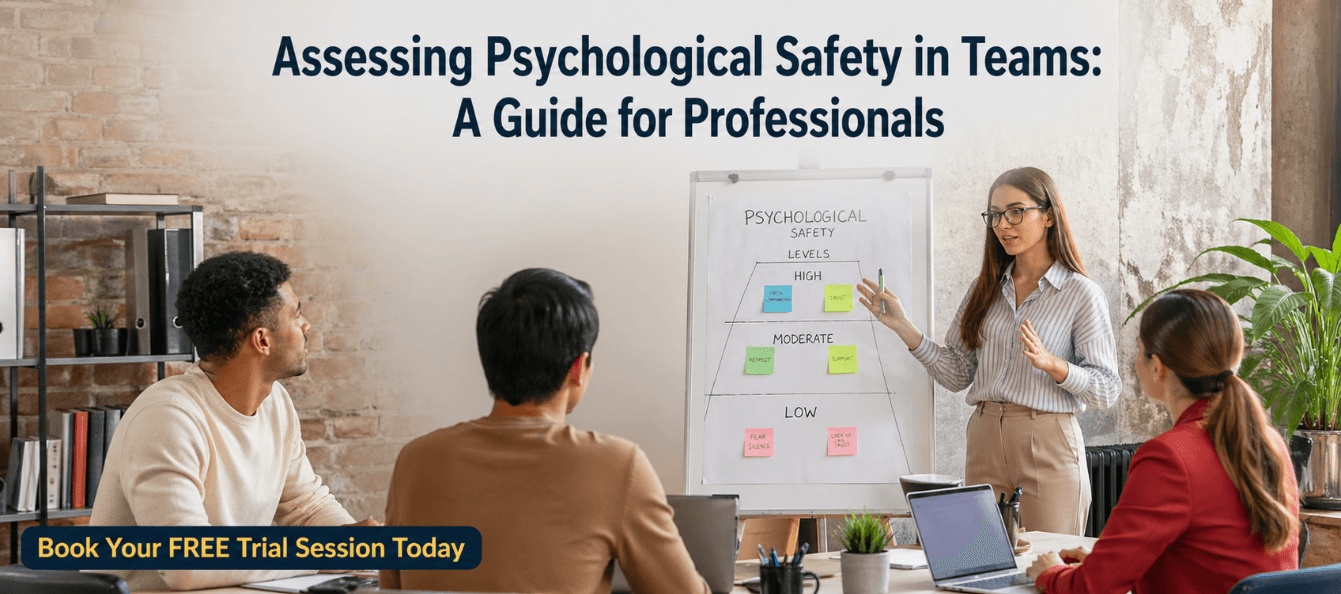
Psychological safety develops in four distinct levels. Each level builds on the previous one, and skipping levels creates fragile team cultures.
Level 1 — Inclusion Safety
Team members feel accepted and respected. They belong without conditions.
Level 2 — Learner Safety
Team members feel safe to ask questions, make mistakes, and learn without fear.
Level 3 — Contributor Safety
Team members feel confident sharing ideas and contributing meaningfully.
Level 4 — Challenger Safety
Team members feel safe to challenge decisions, question authority, and propose new ideas.
Most teams operate at Levels 2 or 3 but struggle to reach Level 4. Without challenger safety, teams lose their most valuable insights and innovation opportunities.
How This Blog and Guidebook Help You
This guide provides a structured, practical system to diagnose and improve team psychological safety.
You will be able to:
- Accurately assess your team’s current safety level
- Identify hidden gaps affecting performance
- Apply targeted interventions based on your team’s needs
- Build a culture where people speak up and contribute fully
The result is stronger collaboration, better decision-making, and higher team performance.
Step-by-Step Breakdown
Assessing Your Team with the Psychological Safety Scorecard
Start by evaluating your team across 12 key behaviours.
Examples include:
- Are all team members acknowledged in meetings?
- Do people openly admit when they don’t know something?
- Are ideas from quieter members considered?
- Do team members challenge leadership decisions?
Each behaviour is rated on a scale of 1 to 5. The total score determines your team’s safety level:
- 48–60: High safety
- 36–47: Moderate safety
- 24–35: Low safety
- Below 24: Critical condition
Focus on the lowest-scoring level, as that is where intervention is needed most.
Interpreting Your Team’s Safety Level
Each score range represents a different team climate:
High-Trust Teams
People contribute openly, challenge ideas constructively, and collaborate effectively. Focus on maintaining this culture.
Capable-but-Cautious Teams
Basic safety exists, but people hold back in high-stakes situations. Improvement requires targeted interventions.
Anxious Teams
Fear is present. Silence, lack of feedback, and hesitation dominate interactions. Rebuilding must start with inclusion.
Survival-Mode Teams
Team members operate in self-protection mode. Immediate intervention is required to prevent burnout and turnover.
Applying Level-Specific Interventions
Once you identify the weakest level, apply targeted actions:
Level 1 — Inclusion
- Acknowledge every team member in meetings
- Address exclusion immediately
- Ensure equal participation
Level 2 — Learning
- Encourage questions without judgment
- Share your own mistakes openly
- Celebrate learning, not just success
Level 3 — Contribution
- Invite ideas from all team members
- Recognise contributions publicly
- Use structured opportunities for input
Level 4 — Challenging
- Encourage constructive disagreement
- Reward people who question decisions
- Introduce roles like devil’s advocate
Start with one intervention and implement it consistently.
Reflecting on Leadership Behaviour
Psychological safety is shaped primarily by leadership behaviour.
Key reflection questions:
- When did someone on your team last hesitate or withdraw?
- How do you respond to mistakes or challenges?
- Who on your team is not speaking up—and why?
Self-awareness is the starting point for meaningful change.
Real-World Application Example
Consider a manager leading a team that rarely speaks up. Meetings are quiet, and innovation is low.
After using the scorecard:
- The team scores in the critical range
- Inclusion and learning safety are weak
The manager implements simple changes:
- Shares personal mistakes in meetings
- Ensures equal speaking opportunities
- Follows up with team members individually
Within 90 days:
- Team participation increases
- Ideas begin to flow
- Psychological safety score improves significantly
This demonstrates that consistent behavioural change—not large investments—drives results.
Common Mistakes or Pitfalls to Avoid
- Jumping to solutions without listening
- Showing bias in recognition and praise
- Rewarding confidence over honesty
- Critiquing mistakes publicly
- Mistaking agreement for alignment
- Ignoring small contributions
- Waiting for a crisis before addressing safety
Avoiding these mistakes helps build trust and encourages open communication.
How Should You Use This Guidebook Effectively
Follow a structured implementation plan:
- Complete the scorecard yourself
- Share it with your team for honest feedback
- Compare results and identify gaps
- Focus on one safety level at a time
- Implement one intervention consistently
- Reassess after 30 days
Time investment:
- Initial assessment: 20–30 minutes
- Weekly adjustments: 10–15 minutes
- Monthly review: 20 minutes
Consistency and visibility of actions are key to success.
Key Takeaways
- Psychological safety is the foundation of high-performing teams
- It develops in four levels: Inclusion, Learning, Contribution, and Challenging
- Most teams struggle to reach challenger safety
- Measurement through a scorecard enables accurate diagnosis
- Leadership behaviour is the primary driver of team safety
- Small, consistent actions create lasting cultural change
- Start with one intervention and build momentum over time
Your Next Step Accelerate Your Career with PlanetSpark
Creating an impact-driven resume is not just about landing your next job—it’s about owning your professional story and presenting it with clarity, confidence, and credibility. When your resume clearly communicates value, results, and impact, opportunities follow naturally.
At PlanetSpark, we are committed to empowering working professionals with practical, outcome-focused resources that drive real career growth. From resume building and workplace communication to leadership presence and professional writing, our programs are designed to help you succeed in today’s fast-evolving job market.
Visit https://www.planetspark.in/resources to explore:
- Career and resume-building guides
- Workplace communication and professional writing resources
- Skill-development tools curated for working professionals
Want a deeper, hands-on experience?
You can also book a free trial session to learn more about PlanetSpark’s Working Professional Courses, designed to accelerate your career through personalised coaching, real-world practice, and expert guidance.
Your career deserves more than generic advice.
It deserves clarity, confidence, and measurable impact.
Personalized Communication Roadmaps
Record a video to get a AI generated personalized communication reports