
Balance Deep Work and Recovery: A 2026 Guide
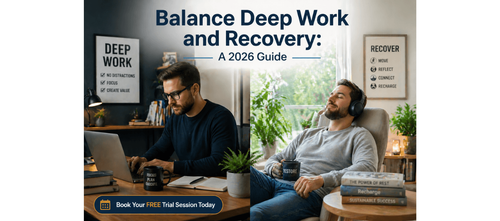

Deep Work Meets Recovery: Sustaining Performance Over the Long Term
Most professionals are not struggling because they lack ambition or capability. They struggle because their days are fragmented, reactive, and overloaded. You start the day with intent, but within hours, your focus is scattered across emails, meetings, messages, and urgent tasks. By the end of the day, you feel exhausted—yet unsure if you made real progress on what actually matters.
This is the hidden cost of modern work. The issue is not effort—it is misalignment. Without a system that protects deep focus and supports genuine recovery, productivity slowly erodes. You end up working more but achieving less, while mental fatigue quietly builds in the background.
This is exactly where the deep work and recovery framework becomes critical. It helps you shift from constant busyness to intentional performance. Instead of reacting to everything, you learn to structure your time, protect your energy, and sustain high-quality output without burning out.
Download these resources and apply them alongside your daily work for improved clarity, productivity, and professional growth. You can also book a free trial to gain expert guidance and enhance your communication, problem-solving, and decision-making skills. The materials are designed in a clear, structured format to help professionals learn efficiently and implement insights with confidence.
Who Is This Blog For?
- Career changers trying to prove themselves in new roles
- Early to mid-career professionals struggling with focus and consistency
- Managers handling multiple responsibilities and team demands
- Consultants juggling clients, deadlines, and unpredictable schedules
- Professionals experiencing burnout despite working long hours
Why This Topic Matters Today?
Modern work environments are designed for interruption. Research shows that the average knowledge worker switches tasks every few minutes, which significantly reduces the ability to perform meaningful, high-quality work. Each interruption forces your brain to reset, creating cognitive fatigue and reducing clarity.
Over time, this leads to:
- Declining productivity despite longer work hours
- Increased stress and decision fatigue
- Lower quality output on important tasks
- Difficulty disconnecting from work
Without structured focus and intentional recovery, this cycle becomes unsustainable. Professionals are not failing due to lack of discipline—they are operating without a system that aligns with how the brain actually works.
Core Concept or Framework Explained
At the heart of this guide is the Deep Work–Recovery Cycle.
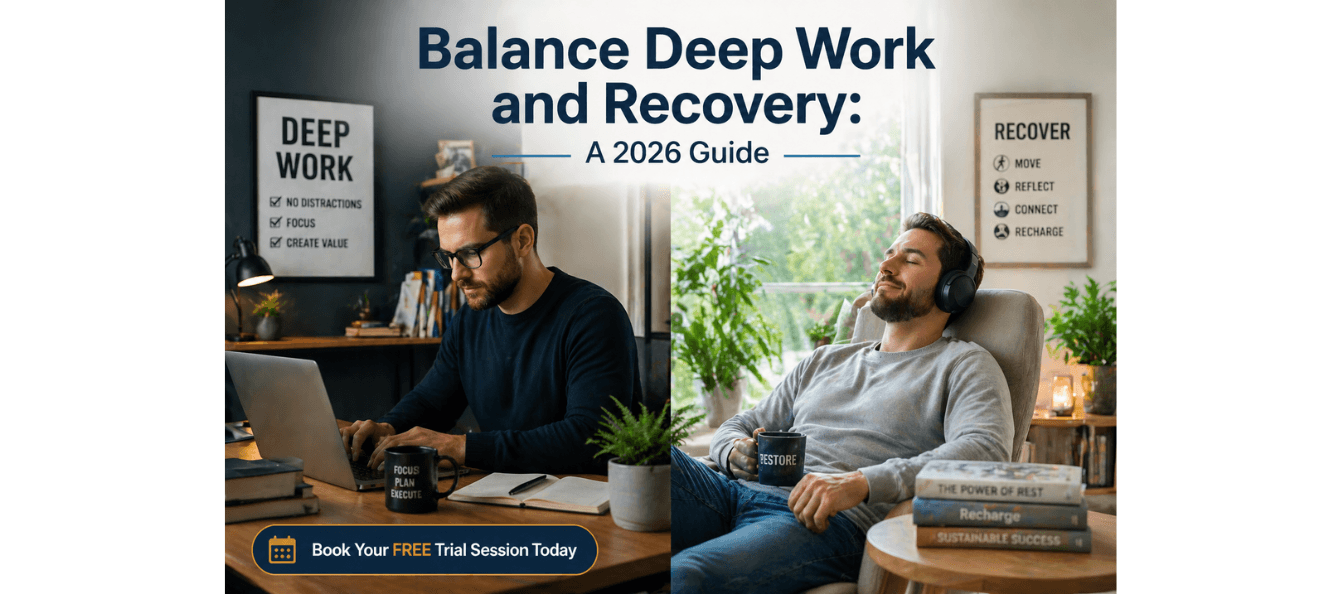
Deep work refers to cognitively demanding tasks performed in a distraction-free state. These are the activities that truly move your career forward—strategic thinking, problem-solving, learning, and creating high-value output.
Recovery, on the other hand, is not optional. It is essential. During recovery, your brain restores its ability to focus, processes information, and prepares for the next cycle of deep work.
The key insight is simple:
- Deep work creates value
- Recovery sustains the ability to create that value
High performers do not rely on constant effort. They operate in cycles:
- Focus intensely for a defined period
- Step away to recover intentionally
- Return with renewed clarity and energy
This rhythm—not longer hours—is what drives consistent performance over time.
How This Blog and Guidebook Help You?
This blog translates the guidebook into actionable insights you can apply immediately.
You will learn how to:
- Identify your peak energy window and protect it
- Structure your day for maximum focus and output
- Build deep work habits that reduce distractions
- Implement recovery strategies that actually restore energy
- Create a sustainable work rhythm that prevents burnout
The result is not just better productivity—it is better quality work, improved clarity, and a more sustainable career trajectory.
Step-by-Step Breakdown
Step 1: Build Awareness Through a Focus Audit
Before improving productivity, you need clarity on your current habits.
A focus audit helps you evaluate:
- How often you achieve uninterrupted work
- Whether your important tasks get your best energy
- Your ability to disconnect from work
- Your sleep and recovery patterns
This creates a baseline. If your score is low, it is not failure—it is a signal that your current system needs redesign.
Step 2: Map Your Energy, Not Just Your Time
Not all hours are equal. Your cognitive performance fluctuates throughout the day based on your biological rhythm.
Track your energy levels across different time blocks for a few days. Identify:
- When you feel most alert and focused
- When your energy naturally dips
Your peak window is where deep work should happen. Aligning work with energy dramatically improves efficiency.
Step 3: Design Your Deep Work Architecture
Instead of relying on motivation, create a structure that makes focus automatic.
Choose a deep work style that fits your role:
- Monastic: minimal distractions, ideal for independent roles
- Bimodal: dedicated deep work days and shallow work days
- Rhythmic: consistent daily focus blocks
- Journalistic: flexible deep work when opportunities arise
For most professionals, a daily rhythmic approach is the most practical starting point.
Step 4: Create a Deep Work Session Protocol
A successful deep work session follows a repeatable structure:
- Pre-session ritual to signal focus mode
- 90–120 minutes of uninterrupted work on one task
- Short recovery break afterward
- End-of-session review to capture progress
Key practices include:
- Defining one clear task
- Eliminating all distractions
- Writing down stray thoughts instead of acting on them
This prevents cognitive overload and maintains focus.
Step 5: Structure Your Full Workday
Your calendar should reflect priorities—not just availability.
A high-performance workday includes:
- Morning deep work during peak energy
- Midday shallow work and communication
- Planned recovery breaks
- A second focus block if possible
- A clear end-of-day shutdown
The principle is simple: schedule important work first, then fit everything else around it.
Step 6: Build a Multi-Layered Recovery System
Recovery operates across multiple levels:
- Physical: sleep, movement, nutrition
- Cognitive: mental downtime without effort
- Emotional: connection and stress processing
- Social: interaction or solitude based on personality
Most professionals rely on low-quality recovery like scrolling or passive consumption, which does not restore energy.
High-quality recovery includes:
- Walking in nature
- Engaging hobbies
- Meaningful conversations
- Deep sleep
Step 7: Use Micro, Macro, and Mega Recovery
To sustain performance, recovery must happen at different time scales:
- Micro: short breaks every 60–90 minutes
- Macro: daily sleep and weekly rest days
- Mega: extended breaks like vacations
Ignoring any one of these leads to long-term fatigue.
Step 8: Implement a Daily Shutdown Ritual
The shutdown ritual is a critical habit that marks the end of your workday.
It includes:
- Reviewing completed work
- Capturing unfinished tasks
- Setting the next day’s priority
- Closing all work tools
- Mentally signaling that work is done
This helps you disconnect, reduce stress, and improve next-day focus.
Step 9: Use the Deep Work–Recovery Matrix
This framework helps categorize tasks based on:
- Cognitive demand
- Level of intentionality
It reveals where your time is going and helps you shift toward high-impact, proactive work.
Step 10: Plan Weekly and Reflect Monthly
Use a weekly planner to:
- Schedule deep work blocks
- Plan recovery activities
- Set boundaries for meetings
Use monthly reflection to:
- Evaluate what worked
- Identify disruptions
- Adjust your system
Consistency—not perfection—is the goal.
Common Mistakes or Pitfalls to Avoid
- Treating deep work as optional instead of scheduling it first
- Confusing busy schedules with meaningful output
- Using passive activities like scrolling as recovery
- Skipping shutdown rituals on busy days
- Trying to optimise short-term output instead of long-term sustainability
Each of these mistakes reduces effectiveness and increases fatigue over time.
How Should You Use This Guidebook Effectively?
To get maximum value from this system:
- Start with a full read-through to understand the framework
- Use worksheets and audits to personalise your approach
- Implement one habit at a time instead of everything at once
- Dedicate 15 minutes weekly for planning
- Spend 20 minutes monthly on reflection and adjustment
Think of this as a living system. It should evolve as your role and responsibilities change.
Key Takeaways
- Deep work and recovery are interdependent, not separate
- Your peak energy window is your most valuable asset
- Structured systems outperform motivation and willpower
- High-quality recovery is essential for sustained performance
- The shutdown ritual is a powerful daily reset tool
- Weekly planning creates clarity and reduces reactivity
- Long-term success depends on sustainable work rhythms
Your Next Step: Accelerate Your Career with PlanetSpark
Creating an impact-driven resume is not just about landing your next job—it’s about owning your professional story and presenting it with clarity, confidence, and credibility. When your resume clearly communicates value, results, and impact, opportunities follow naturally.
At PlanetSpark, we are committed to empowering working professionals with practical, outcome-focused resources that drive real career growth. From resume building and workplace communication to leadership presence and professional writing, our programs are designed to help you succeed in today’s fast-evolving job market.
Visit https://www.planetspark.in/resources to explore:
- Career and resume-building guides
- Workplace communication and professional writing resources
- Skill-development tools curated for working professionals
Want a deeper, hands-on experience?
You can also book a free trial session to learn more about PlanetSpark’s Working Professional Courses, designed to accelerate your career through personalised coaching, real-world practice, and expert guidance.
Your career deserves more than generic advice.
It deserves clarity, confidence, and measurable impact.
Start building that advantage today—with PlanetSpark.
Personalized Communication Roadmaps
Record a video to get a AI generated personalized communication reports