
Balancing AI Usage While Strengthening Core Professional Skills
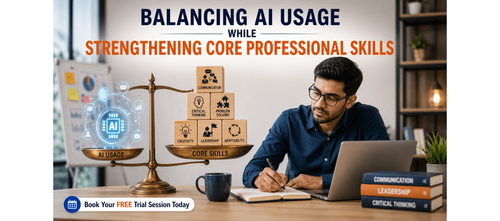

Maximize Your Professional Skills: How to Prevent AI Dependency From Weakening Your Core Skills
AI tools are a game-changer for productivity, helping professionals complete tasks faster—from drafting emails to generating reports. However, there’s a hidden risk: over-relying on AI can erode the core skills that define your professional identity, such as judgment, critical thinking, and problem-solving. Without deliberate practice, AI tools could slowly undermine the very abilities that make you valuable in your career.
This guide will show you how to harness AI effectively without losing the cognitive skills you’ve worked hard to build. Learn how to use AI as a lever to enhance your expertise while keeping your core skills sharp.
Download these resources and apply them alongside your daily work for improved clarity, productivity, and professional growth. You can also book a free trial to gain expert guidance and enhance your communication, problem-solving, and decision-making skills. The materials are designed in a clear, structured format to help professionals learn efficiently and implement insights with confidence.
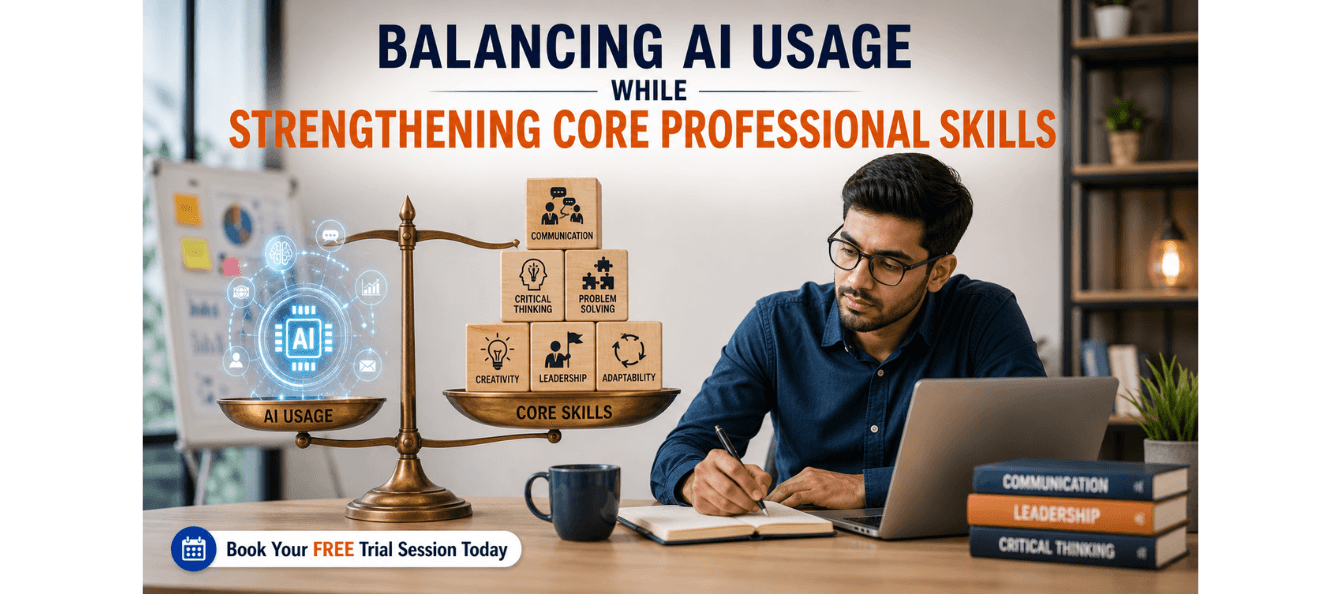
Who Is This Blog For?
- Career switchers who need to maintain essential skills while adapting to AI
- Managers overseeing teams that rely on AI tools
- Consultants and professionals who use AI in client-facing situations
- Anyone looking to avoid becoming dependent on AI and keep their core skills intact
Why This Topic Matters Today?
AI is everywhere in the workplace. From drafting documents to analyzing data, it’s tempting to offload more and more cognitive tasks to AI tools. For many, this seems like a time-saver. But there’s a catch: the more you rely on AI, the less you practice the skills that matter most in your professional life. Over time, you might find it difficult to perform tasks without AI support or struggle with tasks that demand critical thinking and decision-making.
The goal of this blog is to show you how to use AI as a tool to enhance your capabilities—not as a crutch that weakens your expertise. Staying sharp and confident in your abilities is key to thriving in the age of AI.
Core Concept or Framework Explained
The main framework in this guide revolves around the simple but powerful distinction between using AI as a Lever vs. using it as a Crutch.
1. Lever: You use AI to amplify your skills. AI speeds up your work and enhances your capabilities, but you remain in control of the thinking, judgment, and decision-making.
2. Crutch: You rely on AI to do your thinking for you. AI becomes a substitute for your own cognitive abilities, weakening your skills over time.
The key to long-term professional success in an AI-driven world is to use AI as a lever, not a crutch. This means engaging your own thinking first and using AI to support and accelerate your work, not replace it.
How This Blog and Guidebook Help You?
This blog, paired with the accompanying guidebook, provides you with:
- A clear framework to differentiate between using AI as a Lever and a Crutch
- Tools and strategies for protecting your cognitive skills from AI over-dependency
- Practical steps for building a sustainable balance between AI and human expertise
- Reflection worksheets and audits to track and improve your AI usage habits
By following the guide, you will be able to keep your core skills sharp while leveraging AI to enhance your work output.
Step-by-Step Breakdown
Step 1: Audit Your AI Usage
To start, track every instance where you use AI tools for one week. Note the task, the tool used, and whether you attempted the task yourself first. At the end of the week, categorize each use as a Lever (AI enhanced your work) or a Crutch (AI replaced your effort). This exercise will help you identify where dependency is creeping in.
Reflection Questions:
- Which tasks have you stopped attempting yourself in the past six months?
- Where do you feel least confident without AI assistance?
- What tasks would you struggle to do in a tool-free environment?
If more than 40% of your AI uses fall under the Crutch category, it’s time to take action immediately.
Step 2: Protect Your Practice Zones
Once you’ve identified the areas where dependency is creeping in, it’s time to protect certain tasks as human-first zones. These are tasks you commit to doing yourself before AI involvement. Just like athletes don’t skip practice because they have good equipment, professionals shouldn’t skip cognitive effort because they have good tools.
Key strategies:
- Draft Before You Prompt: For written communication—emails, reports, proposals—write your own first draft before using AI to refine or expand.
- Ideate Before You Generate: Spend five minutes brainstorming ideas on your own before using AI to generate options.
- Analyze Before You Summarize: When reviewing data or documents, form your own initial interpretation before asking AI to summarize.
These steps keep your core skills active while allowing AI to complement your efforts.
Step 3: Build Deliberate Skill Practice Into Your Week
Protecting your practice zones is reactive; this step is proactive. Schedule regular time each week to practice key professional skills without AI. Treat these sessions as non-negotiable, just like a client meeting or deadline.
Suggested Weekly Practice Schedule:
- Monday (Writing): Write a short email or LinkedIn post entirely from scratch. Focus on clarity and your own voice.
- Wednesday (Analysis): Take a dataset or business problem and write your own interpretation before checking AI-generated summaries.
- Friday (Communication): Spend 15 minutes explaining a complex idea to a non-expert—no AI scaffolding.
By dedicating time each week to practice these skills, you’ll keep your cognitive abilities sharp and prevent over-reliance on AI.
Step 4: Real-World Application—Case Example
Priya, a Senior Marketing Consultant, had been using AI to draft client-facing reports. When asked to present her analysis live in a client workshop—without slides or AI—she froze. She realized she could no longer articulate her strategic thinking fluently without a generated draft. Her confidence had eroded.
The Fix: Priya completed an AI usage audit and identified report drafting and verbal synthesis as crutch zones. She committed to writing the first page of every report herself before using AI to refine it. She also spent 20 minutes each week practicing verbal explanations of client situations to colleagues—no AI assistance.
Result: Six weeks later, Priya confidently led a client workshop. Her manager noted that she was “back to her best.”
Common Mistakes or Pitfalls to Avoid
1. Mistake: Accepting AI Output Without Editing
Fix: Always read AI output critically. Ask: Does this sound like me? Is it accurate? What would I change? Make deliberate edits before using AI-generated text.
2. Mistake: Using AI to Avoid Discomfort
Fix: Discomfort often signals growth. If a task feels hard without AI, that’s a sign it needs practice, not avoidance.
3. Mistake: No Personal Voice in Written Work
Fix: Write one paragraph in your own words before using AI to expand. AI can help, but your voice must lead.
4. Mistake: Skipping the “Think First” Step
Fix: Introduce a mandatory two-minute thinking pause before opening any AI tool. This simple habit significantly reduces crutch-style usage.
Key Takeaways
- AI should amplify your expertise, not replace it.
- Awareness is the first step to managing AI dependency.
- Use AI as a tool to support your thinking, not as a crutch to avoid cognitive effort.
- Protect core tasks by practicing them manually before turning to AI.
- Build regular, deliberate practice into your week to keep your skills sharp.
Your Next Step: Accelerate Your Career with PlanetSpark
Creating an impact-driven resume is not just about landing your next job—it’s about owning your professional story and presenting it with clarity, confidence, and credibility. When your resume clearly communicates value, results, and impact, opportunities follow naturally.
At PlanetSpark, we are committed to empowering working professionals with practical, outcome-focused resources that drive real career growth. From resume building and workplace communication to leadership presence and professional writing, our programs are designed to help you succeed in today’s fast-evolving job market.
Visit https://www.planetspark.in/resources to explore:
- Career and resume-building guides
- Workplace communication and professional writing resources
- Skill-development tools curated for working professionals
Want a deeper, hands-on experience?
You can also book a free trial session to learn more about PlanetSpark’s Working Professional Courses, designed to accelerate your career through personalised coaching, real-world practice, and expert guidance.
Your career deserves more than generic advice.
It deserves clarity, confidence, and measurable impact.
Personalized Communication Roadmaps
Record a video to get a AI generated personalized communication reports