
Career Experimentation Framework Guide for Professionals 2026

Using the Career Experimentation Framework to Navigate Career Transitions with Confidence: A Practical Guide
Navigating a career transition can be a daunting and uncertain process. Whether you're considering a move to a new role, exploring a completely different industry, or shifting from a managerial to a consulting position, the risk of making the wrong decision can feel overwhelming. Many professionals find themselves stuck, unsure of how to test new career paths without taking irreversible steps.
Fortunately, there's a better way to approach career transitions — with clear data and systematic experimentation. The Career Experimentation Framework offers a structured, low-risk way to explore career changes without the guesswork. This toolkit allows you to test potential career paths, validate your hypotheses, and build confidence before making any life-changing decisions.
Download these resources and apply them alongside your daily work for improved clarity, productivity, and professional growth. You can also book a free trial to gain expert guidance and enhance your communication, problem-solving, and decision-making skills. The materials are designed in a clear, structured format to help professionals learn efficiently and implement insights with confidence.

Who Is This Blog For?
This guide is ideal for professionals who are considering a career switch but need clarity and confidence before making any major decisions. It's particularly helpful for:
- Mid-career professionals considering a pivot into a new industry or role
- Managers thinking about transitioning to consulting or advisory positions
- Analysts or specialists exploring management or technical roles
- Professionals who want a structured, evidence-based approach to career transitions
Why This Topic Matters Today?
The modern professional landscape is fast-paced and constantly evolving. Career transitions are a natural part of professional growth, but many professionals struggle with the decision-making process. Statistics show that nearly 40% of people who switch careers regret their decision within the first year, largely due to making choices based on incomplete information.
The Career Experimentation Framework solves this problem by offering a methodical, evidence-driven approach to career exploration. Instead of making a blind leap, professionals can now experiment, gather data, and make informed decisions that reduce the risk of regret and burnout.
Core Concept
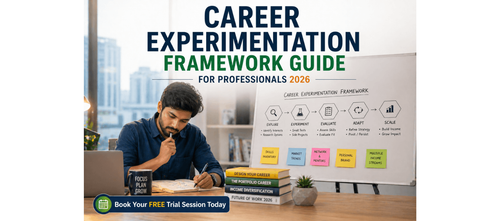
At the heart of this guide is the Career Experimentation Framework, a five-phase process that transforms how you approach career decisions. The framework treats your career transition like a scientific experiment: you hypothesize, test, gather real-world data, and iterate based on your findings. Here's an overview of the key phases:
1. Audit: Know your current starting point by assessing your skills, values, and energy levels.
2. Hypothesize: Create specific, testable hypotheses about potential career paths.
3. Design Experiments: Plan small, low-risk career experiments to test your hypotheses.
4. Run & Measure: Execute your experiments and reflect on the outcomes.
5. Decide: Use the data you’ve gathered to make a clear, informed decision about your next career move.
How This Blog and Guidebook Help You?
This blog and the Career Experimentation Framework provide tangible, actionable insights to help you make well-informed career transitions. The outcome is clear: reduce uncertainty, make data-backed decisions, and feel confident about your career direction. This framework will give you the structure to experiment systematically, so you can feel assured that your next career step is the right one.
Step-by-Step Breakdown
Phase 1: Audit
The first phase focuses on understanding where you currently stand. You'll assess your strengths, skills, energy levels, and core values. This self-audit will form the baseline for your experiments. Key activities in this phase include:
- Skills Inventory: List every skill you regularly use and separate them into "energising" (skills you enjoy) and "draining" (skills you tolerate but don't love).
- Energy Audit: Track your energy levels over two weeks to identify tasks that energize or drain you.
- Values Clarification: Rank your career values (autonomy, impact, growth, etc.) and identify your non-negotiables.
Phase 2: Hypothesize
In this phase, you generate specific, testable hypotheses about potential career directions. This is not a vague wish ("I want to be more creative") but a concrete statement you can test ("I believe I would thrive as a product manager because my skills in user empathy and structured problem-solving align with this role").
- Use the hypothesis formula to create clear statements about potential roles.
- Score each hypothesis based on desirability (how much you want it) and feasibility (how realistic it is).
Phase 3: Design Experiments
Career experiments should be small, time-boxed (2–6 weeks), and low-risk. For example:
- Writing Experiment: Write and publish a blog post related to your target career field and measure your energy levels while doing so.
- Consulting Experiment: Offer a pro bono consulting session to gain hands-on experience.
- Technical Skill Experiment: Build a small project, like a product wireframe or a dashboard, to test your skills in a technical role.
Phase 4: Run & Measure
This phase is all about executing your experiments and capturing the right data. Maintain an experiment log to track:
- The hypothesis tested
- The experiment run
- Observable outcomes (e.g., success or failure)
- Your energy levels before and after the task
- Insights gained from the experiment
Phase 5: Decide
After conducting several experiments, you'll have enough data to make an informed decision. The decision is not always binary (switch or stay) — it can be a spectrum. For example:
- Clear Signal: Multiple experiments validate your hypothesis, and you're ready to move forward.
- Partial Signal: Some aspects of the new direction energize you, but others don't. A hybrid path may be the solution.
- Weak Signal: The experiments drain you or produce weak output. You may need to go back to the Audit phase to reframe your hypothesis.
- No Signal Yet: If you're undecided, continue running experiments to gather more data.
Common Mistakes
- Skipping the Audit Phase: Rushing past the self-audit leads to misguided experiments. It's crucial to have a solid understanding of your strengths and values before testing new career paths.
- Overlooking Small Experiments: Large, high-risk experiments can be costly and may not provide meaningful data. Start with small, manageable experiments that can be completed alongside your current role.
- Confirmation Bias: When analyzing your experiments, be mindful of confirmation bias. Pay attention to internal signals like energy levels, curiosity, and engagement, rather than focusing solely on external validation like praise or job offers.
How Should You Use This Guidebook Effectively?
- Time Investment: The toolkit can be applied over several weeks or months, depending on your availability. Each phase should take 1–2 weeks to complete.
- Practical Workflow: Start with the Audit phase, then move through each phase systematically. Revisit previous phases if new insights emerge from your experiments.
- Consistency: Consistently log your experiments, reflect on the outcomes, and adjust your hypotheses as necessary. The process is iterative — not linear.
Key Takeaways
- Start with a rigorous self-audit to understand your baseline.
- Generate specific career hypotheses to test potential directions.
- Run small, low-risk experiments to gather real data and insights.
- Measure your energy, curiosity, and engagement throughout each experiment.
- Use the data to make an informed decision about your next career move.
Your Next Step: Accelerate Your Career with PlanetSpark
Creating an impact-driven resume is not just about landing your next job—it’s about owning your professional story and presenting it with clarity, confidence, and credibility. When your resume clearly communicates value, results, and impact, opportunities follow naturally.
At PlanetSpark, we are committed to empowering working professionals with practical, outcome-focused resources that drive real career growth. From resume building and workplace communication to leadership presence and professional writing, our programs are designed to help you succeed in today’s fast-evolving job market.
Visit https://www.planetspark.in/resources to explore:
- Career and resume-building guides
- Workplace communication and professional writing resources
- Skill-development tools curated for working professionals
Want a deeper, hands-on experience?
You can also book a free trial session to learn more about PlanetSpark’s Working Professional Courses, designed to accelerate your career through personalised coaching, real-world practice, and expert guidance.
Your career deserves more than generic advice.
It deserves clarity, confidence, and measurable impact.
Personalized Communication Roadmaps
Record a video to get a AI generated personalized communication reports