
Combining Data and Intuition in Decision-Making: A Guide for Professionals
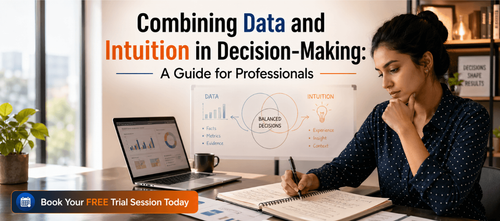

Integrating Data and Intuition in Decision-Making: A Guide to Making Smarter and Faster Choices
Every day, professionals face decisions under pressure—whether it's crafting a pitch, choosing a new strategy, or deciding on team priorities. The question often arises: Should you trust data or rely on gut feeling? The real skill is in knowing how to balance both. Over-relying on one or the other can result in poor decision-making, whether it's from data overload or gut-driven mistakes. This guide will help you build the ability to combine both data and intuition, enabling you to make faster, smarter, and more confident decisions.
Download these resources and apply them alongside your daily work for improved clarity, productivity, and professional growth. You can also book a free trial to gain expert guidance and enhance your decision-making skills. The materials are designed in a clear, structured format to help professionals learn efficiently and implement insights with confidence.
Who Is This Blog For?
This blog and the accompanying guidebook are designed for:
- Career switchers who need to make quick and informed decisions in a new role.
- Consultants facing high-stakes decisions with varying data points.
- Managers who need to balance team input, data analysis, and intuitive judgment.
- Early-to-mid-career professionals who want to avoid second-guessing and build their decision-making confidence.
- Professionals facing important decisions but unsure how to combine data and intuition effectively.
Why This Topic Matters Today?
In today’s fast-paced work environment, professionals often fall into one of two traps:
1. The Data-Only Trap: Relying solely on data, which can lead to analysis paralysis and delays in decision-making.
2. The Gut-Only Trap: Making decisions based on intuition without solid data backing, which can lead to mistakes and poor outcomes.
The key to making better decisions is recognizing when to lean on data and when to trust your gut. Both data and intuition are valuable, but knowing how to blend them creates more informed, confident decisions and minimizes the risks associated with both extremes.
Core Concept or Framework Explained
The Data-Intuition Tension
Data and intuition are not opposites; they are complementary. The goal is to develop the skill of blending both to make more informed decisions. The key problems arise when:
- Data-Only Approach: Often leads to decision paralysis, slow cycles, and false certainty. It ignores the context, culture, and human dynamics that can’t always be captured by numbers.
- Intuition-Only Approach: Can cause errors due to cognitive bias and overconfidence, especially in unfamiliar contexts. Intuitive decisions can be hard to defend and justify when they go wrong.
Balancing both allows for more efficient decision-making, where data informs your decisions and intuition helps you contextualize and act quickly, particularly in high-stakes situations.
How This Blog and Guidebook Help You?
This blog and guidebook will help you:
- Classify the type of decision you're facing to determine the right balance of data vs. intuition.
- Learn when to trust data and when to lean on intuition.
- Apply the 70/30 Rule: Gather enough data to be 70% confident, then let your informed intuition handle the remaining 30%.
- Understand your decision-making default style and develop the flexibility to switch between data-driven and intuition-driven approaches.
- Implement frameworks like the D.A.T.A. framework to make decisions in a structured and repeatable way.
The result? You’ll be able to make faster, smarter, and more confident decisions.
Step-by-Step Breakdown
Step 1: Know Your Decision Type
The first step is understanding the nature of the decision. Different decisions require different levels of data and intuition. Classify your decision into one of these four types:
- Routine Decisions: Use checklists and intuition based on past precedent (e.g., weekly reports).
- Analytical Decisions: Rely on data-heavy analysis (e.g., vendor selection, budget allocation).
- Judgment Calls: Blend data and intuition, where data informs but intuition holds the deciding vote (e.g., hiring decisions).
- Crisis Decisions: Trust intuition but validate with data retrospectively (e.g., PR incidents, urgent pivots).
Once classified, use the appropriate approach to balance your decision-making process.
Step 2: The 70/30 Rule
The 70/30 Rule encourages you to gather enough data to be 70% confident and use intuition for the remaining 30%. This prevents two major mistakes:
1. Waiting for 100% certainty (which rarely exists).
2. Relying on gut feeling without enough data.
For example, if you’re deciding on a Judgment Call decision like hiring someone, gather enough information (e.g., data on experience, skills, and past performance) and then trust your instincts regarding cultural fit or team dynamics.
Step 3: The D.A.T.A. Framework
The D.A.T.A. Framework is a repeatable decision-making process for significant decisions. It includes:
1. Define: Clearly articulate the decision. What is the real question?
2. Analyse: Gather data and identify assumptions.
3. Trust: Check your gut. Does your intuition align with the data?
4. Act: Make the decision, commit, and document your reasoning.
Using the D.A.T.A. framework helps you maintain balance by ensuring you don’t skip any critical steps in the decision-making process.
Step 4: Calibrating Your Intuition
Intuition is based on experience, but it can be wrong if not properly calibrated. To improve your intuition:
- Track your predictions before making decisions.
- Score the accuracy of your decisions over time to identify patterns.
- Adjust based on feedback to continuously refine your gut instinct.
By tracking your decisions and comparing them to actual outcomes, you’ll be able to improve the accuracy of your intuition.
Step 5: Recognizing Cognitive Biases
Both data analysis and intuition can be affected by cognitive biases:
- Confirmation Bias: Seeking data that supports your existing beliefs.
- Anchoring Bias: Giving too much weight to the first piece of information.
- Sunk Cost Fallacy: Letting past investments drive future decisions.
By recognizing these biases, you can consciously adjust your decision-making process to improve its reliability and effectiveness.
Common Mistakes or Pitfalls to Avoid
- Waiting for certainty: Data is rarely 100% complete. Set a deadline for data gathering and commit.
- Confusing familiarity with intuition: Not all gut feelings are based on experience. Be mindful of comfort-based decision-making.
- Using data to justify a pre-made decision: Ensure data analysis happens before forming conclusions.
- Ignoring dissenting intuition: Pay attention to "nagging concerns" that don’t fit the data.
- Failing to document decisions: Keep a decision log for future reference and continuous improvement.
Avoiding these common mistakes will ensure your decision-making is consistently strong and reliable.
How Should You Use This Guidebook Effectively?
To get the most out of this guide:
- Read through the framework for understanding how to balance data and intuition.
- Use the worksheets to assess your default decision-making style and start applying the 70/30 Rule and the D.A.T.A. framework.
- Apply the tools in real-time decisions and track your progress to improve over time.
- Review your decisions regularly to calibrate your intuition and refine your approach.
This guide provides you with the tools, frameworks, and strategies to consistently make smarter, faster, and more confident decisions.
Key Takeaways
- Balance data and intuition: Both are essential, but understanding when to use each is key.
- Use the 70/30 Rule: Gather 70% of the necessary data and trust your intuition for the remaining 30%.
- Apply the D.A.T.A. Framework: Follow a structured process for every significant decision.
- Calibrate your intuition: Track your decisions to improve accuracy over time.
- Recognize and neutralize cognitive biases: Be aware of biases and adjust accordingly.
Your Next Step: Accelerate Your Career with PlanetSpark
Creating an impact-driven decision-making process is not just about making smarter choices—it’s about owning your professional decisions and leading with confidence. When you balance data and intuition effectively, opportunities follow naturally.
At PlanetSpark, we are committed to empowering working professionals with practical, outcome-focused resources that drive real career growth. From decision-making frameworks to leadership development and workplace communication, our programs are designed to help you succeed in today’s fast-evolving job market.
Visit https://www.planetspark.in/resources to explore:
- Decision-making and leadership resources
- Professional communication and productivity tools
- Skill-development programs for working professionals
Want a deeper, hands-on experience?
You can also book a free trial session to learn more about PlanetSpark’s Working Professional Courses, designed to accelerate your career through personalized coaching, real-world practice, and expert guidance.
Your career deserves more than generic advice.
It deserves clarity, confidence, and measurable impact.
Start building that advantage today—with PlanetSpark.
Personalized Communication Roadmaps
Record a video to get a AI generated personalized communication reports