
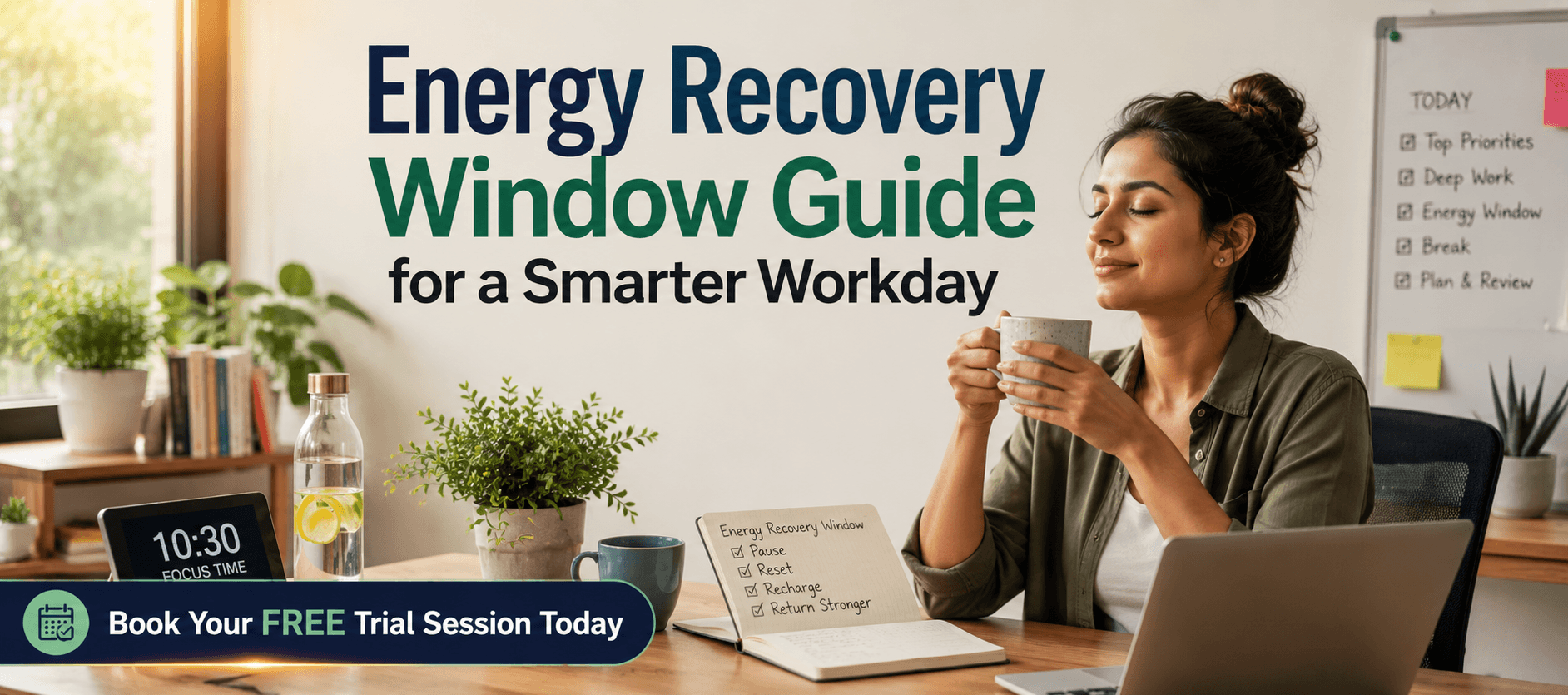
Energy Recovery Window Guide for a Smarter Workday
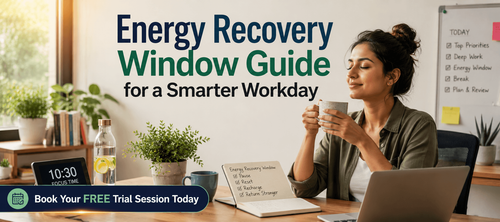

Design Energy Recovery Windows Into Your Workday for Better Focus and Sustainable Performance
Most professionals know how to manage time, but very few are taught how to manage energy. That is why many people still feel drained by 2 PM even when their calendar looks manageable. The issue is not always lack of time. Often, it is lack of recovery.
The guide How to Design Energy Recovery Windows into Your Workday introduces a practical system for building short, intentional recovery breaks into the workday. These breaks, called Energy Recovery Windows or ERWs, help professionals restore focus, reduce emotional reactivity, and perform consistently without running on empty.
Download these resources and apply them alongside your daily work for improved clarity, productivity, and professional growth. You can also book a free trial to gain expert guidance and enhance your communication, problem-solving, and decision-making skills. The materials are designed in a clear, structured format to help professionals learn efficiently and implement insights with confidence.
Who Is This Blog For?
This blog is for working professionals who want to improve performance without depending only on willpower.
* Professionals who feel mentally tired by mid-afternoon
* Managers dealing with back-to-back meetings
* Consultants handling demanding client schedules
* Team leads who want better focus and emotional control
* Remote or hybrid workers struggling with screen fatigue
* High performers who want sustainable productivity
Why This Topic Matters Today?
Modern work often rewards constant availability. Many professionals move from one call to another, eat lunch at their desk, check messages between tasks, and call it productivity. Over time, this creates cognitive depletion.
The guide explains that after long periods of unbroken work, focus drops, errors increase, and emotional reactivity rises. Running without recovery does not just make you tired. It affects decision-making, communication, creativity, and long-term job satisfaction.
The key idea is simple: the professionals who perform best over time are not always the ones who work the longest. They are the ones who recover the smartest.
Core Concept or Framework Explained
An Energy Recovery Window is a short, intentional pause built into the workday. It usually lasts between 3 and 15 minutes. Its purpose is not entertainment or distraction. Its purpose is recovery.
Scrolling social media, checking news, or mentally preparing for the next meeting does not count as an ERW. A true recovery window helps your brain, body, and emotional system reset before the next work block.
The guide explains three major benefits:
Cognitive recovery
This gives the brain a pause from planning, decision-making, and problem-solving. It helps restore focus and executive function.
Emotional recovery
This reduces reactivity and helps professionals communicate with more patience, clarity, and empathy.
Physical recovery
This reduces tension from sitting, improves circulation, and restores alertness through movement or stillness.
How This Blog and Guidebook Help You?
This blog and guidebook help you turn recovery from a vague idea into a daily system. Instead of waiting until you feel exhausted, you learn how to plan recovery before depletion takes over.
You will learn how to:
* Map your personal energy curve
* Identify your recovery blockers
* Choose the right type of recovery
* Build ERWs into your calendar
* Anchor recovery habits with triggers
* Review and improve your system weekly
The result is a more practical approach to productivity. You are not adding more work to your day. You are protecting the energy that makes quality work possible.
Step-by-Step Breakdown
Step 1: Map Your Personal Energy Curve
The guide begins with energy tracking. For three working days, you pause every 90 minutes and rate your energy and focus on a 1–5 scale.
This helps you identify when your energy naturally rises, holds, and drops. Some professionals have high morning energy. Others peak later. Some have two strong focus windows with a midday dip.
Once you know your lowest-energy time slots, you can place recovery windows where they will have the most impact.
Step 2: Understand the Four Types of Energy Recovery
The guide identifies four types of micro-recovery.
Cognitive disengagement means stepping away from thinking, planning, and decision-making. Examples include staring out a window, sitting quietly, or doing a simple physical task for 3–7 minutes.
Movement recovery uses light activity to reset the body. This can include walking, stretching, or climbing stairs for 5–10 minutes.
Sensory downshift reduces visual and auditory stimulation. Examples include breathing exercises, sitting in silence, or stepping outside without your phone for 3–5 minutes.
Social micro-recovery means having a brief, positive, non-work interaction. This can be a light conversation with a colleague or a quick kind message to a friend.
Step 3: Identify Your Recovery Blockers
Most professionals know they need breaks, but they do not take them. The guide separates blockers into internal and external barriers.
Internal blockers include guilt, perfectionism, fear of missing messages, and the belief that busyness equals productivity.
External blockers include back-to-back meetings, constant notifications, open offices, and team cultures that confuse presence with performance.
The goal is not to fix everything immediately. The goal is to reduce friction by making one or two small changes, such as setting notification boundaries or asking for calendar buffers.
Step 4: Design Your Energy Recovery Windows
The guide suggests thinking of the workday in three zones:
Morning is usually best for deep work.
Midday is useful for transition, connection, and lighter cognitive tasks.
Afternoon often needs structured recovery and execution-focused work.
A strong ERW system prevents more than 90 minutes of unbroken work without a deliberate pause. High depletion may need movement or sensory downshift. Moderate depletion may need cognitive disengagement. Social fatigue may need a light, positive interaction.
Step 5: Anchor Recovery Habits with Triggers
A recovery plan only works if you remember to use it. That is why the guide recommends triggers.
Time-based triggers use a recurring 90-minute alarm.
Transition triggers use natural moments such as the end of a meeting, finishing a task, or before starting a new agenda.
Depletion signal triggers use warning signs like re-reading the same sentence, irritability, or decision avoidance as cues to pause.
The habit becomes easier when recovery is tied to a system instead of motivation.
Common Mistakes or Pitfalls to Avoid
Using screens as recovery
Scrolling is not recovery. It keeps the brain processing information. Keep the phone away during ERWs.
Planning work during your break
If you use the break to rehearse your next task, your brain never fully disengages. Write down your next action before the ERW starts.
Skipping recovery on busy days
Busy days create more depletion, not less. Even a 3-minute ERW is better than no recovery.
Expecting instant results
ERWs compound over time. The guide recommends a 14-day trial and tracking end-of-day energy trends.
How Should You Use This Guidebook Effectively?
Use the guide in three stages.
First, read it once to understand the ERW system.
Second, complete the 3-day energy tracking log and identify your lowest-energy slots.
Third, choose one recovery window per day for one week. Keep it simple. Start with one 5-minute screen-free pause, then build from there.
You can also use the 7-day planner: observe, identify, add your first window, create a trigger, stack the habit, experiment with recovery type, and review the week.
Key Takeaways
* Energy is one of your most important professional resources
* Recovery is a performance strategy, not a reward
* Your brain needs intentional pauses after focused work
* ERWs should be short, practical, and screen-free
* Different types of depletion need different recovery methods
* Triggers make recovery easier to repeat
* Start small, track honestly, and improve weekly
Your Next Step: Accelerate Your Career with PlanetSpark
Creating an impact-driven resume is not just about landing your next job—it’s about owning your professional story and presenting it with clarity, confidence, and credibility. When your resume clearly communicates value, results, and impact, opportunities follow naturally.
At PlanetSpark, we are committed to empowering working professionals with practical, outcome-focused resources that drive real career growth. From resume building and workplace communication to leadership presence and professional writing, our programs are designed to help you succeed in today’s fast-evolving job market.
Visit https://www.planetspark.in/resources to explore:
* Career and resume-building guides
* Workplace communication and professional writing resources
* Skill-development tools curated for working professionals
Want a deeper, hands-on experience?
You can also book a free trial session to learn more about PlanetSpark’s Working Professional Courses, designed to accelerate your career through personalised coaching, real-world practice, and expert guidance.
Your career deserves more than generic advice.
It deserves clarity, confidence, and measurable impact.
Personalized Communication Roadmaps
Record a video to get a AI generated personalized communication reports