
Everything You Need to Know About Strategic Prioritization
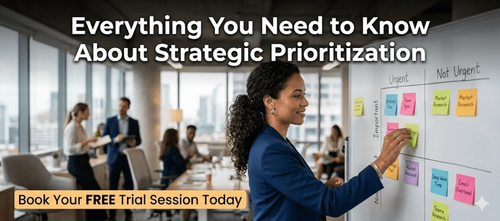

Strategic Prioritization to Boost Your Career and Achieve More
In today’s world of constant emails, meetings, and deadlines, it’s easy to feel overwhelmed by the sheer volume of tasks demanding your attention. The problem is not the amount of work — it’s how we prioritize. Without a clear system, professionals fall into the trap of reacting to urgency rather than focusing on what truly matters. This lack of prioritization often leads to exhaustion, missed opportunities, and stagnation in your career.
The Strategic Prioritization Framework is designed to help you break free from this cycle. Whether you’re managing multiple projects, navigating a career change, or striving for personal growth, this proven system will help you focus on what truly moves the needle.
Download these resources and apply them alongside your daily work for improved clarity, productivity, and professional growth. You can also book a free trial to gain expert guidance and enhance your communication, problem-solving, and decision-making skills. The materials are designed in a clear, structured format to help professionals learn efficiently and implement insights with confidence.
Who Is This Blog For?
This blog and accompanying guidebook are perfect for:
- Professionals with heavy workloads who struggle to prioritize effectively
- Career changers looking to gain clarity during transitions
- Managers aiming to lead their teams with more intentional focus
- Consultants seeking a structured framework to stay on top of multiple projects
- High-performing individuals wanting to boost their productivity and career growth
Why This Topic Matters Today?
The world of work has changed dramatically. With remote work, digital communication, and endless information streams, it’s easy to get lost in busyness rather than focus on the high-impact work that drives career success. High performers don’t work the hardest; they work the smartest. They focus on strategic tasks that move them closer to their goals, and they do it consistently.
The Strategic Prioritization Framework helps you identify, protect, and execute on the work that creates the most value, while avoiding distractions and low-impact tasks. This system allows you to operate with greater clarity, reduce decision fatigue, and make faster, more confident decisions.
Core Concept or Framework Explained
The Strategic Prioritization Framework is built around five interconnected modules designed to take you from reactive to intentional in your work. These modules include:
1. Audit — The first step is to capture everything on your plate. This comprehensive task audit externalizes your mental load, making it easier to decide what truly matters.
2. Classify — Use the Eisenhower Matrix to sort tasks by urgency and importance. This helps you focus on what really drives career growth and avoid distractions.
3. Focus — Protect your highest-value time by blocking out periods for deep work and eliminating micro-decisions that drain your mental energy.
4. Execute — Work on your most important tasks with intention, using tools like the MIT Method (Most Important Task) to guide your daily actions.
5. Review — A structured weekly review helps you reflect on progress, adjust priorities, and prepare for the next week.
The framework isn’t a one-time fix; it’s a living system that becomes more intuitive the more you practice it.
How This Blog and Guidebook Help You?
This blog, along with the Strategic Prioritization Framework, will help you:
- Tackle overwhelming workloads with a clear, actionable system
- Focus on high-impact tasks that lead to measurable career growth
- Break free from urgent-but-low-value tasks that drain your energy
- Improve decision-making by using a structured approach to prioritize
- Build confidence in your ability to say no to low-priority requests
By using this framework, you’ll not only become more productive but also gain a strategic advantage in your career by making decisions that matter.
Step-by-Step Breakdown
Step 1: The Priority Audit
The first step is a comprehensive audit of everything on your plate. For 15 minutes, list every task, project, and commitment. Capture them without filtering or judging, just writing down everything you can think of. This simple exercise externalizes the chaos and gives you clarity.
Step 2: Classify — Sort by Impact and Urgency
Use the Eisenhower Matrix to classify tasks into four quadrants:
- Q1 (Do First): Urgent + Important tasks that demand immediate attention.
- Q2 (Schedule): Not Urgent + Important tasks like strategic work, planning, and relationship building.
- Q3 (Delegate): Urgent + Not Important tasks that can be delegated.
- Q4 (Eliminate): Not Urgent + Not Important tasks that don’t add value.
The key takeaway: most career-defining work sits in Q2 — strategic thinking and skill development. Protect your Q2 time as fiercely as possible.
Step 3: Focus — Protect Your Highest-Value Time
Once you’ve identified your priorities, it’s time to focus. Block out fixed times in your calendar for Q1 and Q2 work. Guard these blocks like external meetings, ensuring that nothing interrupts them. Use tools like time blocking to protect your best work time.
Step 4: Execute — Work with Intention, Not Just Effort
Execution is where strategy becomes reality. Every morning, identify your Most Important Task (MIT) for the day. This task should have the highest strategic value and should be completed first, before checking emails or attending meetings.
Apply the 80/20 Rule to identify the 3–5 tasks that will have the greatest impact that week, and focus disproportionately on those.
Step 5: Review — Reflect and Recalibrate Weekly
The weekly review is an essential part of the system. Spend 30–45 minutes each week (ideally on Fridays) to:
- Capture new tasks or commitments
- Reassess your priorities using the Eisenhower Matrix
- Block deep work time for the upcoming week
- Reflect on your progress and adjust your focus as needed
A consistent weekly review will help you stay on track and make adjustments quickly, keeping you aligned with your long-term goals.
Common Mistakes or Pitfalls to Avoid
Here are some common mistakes people make when it comes to prioritization, and how to avoid them:
- The Urgency Trap: Everything feels urgent, but not everything requires immediate action. Ask yourself, “What is the actual consequence if I delay this?”
- The Pleaser Trap: Saying yes to every request might feel good in the moment but leads to burnout. Practice saying “no” or delaying low-priority tasks.
- The Perfectionism Trap: Spending too much time on low-value tasks. Set “good enough” standards for tasks that won’t impact your outcomes.
- The Multitasking Trap: Juggling multiple tasks can feel productive but dilutes your focus. Practice single-tasking and protect your deep work time.
How Should You Use This Guidebook Effectively?
To use this guidebook effectively:
1. Complete the Priority Audit to gain a full picture of your workload.
2. Classify tasks using the Eisenhower Matrix to prioritize your most important work.
3. Focus on strategic work by blocking time in your calendar.
4. Execute on your Most Important Tasks (MITs) each day.
5. Review your progress weekly and make necessary adjustments.
By regularly applying this framework, you’ll transform your work habits, reduce decision fatigue, and achieve career growth faster.
Key Takeaways
- Prioritization is a skill that can be developed with practice.
- Use the Priority Audit to gain clarity on your workload.
- Protect time for strategic work in Q2, where career growth happens.
- Use time blocking and the MIT method to ensure focused execution.
- Regularly conduct a weekly review to stay on track and adjust priorities.
Your Next Step: Accelerate Your Career with PlanetSpark
Mastering strategic prioritization will give you the tools to make smarter decisions, faster. Whether you’re handling multiple projects, navigating a career change, or striving for personal growth, the Strategic Prioritization Framework will help you achieve clarity, focus, and meaningful progress.
At PlanetSpark, we are committed to empowering working professionals with practical, outcome-focused resources that drive real career growth. From leadership development and strategic thinking to career acceleration, our programs are designed to help you succeed in today’s fast-evolving job market.
Visit https://www.planetspark.in/resources to explore:
- Career development and strategic thinking guides
- Leadership resources and personal growth tools
- Skill-enhancement materials for working professionals
Want a deeper, hands-on experience?
You can also book a free trial session to learn more about PlanetSpark’s Working Professional Courses, designed to accelerate your career through personalized coaching, real-world practice, and expert guidance.
Your career deserves more than generic advice.
It deserves clarity, confidence, and measurable impact.
Start building that advantage today—with PlanetSpark.
Personalized Communication Roadmaps
Record a video to get a AI generated personalized communication reports