
Handling Difficult Conversations: Dealing with Passive-Aggressive Behavior
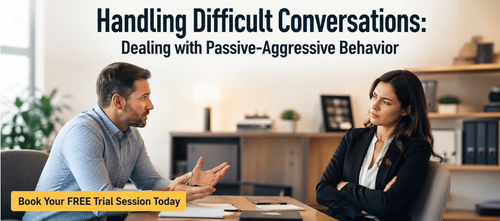

Handling Passive-Confrontational Behavior Professionally Without Escalating Conflict
Passive-aggressive behavior is one of the hardest workplace challenges to address because it rarely arrives as open conflict. It shows up in subtle delays, dismissive comments disguised as jokes, vague feedback, silent treatment, exclusion from conversations, or indirect resistance that creates friction without naming disagreement directly. And that is precisely what makes it so draining. It affects productivity, trust, and confidence while remaining difficult to confront without risking being perceived as “overreacting.”
For many working professionals, this is not an occasional irritation but a recurring workplace reality. Whether it comes from a colleague, manager, client, or team member, passive-aggressive behavior often creates confusion before it creates conflict. You sense something is off, but proving it or responding effectively feels difficult. That is where this guide becomes practical. Rather than offering abstract conflict theories, it gives you a clear playbook to recognize patterns, respond calmly, prepare for difficult conversations, and build healthier communication habits that reduce these dynamics over time.
This resource turns an uncomfortable, often invisible problem into something workable. Through awareness frameworks, conversation scripts, checklists, defensive response strategies, and real-world examples, it helps professionals respond with clarity instead of reaction, and confidence instead of avoidance.
Download these resources and apply them alongside your daily work for improved clarity, productivity, and professional growth. You can also book a free trial to gain expert guidance and enhance your communication, problem-solving, and decision-making skills. The materials are designed in a clear, structured format to help professionals learn efficiently and implement insights with confidence.
Who Is This Blog For?
This blog is valuable for:
- Working professionals managing difficult peer relationships
- Managers handling indirect team conflict
- Consultants navigating resistant clients or stakeholders
- Career changers adapting to unfamiliar workplace dynamics
- Emerging leaders building emotional intelligence and executive presence
- High performers who want to set boundaries without damaging relationships
Why This Topic Matters Today?
Indirect conflict has become more common in modern workplaces, not less.
Hybrid communication, overloaded teams, ambiguous reporting structures, and pressure-driven cultures often increase miscommunication while reducing direct dialogue.
That creates fertile ground for passive-aggressive patterns like:
- Delayed responses after disagreements
- Backhanded compliments framed as feedback
- Exclusion from decision-making loops
- Chronic non-follow-through on shared work
- Subtle undermining in meetings
- Surface-level politeness masking resentment
Why does this matter professionally?
Because these behaviors:
- Drain productivity
- Damage trust quietly
- Increase emotional fatigue
- Slow collaboration
- Undermine leadership credibility
- Create unresolved tension that compounds over time
The guidebook makes an important point:
Passive aggression often thrives through ambiguity and deniability.
That is why many professionals struggle with it.
Not because they lack communication skills.
Because the behavior itself is designed to be difficult to name.
That makes learning how to identify and respond to it a career-critical skill.
Core Concept or Framework Explained
This guidebook uses a practical three-part framework:
Awareness
Application
Mastery
Simple. Useful. High leverage.
Awareness: Recognise and Name the Pattern
You cannot respond effectively to what you have not clearly identified.
The first framework helps distinguish isolated incidents from behavioral patterns.
Signs to watch for include:
- Silent treatment after disagreement
- Chronic lateness or non-delivery
- Weaponized incompetence
- Subtle exclusion
- Contradictory body language
- Public praise with private undermining
- Sarcasm disguised as humor
- Minimal replies communicating disengagement
A major principle in the framework:
Look for frequency, targeting, and impact.
That separates quirks from patterns.
The resource also stresses something many professionals need to hear:
Your discomfort is data.
If something repeatedly feels off, pay attention.
Application: Respond With Structured Communication
Once the pattern is recognized, the framework shifts from diagnosis to response.
The conversation structure follows a practical formula:
- Name the observation
- Share the impact
- Invite dialogue
- Focus on future working norms
This keeps conversations grounded in behavior, not accusation.
Instead of saying:
You are being passive-aggressive.
The framework recommends:
When X happened, the impact was Y. I would like us to work differently going forward.
That changes everything.
Less blame.
More traction.
Mastery: Prevent Recurrence
This guidebook does not stop at managing incidents.
It moves into prevention.
It focuses on building communication habits that reduce indirect conflict before it escalates.
That includes:
- Regular check-ins
- Normalising disagreement
- Addressing early signals quickly
- Reinforcing direct communication when it happens
That is where conflict handling becomes leadership.
How This Blog and Guidebook Help You?
This framework helps professionals:
- Identify passive-aggressive patterns earlier
- Stop second-guessing subtle workplace dynamics
- Prepare for difficult conversations with less anxiety
- Use scripts instead of improvising under pressure
- Respond calmly to defensiveness
- Set boundaries without escalation
- Build healthier long-term communication norms
Career impact can include:
- Better stakeholder relationships
- Stronger conflict navigation skills
- Improved executive communication
- Greater emotional control under pressure
- Higher trust and professional credibility
That is not soft skill territory.
That is career leverage.
Step-by-Step Breakdown
Step 1: Recognise Passive-Aggressive Behavior Clearly
The guidebook highlights a critical distinction:
Name behavior.
Do not diagnose character.
Observe:
- What happened?
- Is there a pattern?
- What was said versus implied?
- What impact did it have?
Document patterns for clarity if needed.
Not for ammunition.
For objectivity.
Step 2: Use a Pre-Conversation Readiness Framework
One of the strongest sections in the resource is preparation.
Before any difficult conversation, run a readiness checklist.
Ask yourself:
- Can I name the specific behavior?
- What impact did it have?
- What outcome do I want?
- Am I addressing a pattern or one incident?
- Am I having this conversation from reaction or intention?
This matters because many professionals either:
- Overreact in the moment
or
- Say nothing and absorb it
Neither works.
Preparation creates a third option.
Strategic response.
Step 3: Use Practical Scripts in the Moment
The guidebook offers strong scenario-based scripts.
Scenario: Sarcastic Comment in a Meeting
Response approach:
- Reference the exact comment
- Describe how it landed
- Invite direct feedback
This surfaces tension without accusation.
Scenario: Silent Treatment After Feedback
Response approach:
- Name the shift in dynamic
- Check whether feedback landed poorly
- Open direct conversation
This often unlocks what avoidance is hiding.
Scenario: Late Deliverables as Indirect Resistance
Response approach:
- Focus on pattern
- Highlight impact on work
- Problem-solve collaboratively
That keeps accountability without blame.
Scenario: Exclusion From Emails or Meetings
Response approach:
- Raise the omission directly
- Ask for context
- Re-establish inclusion expectations
Calm. Direct. Professional.
Step 4: Prepare for Defensiveness
This is where many people lose the conversation.
The guidebook identifies four common responses:
Denial
“That never happened.”
Response:
Stay with observation.
Do not debate memory.
Minimisation
“You’re overthinking this.”
Response:
Acknowledge their perspective.
Maintain impact.
Counter-attack
“What about when you did X?”
Response:
Separate issues.
Stay on current topic.
Non-apology
“Sorry you feel that way.”
Response:
Redirect toward shared agreements for future behavior.
Brilliantly practical.
Because this is usually where real conversations wobble.
Step 5: Learn From the Priya Case Study
The Priya-Rohan case study makes the framework real.
Situation:
Indirect exclusion.
Dismissive comments.
Withdrawal after disagreement.
Instead of reacting emotionally, Priya:
- Documented patterns
- Clarified her objective
- Requested a private conversation
- Used an impact-focused opening
- Stayed calm through deflection
Result:
Not dramatic reconciliation.
Something better.
A workable communication reset.
That is what professionals actually need.
Not movie endings.
Functional outcomes.
Step 6: Build Prevention Habits
The mastery section is gold.
Use:
Regular Check-Ins
Create low-stakes spaces where tension surfaces early.
Model Directness
Show disagreement can be expressed safely.
Name Early Signals
Address withdrawal early.
Do not let patterns harden.
Acknowledge Honest Communication
Reinforce directness when others use it.
That reduces passive aggression at the system level.
Common Mistakes or Pitfalls to Avoid
Mistake 1: Waiting Too Long
Silence compounds tension.
Better:
Address signals before they become patterns.
Mistake 2: Addressing It Publicly
Public confrontation creates shame.
Better:
Always address privately.
Mistake 3: Labelling the Person
“You’re passive-aggressive” kills dialogue.
Better:
Discuss observable behavior.
Mistake 4: Bringing Up Everything at Once
Conflict dumping overwhelms people.
Better:
One issue per conversation.
Mistake 5: Accepting Vague Non-Answers
Polite deflection is not resolution.
Better:
Anchor back to specifics.
Mistake 6: Matching Indirectness With Indirectness
Huge trap.
Passive aggression answered with passive aggression is gasoline.
Better:
Stay explicitly direct.
That protects both outcomes and reputation.
How Should You Use This Guidebook Effectively?
Use it as a practical operating manual.
Suggested workflow:
First read
- Understand awareness, application, mastery model
- Identify one real situation relevant to you
Before a difficult conversation
- Use pre-conversation checklist
- Choose one script to adapt
- Prepare for likely defensiveness
After the conversation
- Reflect on what shifted
- Follow up briefly if appropriate
- Reinforce progress
Suggested time investment
- 20 minutes to study framework
- 10 minutes for readiness checklist
- 15 minutes to rehearse a script before a difficult discussion
High return for very little time.
Use it before tension escalates.
Not after damage compounds.
Key Takeaways
- Passive-aggressive behavior is often subtle but highly disruptive
- Naming patterns clearly is the first professional advantage
- Preparation matters more than reacting in the moment
- Scripts reduce anxiety and improve difficult conversations
- Focus on behavior and impact, not character judgments
- Defensiveness is predictable and manageable
- Directness and calm can coexist
- Small early conversations prevent bigger conflicts later
- Long-term communication habits matter more than one-off interventions
- Handling indirect conflict well is a leadership capability
Your Next Step: Accelerate Your Career with PlanetSpark
Creating an impact-driven resume is not just about landing your next job—it’s about owning your professional story and presenting it with clarity, confidence, and credibility. When your resume clearly communicates value, results, and impact, opportunities follow naturally.
At PlanetSpark, we are committed to empowering working professionals with practical, outcome-focused resources that drive real career growth. From resume building and workplace communication to leadership presence and professional writing, our programs are designed to help you succeed in today’s fast-evolving job market.
Visit https://www.planetspark.in/resources to explore:
- Career and resume-building guides
- Workplace communication and professional writing resources
- Skill-development tools curated for working professionals
Want a deeper, hands-on experience?
You can also book a free trial session to learn more about PlanetSpark’s Working Professional Courses, designed to accelerate your career through personalised coaching, real-world practice, and expert guidance.
Your career deserves more than generic advice.
It deserves clarity, confidence, and measurable impact.
Personalized Communication Roadmaps
Record a video to get a AI generated personalized communication reports