
Handling Emotional Outbursts at Work Without Escalation
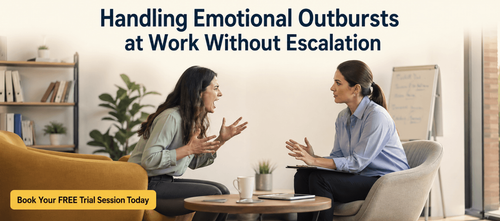

Handling Emotional Reactions at Work Without Escalation A Guide for Professionals
You are in a meeting. A colleague raises their voice unexpectedly. A client sends an aggressive email. A manager reacts sharply under pressure. In these moments, your instinct is immediate—defend yourself, go silent, or respond with equal intensity.
And that is exactly where most professionals go wrong.
The way you respond to emotional outbursts defines your professional reputation far more than your technical skills or presentations. One poorly handled moment can damage trust built over months, while one well-handled response can establish you as a composed, reliable professional.
The challenge is that no one teaches you how to act in these situations. You are told to “stay calm” or “be professional,” but not how to actually do it when emotions are high.
This guide provides a clear, structured framework to help you stay composed, communicate effectively, and de-escalate tension in real time. Instead of reacting emotionally, you learn to lead the situation with clarity and control.
Download these resources and apply them alongside your daily work for improved clarity, productivity, and professional growth. You can also book a free trial to gain expert guidance and enhance your communication, problem-solving, and decision-making skills. The materials are designed in a clear, structured format to help professionals learn efficiently and implement insights with confidence.
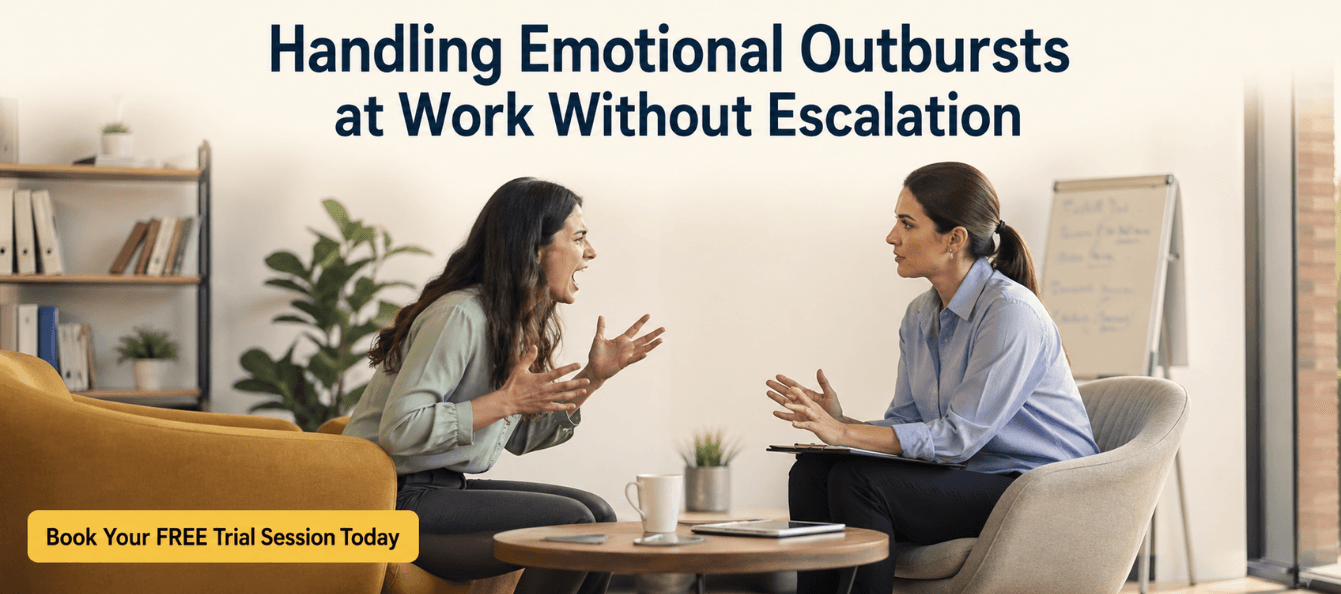
Who Is This Blog For
- Working professionals dealing with difficult colleagues or clients
- Managers handling emotionally charged team situations
- Early-career professionals unsure how to respond under pressure
- Consultants managing high-stakes client interactions
- Team leads responsible for maintaining team stability
- Anyone who wants to communicate effectively in tense situations
Why This Topic Matters Today
Workplace pressure is higher than ever. Deadlines, performance expectations, and constant communication create environments where emotional reactions are common.
However, most professionals are not trained to manage these situations effectively.
Common outcomes include:
- Escalating the situation further
- Freezing and not responding
- Over-apologising unnecessarily
- Avoiding future interactions
These reactions damage relationships, reduce trust, and affect long-term career growth.
Professionals who can handle emotional situations calmly are seen as:
- Reliable under pressure
- Strong communicators
- Leadership-ready
- Trustworthy decision-makers
This makes emotional control a critical professional skill.
Core Concept or Framework Explained
Responding to an emotional outburst is not a single action—it is a sequence.
The framework is built on three phases:
- Regulate
Manage your own emotional state first - Acknowledge
Recognise and validate the other person’s emotion without agreeing - Redirect
Guide the conversation toward a constructive outcome
Most professionals skip the first two phases and jump directly to solving the problem. This leads to escalation because the other person is still in an emotional state.
This framework works because it aligns with how the brain processes emotional stress. When emotions are high, logic does not work until emotional intensity is reduced.
How This Blog and Guidebook Help You
This framework gives you practical control in unpredictable situations.
By applying it, you will:
- Stay calm during emotional interactions
- Reduce escalation and conflict
- Communicate with clarity and authority
- Handle difficult conversations with confidence
- Build a strong professional reputation
Instead of reacting, you begin to lead conversations effectively.
Step-by-Step Breakdown
Step 1: Regulate Your Own State First
Before responding, stabilise yourself.
Key actions:
- Pause for a few seconds
- Slow your breathing
- Avoid immediate reactions
Your emotional state directly influences the outcome. Calm behaviour reduces tension, while reactive behaviour increases it.
Step 2: Avoid Immediate Problem-Solving
The biggest mistake professionals make is trying to fix the issue immediately.
When someone is emotionally charged:
- They are not processing logic
- They are focused on being heard
Trying to solve too early often worsens the situation.
Step 3: Acknowledge the Emotion
This is the most critical step.
Acknowledge what you observe without agreeing or taking blame.
Examples:
- “I can see this situation is frustrating”
- “It sounds like this has been challenging”
This reduces emotional intensity and builds trust.
Step 4: Maintain Neutral Language
Avoid language that:
- Sounds defensive
- Assigns blame
- Invalidates the other person
Use calm, neutral, and clear communication.
Tone matters as much as words.
Step 5: Redirect the Conversation
Once emotions settle, shift the conversation toward solutions.
You can:
- Ask clarifying questions
- Suggest next steps
- Propose a pause if needed
The goal is to move from emotion to clarity.
Step 6: Set Boundaries When Necessary
De-escalation does not mean accepting inappropriate behaviour.
If needed:
- Calmly set limits
- Redirect respectfully
- Pause the conversation
Professional boundaries maintain respect.
Step 7: Reflect After the Interaction
After the situation:
- Review what happened
- Identify what worked
- Adjust for future situations
This builds long-term skill and confidence.
Common Mistakes or Pitfalls to Avoid
- Reacting immediately without pausing
- Matching the other person’s emotional intensity
- Trying to win the argument
- Ignoring emotions and focusing only on logic
- Over-apologising unnecessarily
- Avoiding the situation completely
These mistakes escalate tension and reduce effectiveness.
How Should You Use This Guidebook Effectively
To build this skill:
- Daily
Observe emotional interactions around you - Weekly
Reflect on one situation and your response - Monthly
Identify patterns and improvements
You can also:
- Practise responses in low-stakes situations
- Prepare phrases in advance
- Seek feedback from trusted colleagues
Consistency builds confidence.
Key Takeaways
- Emotional outbursts are common in workplaces
- Your response defines your professional reputation
- De-escalation requires a structured approach
- Regulate yourself before responding
- Acknowledge emotions before solving problems
- Redirect conversations toward clarity
- Boundaries are essential for respect
- Practice improves long-term effectiveness
Your Next Step: Accelerate Your Career with PlanetSpark
Creating an impact-driven resume is not just about landing your next job—it’s about owning your professional story and presenting it with clarity, confidence, and credibility. When your resume clearly communicates value, results, and impact, opportunities follow naturally.
At PlanetSpark, we are committed to empowering working professionals with practical, outcome-focused resources that drive real career growth. From resume building and workplace communication to leadership presence and professional writing, our programs are designed to help you succeed in today’s fast-evolving job market.
Visit https://www.planetspark.in/resources to explore:
- Career and resume-building guides
- Workplace communication and professional writing resources
- Skill-development tools curated for working professionals
Want a deeper, hands-on experience?
You can also book a free trial session to learn more about PlanetSpark’s Working Professional Courses, designed to accelerate your career through personalised coaching, real-world practice, and expert guidance.
Your career deserves more than generic advice.
It deserves clarity, confidence, and measurable impact.
Personalized Communication Roadmaps
Record a video to get a AI generated personalized communication reports