
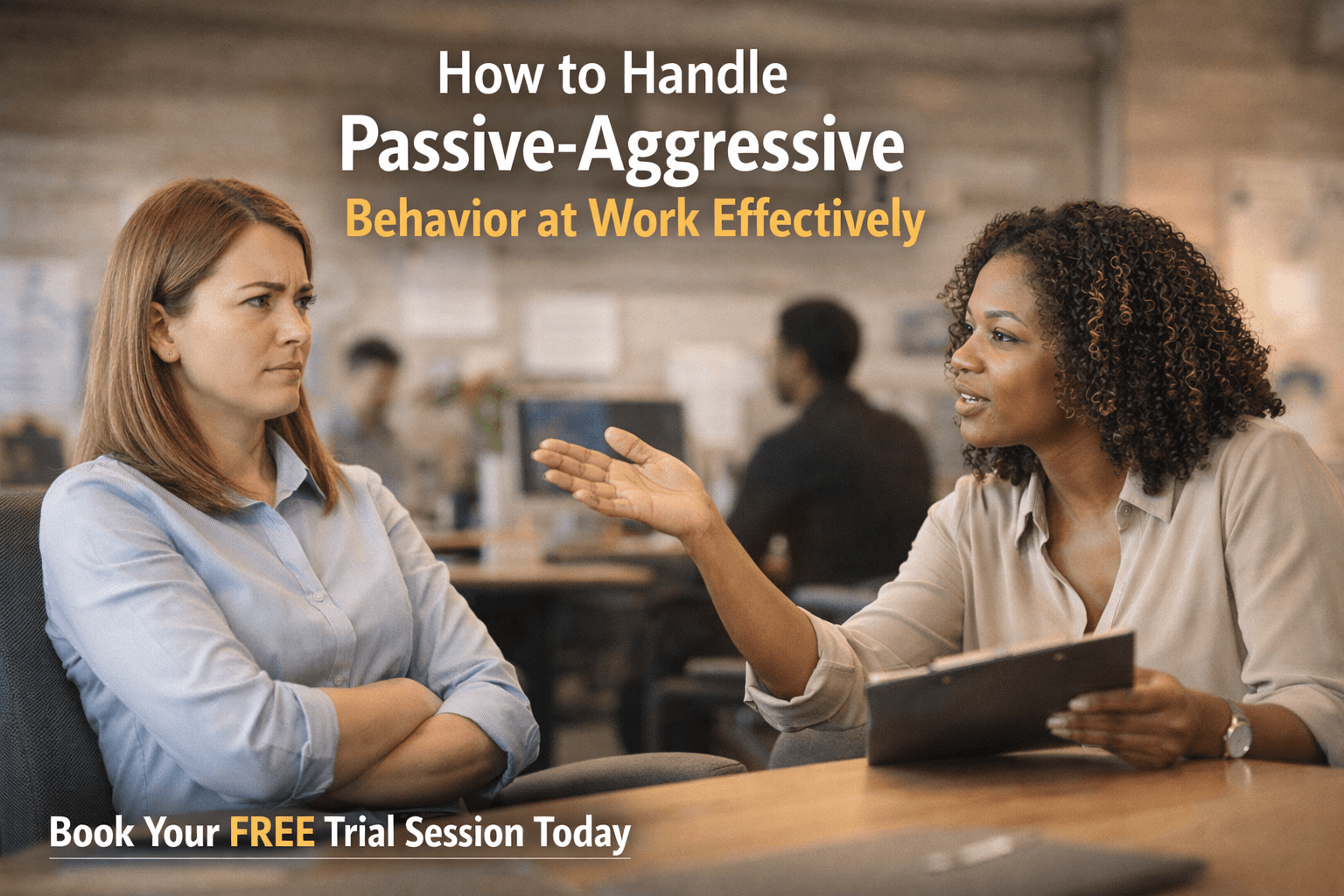
How to Handle Passive-Aggressive Behavior at Work Effectively


A Practical Guide for Professionals to Navigating Subtle Workplace Conflict Effectively
This guide transforms that confusion into clarity. It gives you a structured, practical approach to recognise passive-aggressive patterns, manage your reactions, and respond with professionalism and confidence—without escalating the situation or damaging your credibility.
More importantly, it helps you shift from reacting to responding. Instead of second-guessing intentions or getting pulled into unproductive cycles, you will learn how to identify what is actually happening beneath the surface—whether it is avoidance, misalignment, lack of accountability, or unspoken resistance.
You will also develop the ability to address these situations with calm assertiveness. This includes asking the right questions, setting clear expectations, documenting commitments when needed, and maintaining emotional control even when the behaviour feels personal.
Over time, these skills do more than resolve individual situations—they strengthen your professional presence. You become someone who handles complexity with clarity, communicates with intention, and navigates difficult dynamics without losing composure.
In modern workplaces, technical skills may get you noticed, but it is your ability to handle subtle interpersonal challenges that builds long-term credibility. Mastering how to deal with passive-aggressive behaviour is not just about avoiding frustration—it is about taking control of your work environment, protecting your energy, and showing up as a composed, confident professional in any situation.
Download these resources and apply them alongside your daily work for improved clarity, productivity, and professional growth. You can also book a free trial to gain expert guidance and enhance your communication, problem-solving, and decision-making skills. The materials are designed in a clear, structured format to help professionals learn efficiently and implement insights with confidence.
Who Is This Blog For?
- Working professionals dealing with difficult
colleagues or managers
- Team leaders and managers responsible for team dynamics
- Job seekers navigating workplace communication challenges
- Professionals in cross-functional or high-collaboration roles
- Anyone looking to improve conflict management and emotional intelligence
Why This Topic Matters Today?
Passive-aggressive behaviour is one of the most common yet least addressed workplace challenges. As highlighted in the guidebook, it creates confusion, drains mental energy, and erodes trust without ever being openly acknowledged .
In today’s fast-paced and collaborative work environments, success depends not just on technical skills, but on how effectively you handle communication and conflict.
Key workplace realities include:
- Increased reliance on cross-functional collaboration
- Higher expectations for emotional intelligence and professionalism
- Limited tolerance for visible conflict, leading to indirect communication patterns
When passive aggression goes unaddressed:
- Productivity slows down due to hidden resistance
- Team trust weakens over time
- Professionals experience frustration, self-doubt, and burnout
Handling it effectively is no longer optional—it is a critical professional skill.
Core Concept or Framework Explained
At the heart of this guide is a clear, structured approach to understanding and responding to passive-aggressive behaviour.
Understanding Passive-Aggression
Passive-aggressive behaviour is indirect hostility—where there is a gap between what someone says and what they do . It often appears professional on the surface but creates real disruption underneath.
Common patterns include:
- Missing deadlines after agreeing to them
- Backhanded compliments disguised as praise
- Silence or lack of response during critical collaboration
- Withholding key information
- Playing the victim to avoid accountability
The Awareness–Regulation–Response Model
The guide is built around three core stages:
- Awareness: Recognising patterns clearly instead of second-guessing yourself
- Self-regulation: Managing your emotional response before reacting
- Structured response: Using frameworks to address behaviour professionally
The CALM Framework
A key highlight of the guide is the CALM framework—a practical, repeatable model for handling conversations:
- Clarify the behaviour using observable facts
- Acknowledge the impact on work or outcomes
- Listen to understand the underlying issue
- Move toward a clear agreement
This framework ensures conversations remain professional, focused, and solution-oriented.
How This Blog and Guidebook Help You?
This blog and guidebook provide:
- Clear language to identify passive-aggressive behaviour
- Structured frameworks to respond confidently
- Real-world scripts for difficult conversations
- Practical tools to manage emotional reactions
- Strategies for handling peers, managers, and team dynamics
The outcome is stronger professional credibility, improved communication, and reduced workplace stress.
Step-by-Step Breakdown
Step 1: Recognise the Behaviour Clearly
Before reacting, you must identify what is actually happening.
Ask yourself:
- Is there a gap between words and actions?
- Do I feel confused or responsible without clarity?
- Is this behaviour repeating over time?
The guide also distinguishes between:
- Situational behaviour caused by stress
- Chronic patterns that require structured intervention
This distinction is critical for choosing the right response strategy.
Step 2: Manage Your Reaction First
Your reaction determines whether the situation escalates or resolves.
Use practical techniques from the guide:
- The 90-second rule to pause before reacting
- Naming your emotion internally to regain control
- Depersonalising the behaviour to avoid taking it personally
Self-regulation is not just emotional control—it is a professional advantage.
Step 3: Use the CALM Framework for Conversations
When addressing the issue, follow a structured approach:
- Clarify: Describe the behaviour without assumptions
- Acknowledge: Explain the impact on work
- Listen: Ask open-ended questions
- Move: Agree on next steps
This approach keeps the conversation focused on outcomes rather than emotions.
Step 4: Use Ready-to-Handle Scripts
In real situations, knowing what to say matters.
Examples include:
- Addressing sarcastic comments calmly
- Handling repeated missed deadlines with clarity
- Re-engaging unresponsive colleagues through structured communication
These scripts help you stay composed and avoid escalation traps.
Step 5: Prepare Before Difficult Conversations
Before addressing the issue:
- Identify specific behaviours
- Define the impact clearly
- Regulate your emotions
- Choose a private setting
- Decide the outcome you want
Preparation increases the likelihood of a productive conversation.
Step 6: Adapt Your Approach Based on Context
Different situations require different strategies.
When dealing with a manager:
- Create written documentation of expectations
- Ask clarifying questions to reduce ambiguity
- Build strong peer relationships for support When dealing with peers:
- Reduce dependency where possible
- Use neutral language to reset conversations
- Involve a third party if needed
When you are a manager:
- Create a culture of direct communication
- Address issues privately, not publicly
- Set clear expectations and accountability
Step 7: Document Patterns When Necessary
For repeated behaviour, documentation becomes essential.
Track:
- Specific incidents and dates
- Observable behaviour
- Impact on work
- Your response
Documentation provides clarity and professional protection if escalation is required.
Step 8: Set and Maintain Boundaries
Clear boundaries reduce repeated issues.
Effective boundaries include:
- Clearly stating expectations
- Linking behaviour to outcomes
- Following through consistently
Boundaries are not aggressive—they are necessary for professional effectiveness.
Step 9: Learn from Real-World Application
The guide includes a case study where structured communication transformed a difficult collaboration.
Key lesson:
When behaviour is named clearly and professionally, the dynamic begins to change.
Step 10: Reflect on Your Own Behaviour
An often-overlooked step is self-awareness.
Ask yourself:
- Do I avoid direct conversations?
- Do I use sarcasm instead of clarity?
- Do I delay tasks due to resentment?
Improving your own communication strengthens your ability to handle others effectively.
Common Mistakes or Pitfalls to Avoid
Many professionals unintentionally worsen the situation.
Common mistakes include:
- Responding with passive-aggressive behaviour
- Over-explaining or defending excessively
- Addressing issues publicly instead of privately
- Labelling the person instead of the behaviour
- Ignoring the issue and hoping it resolves itself
A better approach is:
- Stay direct and professional
- Focus on behaviour, not personality
- Address issues early and calmly
How Should You Use This Guidebook Effectively?
To get maximum value:
- Read the guide fully to understand the framework
- Use it as a reference during real situations
- Apply worksheets and scripts immediately
Suggested workflow:
- Identify a real situation
- Use the Trigger Map to reflect
- Apply the CALM framework in one conversation
- Document outcomes and adjust approach
Time investment:
- 10–15 minutes for preparation
- 1 structured conversation
- Continuous improvement through practice
Consistency is key—progress happens through repeated application.
Key Takeaways
- Passive-aggressive behaviour is indirect and often difficult to identify
- Awareness is the first step to effective response
- Emotional regulation prevents escalation and builds credibility
- The CALM framework provides a structured way to handle conversations
- Documentation is essential for recurring patterns
- Boundaries create clarity and accountability
- Direct, professional communication always outperforms indirect responses
- Self-awareness strengthens your overall communication effectiveness
Your Next Step: Accelerate Your Career with PlanetSpark
Creating an impact-driven resume is not just about landing your next job—it’s about owning your professional story and presenting it with clarity, confidence, and credibility. When your resume clearly communicates value, results, and impact, opportunities follow naturally.
At PlanetSpark, we are committed to empowering working professionals with practical, outcome-focused resources that drive real career growth. From resume building and workplace communication to leadership presence and professional writing, our programs are designed to help you succeed in today’s fast-evolving job market.
Visit https://www.planetspark.in/resources to explore:
- Career and resume-building guides
- Workplace communication and professional writing resources
- Skill-development tools curated for working professionals
Want a deeper, hands-on experience?
You can also book a free trial session to learn more about PlanetSpark’s Working Professional Courses, designed to accelerate your career through personalised coaching, real-world practice, and expert guidance.
Your career deserves more than generic advice.
It deserves clarity, confidence, and measurable impact.
Start building that advantage today—with PlanetSpark.
Personalized Communication Roadmaps
Record a video to get a AI generated personalized communication reports