
How to Track Deep Work vs Shallow Work for Better Output
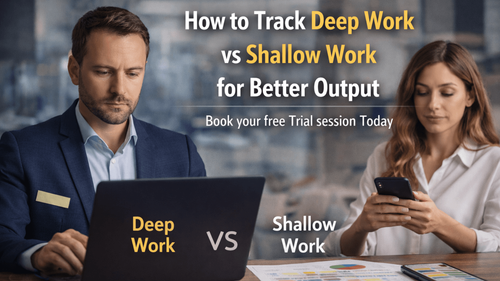

Step-by-Step Guide to Measuring Deep Work and Reducing Shallow Tasks
Most professionals end their workday feeling exhausted—but not accomplished. Calendars are full, inboxes are overflowing, and yet meaningful progress feels minimal. The problem is not a lack of effort. It is a lack of focus on the right kind of work.
Research consistently shows that less than three hours of an average workday are spent on cognitively demanding tasks. The rest is consumed by emails, meetings, and reactive work that creates the illusion of productivity without delivering real value.
This is where tracking deep work versus shallow work becomes a game-changer. Instead of guessing where your time goes, you start measuring it. Instead of staying busy, you start becoming effective. This blog breaks down a practical system to help you track, protect, and expand your deep work hours—so you can produce better results in less time and accelerate your career growth.
The first step is awareness. For one week, track your workday in simple categories: deep work (focused, high-value tasks), shallow work (emails, coordination, admin), and distractions. You don’t need a complex tool—just a notebook or a time-tracking app. This exercise often reveals a hard truth: most of your energy is spent reacting, not creating. Awareness creates the foundation for change.
Once you see where your time actually goes, you can start redesigning your day. Block specific hours for deep work, ideally when your energy is highest, and treat them as non-negotiable. Reduce or batch shallow tasks into defined windows. Over time, this intentional structure helps you reclaim focus, produce higher-quality work, and end your days not just tired—but truly accomplished.
Book your free trial session today with Planetspark.
Download for more details or PDF file.
Who Is This Blog For?
- Working professionals struggling with constant busyness but low output
- Managers and team leaders aiming to improve team productivity
- Consultants and freelancers who want to maximise billable impact
- Career switchers building new skills under time constraints
- Early to mid-career professionals seeking faster growth and clarity
Why This Topic Matters Today?
Modern workplaces are designed for activity, not impact. Notifications, meetings, and constant communication have created an environment where shallow work dominates the day.
The result?
- Professionals feel busy but not productive
- Deep thinking and high-value output get pushed aside
- Career growth slows despite long working hours
The guidebook highlights a critical insight: most professionals operate at just 10–25% deep work capacity. In contrast, high performers consistently achieve 40–60% or more.
The difference is not intelligence or effort—it is how time is allocated. Tracking deep work gives you visibility, and visibility gives you control.
Core Concept or Framework Explained
At the heart of this system is a simple but powerful distinction between two types of work: deep work and shallow work.
Deep work refers to cognitively demanding tasks performed with full concentration. These tasks create real value and are difficult to replicate. Examples include writing strategy documents, analysing data, building systems, or learning complex skills.
Shallow work includes logistical and administrative tasks that keep operations running but rarely create significant value. Examples include responding to emails, attending routine meetings, and scheduling tasks.
To simplify decision-making, the guidebook introduces the 1-Minute Test:
If a reasonably intelligent person can learn to do the task in two weeks, it is shallow work. If it requires months or years of expertise, it is deep work.
The central metric that drives this framework is the Deep Work Ratio:
Percentage of your total working hours spent in deep work
This single metric becomes your most important productivity indicator.
How This Blog and Guidebook Help You?
This system helps you move from reactive work patterns to intentional productivity by enabling you to:
- Identify where your time is actually going
- Measure and improve your focus capacity
- Reduce time wasted on low-value activities
- Protect your most productive hours
- Increase output quality without increasing working hours
The result is not just better productivity—it is better career outcomes through high-impact work.
Step-by-Step Breakdown
Step 1: Audit Your Current Work Mix
The first step is awareness. You cannot improve what you do not measure.
Start by tracking your work for at least five full working days. Create a simple log with:
- Time
- Task name
- Category (Deep or Shallow)
- Notes
Log your activities every 30 minutes in real time. Avoid reconstructing your day later, as memory often overestimates productivity.
At the end of the week, calculate your Deep Work Ratio:
Deep Work Hours ÷ Total Working Hours × 100
Most professionals are surprised by how low their ratio actually is. This baseline becomes your starting point for improvement.
Step 2: Build Your Deep Work Tracking System
Once you have your baseline, the next step is to create a system that you can sustain daily.
Start simple:
- Choose a tracking method such as a notebook, spreadsheet, or tracking app
- Set a daily deep work target
- Record planned vs actual deep work hours
- Track your progress visually using a chart or habit tracker
Set realistic weekly goals. If your current ratio is 20%, aim for 25% in the first phase. Gradual improvement builds consistency and prevents burnout.
Step 3: Use the Deep Work Ratio Dashboard
To fully understand your productivity, track these key metrics weekly:
- Deep Work Ratio percentage
- Total deep work hours per day
- Number of interruptions per session
- Average session length
- Best performing hours of the day
This dashboard gives you a complete view of not just how much you work, but how well you work.
Step 4: Protect Your Deep Work Time
Tracking alone is not enough. You must actively protect your deep work hours using a three-layer system:
Structural protection
- Schedule deep work blocks in advance
- Treat them like non-negotiable meetings
Environmental protection
- Eliminate distractions
- Silence notifications and create a focused workspace
Social protection
- Communicate your availability to colleagues
- Set clear expectations for response times
These systems reduce interruptions and create consistent focus.
Step 5: Identify Your Peak Energy Window
Not all hours are equally productive. Your cognitive energy fluctuates throughout the day.
Track your energy levels using a simple scale from 1 to 5 across two weeks. Identify the 2–3 hour window where your energy is consistently highest.
Use this window exclusively for deep work. Assign shallow tasks to low-energy periods.
Step 6: Apply the Shallow Work Elimination Framework
To create more space for deep work, reduce shallow work using four key levers:
- Eliminate unnecessary tasks
- Delegate tasks that do not require your expertise
- Batch similar tasks like emails into fixed time slots
- Automate repetitive processes
This step can reduce shallow work by up to 30–50%, freeing significant time for high-value work.
Step 7: Follow the 90-Day Transformation Roadmap
Deep work is not built overnight. Follow a structured timeline:
- Days 1–7: Audit your current work patterns
- Days 8–14: Analyse and identify improvements
- Days 15–30: Build your tracking system
- Days 31–60: Strengthen habits and consistency
- Days 61–90: Fully integrate deep work into your routine
Consistency over 90 days leads to lasting transformation.
Common Mistakes or Pitfalls to Avoid
- Tracking work at the end of the day instead of in real time
- Misclassifying shallow tasks as deep work
- Starting deep work sessions without clear output goals
- Trying to increase deep work hours too quickly
- Ignoring interruptions during focus sessions
- Skipping weekly reviews and reflection
- Focusing on hours instead of output quality
Avoiding these mistakes ensures your system remains effective and sustainable.
How Should You Use This Guidebook Effectively?
To get the best results, follow a structured approach:
- Read the guidebook fully to understand the system
- Start tracking your time immediately
- Use worksheets and templates for consistency
- Spend 10–15 minutes weekly reviewing your progress
- Conduct a monthly evaluation to refine your system
A focused investment of 2–3 hours initially can create long-term productivity gains.
Key Takeaways
- Measure your work before trying to improve it
- Focus on increasing your Deep Work Ratio
- Protect your time using structured systems
- Identify and use your peak energy hours
- Reduce shallow work through elimination and automation
- Build habits gradually over a 90-day period
- Prioritise output quality over hours worked
Your Next Step: Accelerate Your Career with PlanetSpark
Creating an impact-driven resume is not just about landing your next job—it’s about owning your professional story and presenting it with clarity, confidence, and credibility. When your resume clearly communicates value, results, and impact, opportunities follow naturally.
At PlanetSpark, we are committed to empowering working professionals with practical, outcome-focused resources that drive real career growth. From resume building and workplace communication to leadership presence and professional writing, our programs are designed to help you succeed in today’s fast-evolving job market.
Visit https://www.planetspark.in/resources to explore:
- Career and resume-building guides
- Workplace communication and professional writing resources
- Skill-development tools curated for working professionals
Want a deeper, hands-on experience?
You can also book a free trial session to learn more about PlanetSpark’s Working Professional Courses, designed to accelerate your career through personalised coaching, real-world practice, and expert guidance.
Your career deserves more than generic advice.
It deserves clarity, confidence, and measurable impact.
Start building that advantage today—with PlanetSpark.
Personalized Communication Roadmaps
Record a video to get a AI generated personalized communication reports