
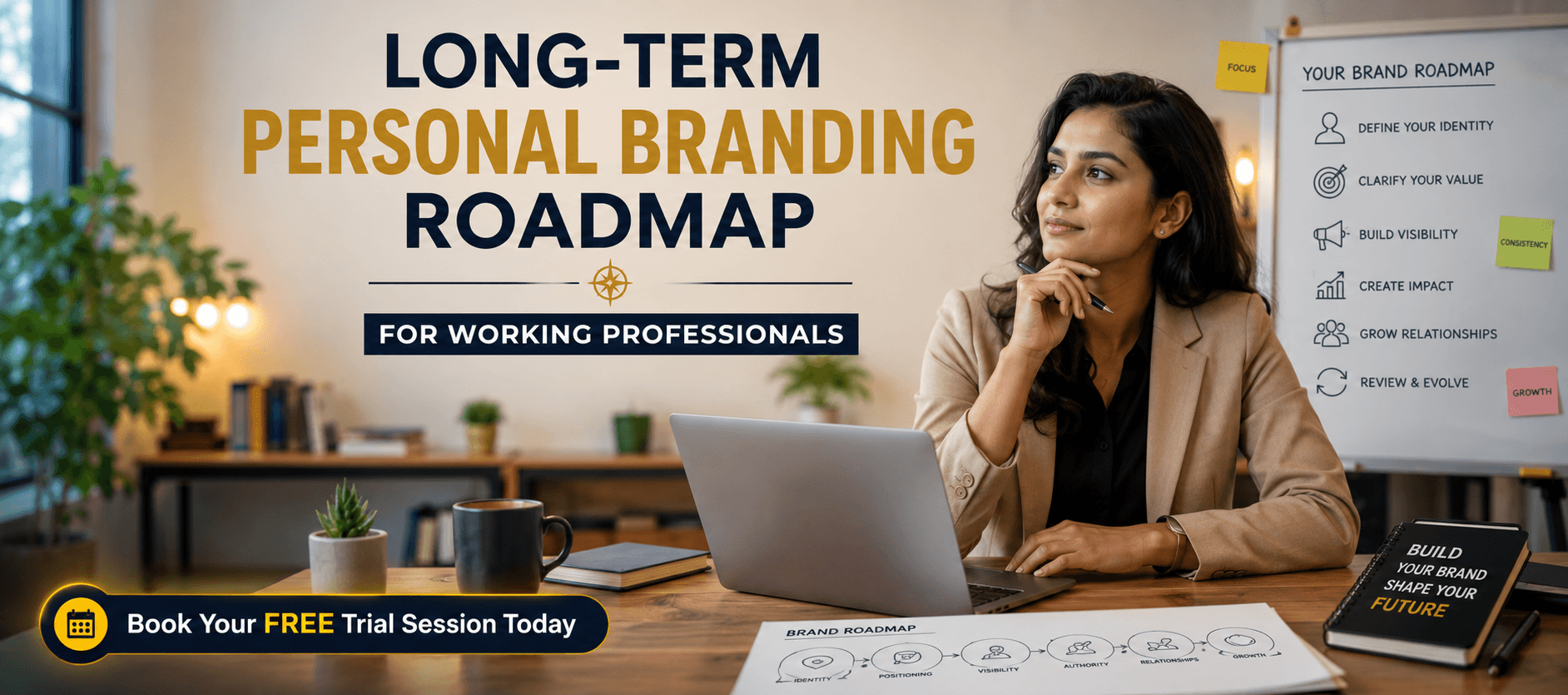
Long-Term Personal Branding Roadmap for Working Professionals


Build a Long-Term Personal Branding Strategy for Career Growth, Visibility, and Professional Authority
Most professionals know they need a stronger personal brand, but few build it with a clear strategy. They update their LinkedIn profile only when they start job hunting, write a bio only when someone requests it, or post content without knowing who they are trying to influence. The result is a scattered professional identity that does not fully reflect their expertise, values, or career goals.
In today’s workplace, your personal brand is often evaluated before you enter the room. Hiring managers search your name before interviews. Clients review your LinkedIn profile before responding to proposals. Industry peers decide whether to connect, recommend, invite, or refer you based on the signals you consistently put into the world. If those signals are unclear, outdated, or inconsistent, your opportunities may be limited even when your skills are strong.
The guidebook, How to Build a Long-Term Personal Branding Strategy, offers a practical roadmap for working professionals who want to define, build, and sustain a powerful brand over time. Instead of treating personal branding as a one-time profile update, it turns the process into a structured system built around identity, positioning, visibility, relationships, thought leadership, and periodic review.
Download these resources and apply them alongside your daily work for improved clarity, productivity, and professional growth. You can also book a free trial to gain expert guidance and enhance your communication, problem-solving, and decision-making skills. The materials are designed in a clear, structured format to help professionals learn efficiently and implement insights with confidence.
Who Is This Blog For?
This blog is designed for professionals who want their expertise to be noticed, understood, and trusted by the right audience.
- Job seekers who want to improve how hiring managers perceive them online and offline
- Career switchers who need to reposition their experience for a new role, function, or industry
- Consultants who want to build authority and attract better-fit clients
- Freelancers who need a sharper brand to increase trust and conversions
- Managers and leaders who want stronger visibility within their organisation or industry
- Working professionals who feel their current LinkedIn profile, bio, or public presence does not reflect their real capabilities
- Professionals starting from scratch who need a clear personal branding roadmap
- Mid-career professionals who want to move from being competent contributors to recognised experts
Why This Topic Matters Today?
Personal branding matters today because professional visibility is no longer limited to resumes, interviews, or annual reviews. Your reputation is shaped across LinkedIn, search results, content, referrals, conversations, communities, speaking opportunities, and how consistently others can describe your value.
The guidebook highlights a major problem: many talented professionals remain invisible because they treat personal branding reactively. They wait for a job loss, a career transition, or a client need before clarifying their positioning. By then, they are trying to build credibility under pressure.
A long-term personal branding strategy solves this problem by helping you answer four important questions:
- Who are you professionally?
- What do you stand for?
- Who do you serve or want to influence?
- How do you show up consistently across platforms and relationships?
This matters because unclear branding creates missed opportunities. If your LinkedIn headline says one thing, your bio says another, and your content has no consistent audience, people struggle to understand what you do and why it matters. The guidebook also warns against defining your brand only around your job title. A job title can change, but your expertise, values, proof points, and professional impact create a more durable identity.
Core Concept or Framework Explained
The core idea of the guidebook is simple: personal branding is not a one-time project. It is an ongoing professional practice.
The resource presents 10 templates that work together as a complete personal branding system. Each template addresses a specific scenario, from starting with a brand identity audit to reviewing your brand annually. The system follows a logical sequence: first clarify your identity, then define your positioning, then optimise your digital presence, build authority through content, strengthen relationships, amplify visibility, and review progress regularly.
The guidebook is built on three foundational principles.
Clarity Before Visibility
Before publishing content, pitching yourself, or redesigning your LinkedIn profile, you need to know who you are and who you serve. The guidebook recommends starting with the Brand Identity Audit and Brand Positioning Statement Builder before moving into visibility work. This prevents random activity and helps every action connect to a strategic goal.
Consistency Compounds
A consistent brand across multiple touchpoints is more powerful than one impressive post or one polished profile. Your LinkedIn profile, bio, email signature, networking introduction, content, portfolio, and speaking bio should all point to the same professional identity. When people repeatedly receive the same brand signals, trust builds faster.
Evidence Over Claims
The guidebook repeatedly emphasises proof. Strong personal brands do not rely on vague adjectives like strategic, creative, or hardworking. They use evidence such as outcomes, metrics, case studies, testimonials, speaking credentials, published work, and measurable achievements. A stronger brand replaces claims with proof.
How This Blog and Guidebook Help You?
This blog helps you understand the guidebook as a complete career growth tool rather than a collection of disconnected templates. By following the roadmap, you can move from uncertainty to clarity and from scattered visibility to intentional professional authority.
The guidebook helps you:
- Identify your authentic professional identity before building a public brand
- Create a clear positioning statement that explains who you help and how
- Optimise your LinkedIn profile around your goals, not just your job history
- Plan 90 days of thought leadership content aligned to your niche
- Reframe past experience during a career transition
- Build relationship capital through strategic networking
- Audit your online and offline visibility
- Track speaking, podcast, panel, and media opportunities
- Review your brand annually and recalibrate for the next stage
- Evaluate how clients or employers currently perceive your brand
The biggest benefit is direction. Instead of guessing what to update, post, rewrite, or pitch, you can work through a structured process that turns personal branding into a repeatable professional habit.
Step-by-Step Breakdown
Step 1: Start With a Brand Identity Audit
The Brand Identity Audit is the foundation of the entire strategy. It is designed for professionals starting from scratch or rebuilding after a major career shift. Before you decide how you want to appear to others, you need to understand your professional values, strengths, current perception, and future goals.
The template asks you to define your full name, current role, industry, years of experience, and primary career goal for the next three years. This ensures your brand is connected to a real professional direction.
Next, it pushes you to identify five professional values that genuinely drive your decisions. The guidebook gives examples such as intellectual honesty, systems thinking, and continuous learning. These values are important because they prevent your brand from becoming generic. A strong personal brand is not only about what you do; it is also about how you think, decide, communicate, and solve problems.
The template also includes a professional strengths inventory. You list your top five skills and support each one with proof. For example, instead of saying you are good at data storytelling, you might show that you reduced reporting time by 40 percent using dashboards. This shifts your brand from opinion to evidence.
Finally, the audit asks how colleagues currently describe you, what people ask you for help with, what you want to be known for, and where the gap lies between current perception and desired perception. That gap becomes your main strategic focus for the next 90 days.
Step 2: Build a Clear Brand Positioning Statement
Once you understand your identity, the next step is positioning. The Brand Positioning Statement Builder is for professionals who struggle to answer, “So, what do you do?” in a clear and memorable way.
The guidebook uses a four-part sequence:
- Target audience
- Unique value
- Proof points
- Positioning
First, you define who you want to serve, impress, or attract. This could be startup founders, hiring managers, clients, industry leaders, or internal decision-makers. The more specific the audience, the stronger the positioning.
Second, you define what you do differently from others in your space. This is where your method, perspective, or professional edge becomes visible. For example, the guidebook gives the idea of combining product-led growth principles with traditional B2B demand generation.
Third, you list three concrete achievements that validate your positioning. Numbers are preferred because they make your brand more credible. Examples include launching products from zero to revenue, building a team from scratch, or speaking at a major conference.
Finally, you create a concise positioning statement using the formula:
I help target audience achieve desired outcome by unique method or approach, unlike others who common alternative or limitation.
The guidebook recommends testing this statement with three people from your target audience and asking whether it makes them want to know more. If the answer is yes, you are ready to deploy it across LinkedIn, your bio, elevator pitch, and networking conversations.
Step 3: Optimise Your LinkedIn Profile Around Your Brand
LinkedIn is one of the most important personal branding platforms for working professionals. The LinkedIn Profile Optimisation Roadmap helps you align your profile with your positioning and desired opportunities.
The roadmap begins with your profile header. Your headline should not simply state your job title. It should communicate your expertise, audience, and impact. For example, instead of a generic title, the guidebook suggests a brand-aligned headline such as “Product Leader | Scaling EdTech platforms from MVP to 1M users | Ex-Google | Speaker.”
Your profile photo, banner, location, and contact information should also support your goals. A custom banner can reinforce your niche, while accurate contact details make it easier for the right people to reach you.
The About section follows a four-part blueprint:
- Opening hook
- Who you help and how
- Proof points
- Call to action
The guidebook encourages a bold opening line that immediately signals expertise. The rest of the section should explain your audience, your method, measurable results, and how people can engage with you.
Your Experience section should also move beyond duties. Each role description should reinforce your current brand narrative by showing impact, trajectory, and transferable strengths. Even older roles should connect to the foundation of your current expertise.
Step 4: Build Authority With Thought Leadership Content
The Thought Leadership Content Planner is designed for consultants, managers, and freelancers who want to become known for a specific area of expertise. It provides a 90-day content planning structure.
The first step is defining your content strategy foundation. You identify your brand niche, target audience, content goal, primary platform, secondary platforms, and content pillars. Content pillars are recurring themes that keep your messaging focused. Examples in the guidebook include leadership psychology insights, practical team performance frameworks, personal stories from consulting engagements, and research breakdowns.
The 90-day calendar helps you plan core posts, engagement activities, formats, and publishing status. For example, one week may include a LinkedIn post on signs of a trust deficit in startup teams, while the engagement activity may involve commenting on founder posts with value-added insights.
The content quality rule is especially important: every piece of content should make your target audience smarter, more confident, or better equipped. If it does not, it should be revised before publishing. This keeps your brand focused on value rather than vanity metrics.
Step 5: Reframe Your Brand During a Career Transition
Career transitions require careful brand management. The Career Transition Brand Pivot Roadmap helps professionals switching industries, roles, or career tracks reposition themselves without starting from zero.
The template begins with your transition context: previous role, target role, reason for transition, and timeline. The key is to create a brand narrative that explains the move with confidence and intention.
The transferable skills mapper helps you translate past experience into the language of the new field. For example, contract negotiation can become vendor and SaaS agreement structuring for startup operations. Risk assessment can become regulatory risk mapping for product launches.
The brand language pivot guide then helps you update outdated descriptions. Instead of saying “litigation attorney with 8 years in financial services,” the guidebook suggests a more future-facing description such as “legal strategist helping early-stage tech companies navigate complexity at speed.”
The roadmap also includes 30, 60, and 90-day actions. In the first 30 days, you update your LinkedIn profile, rewrite your bio, identify target companies, and join relevant communities. In the next 30 days, you publish content and attend an industry event. By days 61 to 90, you seek projects, advisory roles, or freelance engagements to create new proof points.
Step 6: Build Relationship Capital Through Networking
The Networking and Relationship Capital Tracker reminds professionals that personal brand is not only what you publish. It is also how you show up in relationships.
The template starts by asking what you want your network to know you for and what opportunities your network should send your way. These could include speaking invitations, advisory roles, referrals, or consulting projects.
It then asks you to set quarterly networking targets, such as new meaningful connections, re-engagement with dormant contacts, and events or communities to join.
The strategic relationship tracker helps you manage important connections by name, relationship tier, last touchpoint, next action, and brand opportunity. This turns networking into a deliberate relationship-building system rather than random outreach.
The relationship capital rule is powerful: your network should know what you are working on, what you are looking for, and how to introduce you without prompting. If people cannot describe your brand accurately, the issue is not only networking. It is a brand communication gap.
Step 7: Audit Your Personal Brand Visibility
The Personal Brand Visibility Audit helps professionals assess whether their current presence is working. It covers both digital and offline visibility.
The digital audit includes channels such as LinkedIn, personal website or portfolio, Twitter or X, industry newsletter or blog, podcast or YouTube, and Google search results for your name. Each channel receives a status, brand alignment score, and priority action.
The offline visibility audit includes speaking appearances, industry association involvement, internal visibility, referral network strength, and published work or bylines.
The goal is not to be everywhere. The goal is to identify the biggest visibility gap and choose the top three priority actions for the next 30 days. For example, if you are known only within your immediate network, your next action may be to publish articles, update your LinkedIn About section, or pursue speaking opportunities.
Step 8: Track Speaking and Media Opportunities
The Speaking and Media Opportunity Tracker is for professionals ready to amplify their brand through public speaking, podcasts, media features, or panel discussions.
The template asks you to define your speaking or media niche, target audience, 100-word speaker bio, signature talk title, available talk formats, and media kit status. This prepares you to pitch opportunities professionally.
The opportunity pipeline tracker helps you monitor each opportunity by name, type, status, pitch date, and brand value. For example, a summit may offer access to 500 HR leaders, while a podcast may reach 10,000 monthly listeners in your niche.
The post-appearance checklist ensures you maximise every opportunity. You should share the recording, add it to your LinkedIn Featured section, request a testimonial, write a follow-up article, update your speaker bio, and reach out to engaged audience members.
Step 9: Review and Recalibrate Your Brand Every Year
The Annual Brand Review and Recalibration Planner helps prevent brand drift. A brand that is not reviewed can slowly become outdated as your goals, audience, expertise, and opportunities change.
The template tracks year-over-year metrics such as inbound opportunities, LinkedIn follower growth, published content, speaking appearances, referrals, and brand-related revenue or career impact.
It also asks you to identify your top three brand wins, assess whether your audience has changed, evaluate whether your expertise has evolved, and decide whether your positioning statement still works.
The final section sets brand goals for the next 12 months, with measurable targets and key actions. This could include growing a thought leadership platform, expanding offline visibility, increasing referrals, or improving conversion from clients and employers.
Step 10: Measure How Clients and Employers Perceive You
The Client and Employer Brand Impression Scorecard helps freelancers and job seekers evaluate how their brand is landing with decision-makers.
You begin by defining your target audience, the impression you want to create, the impression you think you are currently creating, and the gap between the two.
Then you score key brand signals from 1 to 5, including LinkedIn headline clarity, About section, portfolio quality, written communication, social proof, consistency across touchpoints, responsiveness, and thought leadership presence. The total score shows whether your brand is strong, developing, or in need of a rebuild.
The guidebook’s critical rule is clear: do not try to improve all scores at once. Fix your lowest two areas completely before moving to the next. Brand improvement is sequential, not simultaneous.
Common Mistakes or Pitfalls to Avoid
The guidebook identifies several common mistakes that weaken personal branding.
Defining your brand around your job title
A job title is not a complete brand. It may describe your current position, but it does not explain your expertise, values, audience, or impact. A stronger brand communicates what you help people achieve and what makes your approach distinctive.
Posting content without a clear audience
Content without positioning often becomes random. If you do not know who you are speaking to, your content will struggle to create authority or opportunity. Define your target audience before building a content calendar.
Using inconsistent messaging across platforms
If your LinkedIn profile, bio, portfolio, and networking introduction all say different things, people receive mixed signals. Consistency helps others understand and remember your value.
Treating personal branding as a one-time project
A personal brand evolves as your career evolves. The guidebook recommends reviewing and recalibrating your brand every 6 to 12 months.
Skipping the self-audit
Many professionals jump straight into visibility without understanding their identity. This creates shallow branding. Start with values, strengths, perception, and goals.
Ignoring proof points
Claims without evidence do not build trust. Use metrics, case studies, testimonials, outcomes, speaking credentials, and published work wherever possible.
Trying to improve everything at once
The guidebook recommends focusing on the most important gaps first. This makes brand improvement manageable and measurable.
How Should You Use This Guidebook Effectively?
To use the guidebook effectively, start with Template 1, the Brand Identity Audit. Even if you already have a LinkedIn profile or some online presence, this audit gives you the foundation for every other decision.
Then move to Template 2, the Brand Positioning Statement Builder. Spend around 30 minutes defining your audience, unique value, proof points, and positioning statement. Once this is clear, use it to update your LinkedIn headline, About section, bio, portfolio, email introduction, and networking pitch.
After that, choose your path based on your current situation:
- Building from scratch: Use Templates 1, 2, 3, and 7
- Switching careers or industries: Use Templates 1, 5, 3, and 4
- Freelancer seeking clients: Use Templates 2, 10, 6, and 8
- Mid-career professional building authority: Use Templates 4, 8, 6, and 9
- Job seeker improving brand impact: Use Templates 10, 3, 7, and 1
- Annual strategic review: Use Template 9 and revisit all others
A practical workflow would be to complete one template per week. This gives you enough time to reflect, gather proof points, rewrite assets, test messaging, and take action. If you are preparing for a job search, client outreach, or career transition, you can complete the first three templates over a weekend and then refine them over the next 30 days.
For best results, schedule a quarterly visibility audit and an annual brand review. This ensures your brand stays aligned with your goals instead of becoming outdated.
Key Takeaways
- Personal branding is not a one-time update; it is an ongoing professional strategy
- Start with identity before visibility so your brand is rooted in clarity
- Define your audience before creating content, rewriting your bio, or pitching opportunities
- Use proof points, metrics, and outcomes to make your brand credible
- Align your LinkedIn profile, bio, portfolio, and networking introduction around the same positioning
- Build thought leadership through consistent, audience-focused content
- Use career transitions as opportunities to reframe your existing strengths
- Strengthen relationship capital so your network can describe and refer you accurately
- Audit both online and offline visibility to identify the highest-impact gaps
- Review your brand every 6 to 12 months so it evolves with your career
Your Next Step: Accelerate Your Career with PlanetSpark
Creating an impact-driven resume is not just about landing your next job—it’s about owning your professional story and presenting it with clarity, confidence, and credibility. When your resume clearly communicates value, results, and impact, opportunities follow naturally.
At PlanetSpark, we are committed to empowering working professionals with practical, outcome-focused resources that drive real career growth. From resume building and workplace communication to leadership presence and professional writing, our programs are designed to help you succeed in today’s fast-evolving job market.
Visit https://www.planetspark.in/resources to explore:
- Career and resume-building guides
- Workplace communication and professional writing resources
- Skill-development tools curated for working professionals
Want a deeper, hands-on experience?
You can also book a free trial session to learn more about PlanetSpark’s Working Professional Courses, designed to accelerate your career through personalised coaching, real-world practice, and expert guidance.
Your career deserves more than generic advice.
It deserves clarity, confidence, and measurable impact.
Personalized Communication Roadmaps
Record a video to get a AI generated personalized communication reports