
Managing Emotional Reactions at Work: Practical 2026 Guide
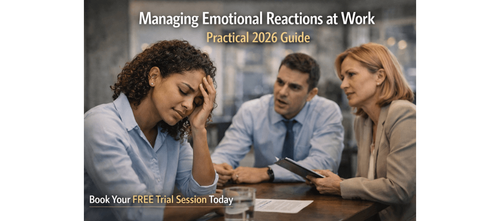

Managing Emotional Reactions at Work: The Complete Step-by-Step Guide to Stay Composed, Credible, and in Control
In today’s professional world, your success is not just determined by what you know—it is shaped by how you respond under pressure. You can be highly skilled, experienced, and reliable, but a single emotional reaction in the wrong moment can overshadow all of it.
Picture this: you’re in a meeting, and your idea is dismissed publicly. In a split second, your body reacts—tight jaw, racing thoughts, rising frustration. You either snap back defensively or shut down completely. Later, you replay the moment, wishing you had handled it differently.
This is not a rare situation. It is a daily reality for professionals across industries.
Emotional reactions are one of the most under-recognised career limiters. They impact how others perceive your credibility, your leadership potential, and your ability to handle responsibility. Yet most professionals are told to “stay calm” without ever being taught how to actually do it.
This is exactly where a structured emotional regulation framework makes a difference. Instead of relying on willpower in high-stakes moments, you can use proven techniques to pause, assess, and respond with intention—turning challenging situations into opportunities to strengthen your professional presence.
Download these resources and apply them alongside your daily work for improved clarity, productivity, and professional growth. You can also book a free trial to gain expert guidance and enhance your communication, problem-solving, and decision-making skills. The materials are designed in a clear, structured format to help professionals learn efficiently and implement insights with confidence.
Who Is This Blog For?
- Working professionals handling high-pressure workplace situations
- Managers navigating team conflicts and performance conversations
- Career switchers adapting to new roles and expectations
- Freelancers and consultants managing client interactions
- Professionals aiming to improve emotional intelligence and self-control
Why This Topic Matters Today?
Modern workplaces demand more than technical expertise. They require emotional intelligence, adaptability, and composure under pressure.
Many professionals struggle because:
- Emotional reactions happen faster than rational thinking
- High-stakes environments increase stress and sensitivity
- Feedback, conflict, and uncertainty are constant
- There is little formal training on emotional regulation
According to the guide, emotional intelligence—especially the ability to manage your reactions—is a stronger predictor of long-term success than technical skills.
Unmanaged emotional reactions can lead to:
- Damaged professional reputation
- Loss of trust and credibility
- Poor decision-making in critical moments
- Increased stress and burnout
In contrast, professionals who regulate emotions effectively:
- Stay composed in difficult situations
- Communicate with clarity and confidence
- Build stronger professional relationships
- Position themselves as reliable leaders
Core Concept or Framework Explained
The guide is built on a powerful yet practical model: the Trigger–Response Gap Framework.
At its core, this framework explains a simple reality—there is always a gap between what happens to you and how you respond. Your success depends on how you use that gap.
Trigger
This is the event—criticism, disagreement, pressure, or unexpected change.
Response Gap
This is the critical window where you can pause, think, and choose your response instead of reacting automatically.
Response
This is your action—what you say or do in that moment.
The goal is not to eliminate emotions. Emotions are natural and valuable. The goal is to expand the gap between trigger and response so that your actions are intentional, not impulsive.
This framework is supported by the concept of the “amygdala hijack,” where your brain’s threat system reacts before your rational thinking engages. The guide helps you slow down this process and regain control.
How This Blog and Guidebook Help You?
This blog translates the guidebook into actionable strategies you can apply immediately.
You gain:
- A structured model to understand emotional reactions
- Real-time techniques to stay calm under pressure
- Reflection tools to learn from every situation
- Communication frameworks to express emotions professionally
The result is improved composure, stronger relationships, and enhanced professional credibility.
Step-by-Step Breakdown
Step 1: Build Awareness Before the Moment
Emotional control starts before the situation happens.
Focus on:
- Identifying your emotional triggers
- Recognising physical body signals like tension or rapid heartbeat
- Understanding patterns in your reactions
For example, you might notice that public criticism or being interrupted consistently triggers frustration.
This awareness gives you an early warning system.
Step 2: Strengthen Your Emotional Baseline
Your daily habits directly impact your emotional resilience.
Key practices include:
- Getting adequate rest
- Managing stress proactively
- Building short recovery routines like a 10-minute walk
A strong baseline reduces the intensity of emotional reactions.
Step 3: Use the STOP Framework in Real Time
In the moment, simplicity is critical. Use the STOP method:
- Stop: Pause before reacting
- Take a breath: Calm your nervous system
- Observe: Notice your emotions and the situation objectively
- Proceed: Choose a deliberate response
This creates the space needed for thoughtful action.
Step 4: Apply Real-Time Regulation Techniques
The guide provides five practical techniques you can use immediately:
- Box breathing to regulate your nervous system
- Naming the emotion to reduce its intensity
- Asking clarifying questions to buy time
- Using physical grounding to stabilise yourself
- Taking a strategic pause if needed
These tools help you stay in control without suppressing emotions.
Step 5: Communicate Emotions Professionally
Effective professionals express emotions without blame.
Instead of saying:
“You made me feel attacked”
Say:
“When that happened, I felt caught off guard. I’d like to understand your perspective.”
This approach:
- Reduces defensiveness
- Keeps conversations productive
- Demonstrates emotional intelligence
Step 6: Handle High-Stakes Scenarios Strategically
Different situations require different approaches.
Examples include:
- Receiving feedback: Listen fully before responding
- Conflict with colleagues: Focus on the issue, not the person
- Presentations under pressure: Pause before answering difficult questions
- Organisational change: Focus on what you can control
Preparation and structure make these situations manageable.
Step 7: Reflect After the Interaction
Growth happens after the moment.
Use a structured reflection process:
- What actually happened?
- What did you feel?
- What did you do?
- What result did it create?
- What would you do differently next time?
This builds long-term emotional intelligence.
Step 8: Build a Continuous Practice System
Consistency is key.
Follow a simple progression:
- Week 1: Identify triggers and patterns
- Week 2: Build awareness of emotions
- Week 3: Practise real-time techniques
- Week 4: Improve communication and reflection
Over time, these skills become automatic.
Common Mistakes or Pitfalls to Avoid
Many professionals unintentionally weaken their emotional control.
Common mistakes include:
- Reacting immediately without pausing
- Suppressing emotions instead of processing them
- Using vague emotional language
- Avoiding reflection after difficult situations
- Replaying situations without learning from them
A better approach is to:
- Pause and create space before responding
- Acknowledge emotions without letting them control behaviour
- Use structured reflection to improve
How Should You Use This Guidebook Effectively?
To maximise the benefits, use the guide as an active tool.
Recommended workflow:
- Read fully to understand the framework
- Identify your personal triggers and patterns
- Practise one technique at a time
- Use reflection after real situations
- Revisit regularly to reinforce learning
Time investment:
- 10–15 minutes for preparation or reflection
- Daily practice for long-term improvement
Consistency transforms knowledge into skill.
Key Takeaways
- Emotional reactions are natural but must be managed intentionally
- The gap between trigger and response determines your outcomes
- Self-awareness is the foundation of emotional control
- Real-time techniques help you stay composed under pressure
- Professional communication strengthens relationships
- Reflection turns experience into learning
- Emotional regulation is a learnable, high-impact career skill
Your Next Step: Accelerate Your Career with PlanetSpark
Creating an impact-driven resume is not just about landing your next job—it’s about owning your professional story and presenting it with clarity, confidence, and credibility. When your resume clearly communicates value, results, and impact, opportunities follow naturally.
At PlanetSpark, we are committed to empowering working professionals with practical, outcome-focused resources that drive real career growth. From resume building and workplace communication to leadership presence and professional writing, our programs are designed to help you succeed in today’s fast-evolving job market.
Visit https://www.planetspark.in/resources to explore:
- Career and resume-building guides
- Workplace communication and professional writing resources
- Skill-development tools curated for working professionals
Want a deeper, hands-on experience?
You can also book a free trial session to learn more about PlanetSpark’s Working Professional Courses, designed to accelerate your career through personalised coaching, real-world practice, and expert guidance.
Your career deserves more than generic advice.
It deserves clarity, confidence, and measurable impact.
Start building that advantage today—with PlanetSpark.
Personalized Communication Roadmaps
Record a video to get a AI generated personalized communication reports