
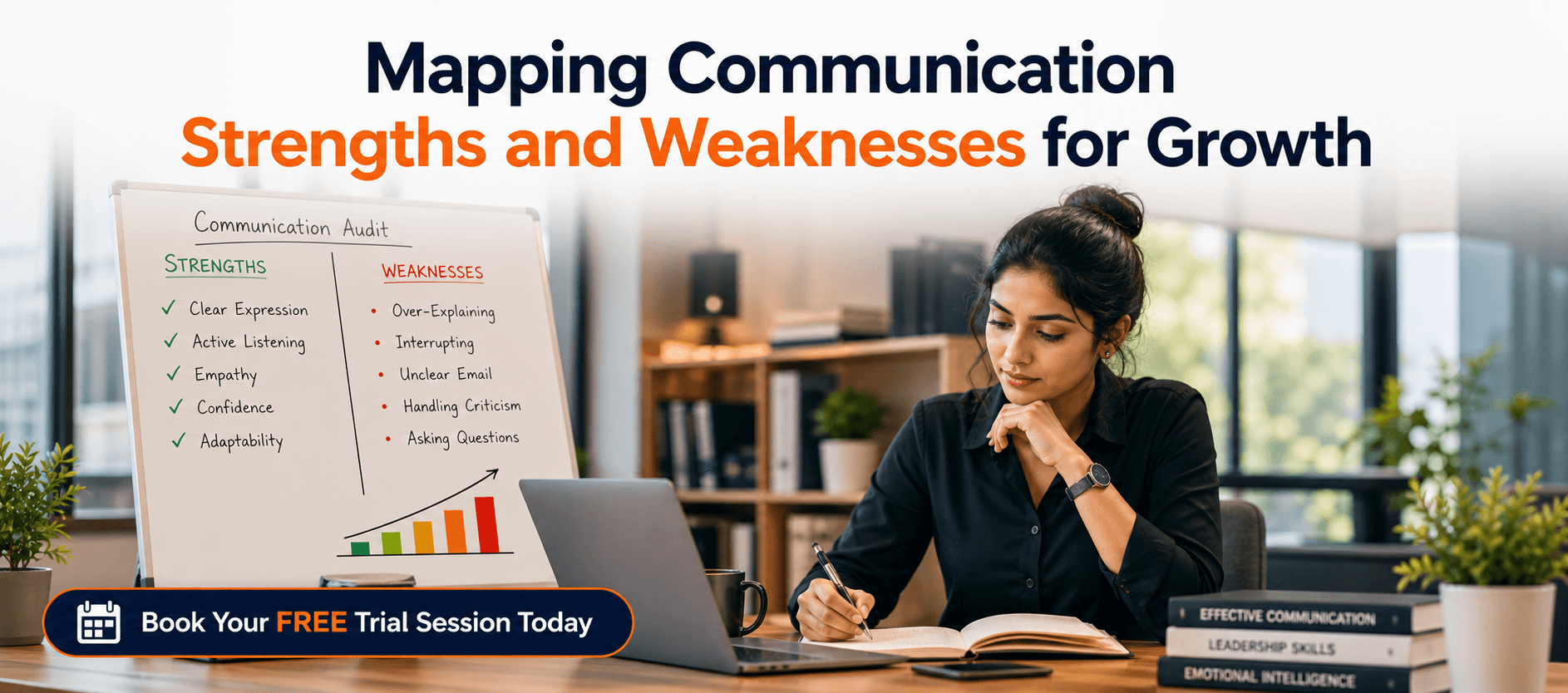
Mapping Communication Strengths and Weaknesses for Growth
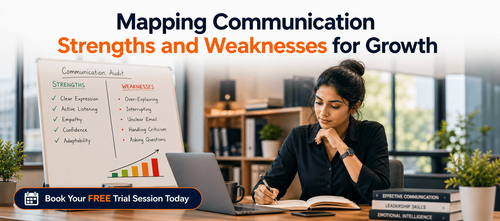

Mastering Communication at Work: How to Identify and Fix Your Strengths and Weaknesses for Career Growth
Communication breakdowns are rarely obvious—but their consequences are. You might be overlooked for a promotion despite strong technical performance. Your ideas may not land the way you intend. Feedback from managers might feel vague, frustrating, or difficult to act on.
The root problem? Most professionals have never systematically assessed their communication strengths and weaknesses. Instead, they rely on assumptions—believing that confidence equals clarity or that experience automatically improves communication.
The reality is different. Communication is one of the most critical yet underdeveloped professional skills, directly impacting hiring decisions, leadership opportunities, and workplace relationships.
This guide transforms a structured worksheet framework into a practical, actionable roadmap to help you audit, analyze, and improve your communication across every professional scenario that matters.
Download these resources and apply them alongside your daily work for improved clarity, productivity, and professional growth. You can also book a free trial to gain expert guidance and enhance your communication, problem-solving, and decision-making skills. The materials are designed in a clear, structured format to help professionals learn efficiently and implement insights with confidence.
Who Is This Blog For?
- Working professionals preparing for performance reviews or promotions
- Managers and leaders transitioning into high-visibility roles
- Job seekers aiming to improve interview and workplace communication
- Consultants, project managers, and cross-functional team members
- Anyone receiving vague feedback like “improve communication”
Why This Topic Matters Today?
Communication is consistently ranked as one of the top skill gaps in hiring, performance reviews, and leadership readiness.
Yet, most professionals:
- Treat communication as a natural skill rather than one that requires deliberate practice
- Seek feedback without structure, leading to vague and unusable insights
- Focus only on speaking skills while ignoring writing, listening, and non-verbal cues
- Fail to recognize that communication effectiveness changes across contexts
The result is costly:
- Missed leadership opportunities
- Misaligned stakeholder expectations
- Ineffective presentations and negotiations
- Strained professional relationships
In today’s fast-paced, cross-functional work environments, communication is no longer optional—it’s a career-defining capability.
Core Concept or Framework Explained
At the heart of this guide is a structured system for mapping communication strengths and weaknesses across different professional scenarios.
Instead of relying on general feedback, the framework breaks communication into measurable, scenario-specific dimensions. These include:
- Communication style (assertive, passive, aggressive)
- Feedback interpretation and decoding
- High-stakes conversation performance
- Written communication effectiveness
- Presentation confidence vs preparation gap
- Active listening behaviors
- Cross-functional communication alignment
- Conflict communication patterns
- Influence and persuasion effectiveness
- Long-term communication growth planning
Each area is assessed using targeted worksheets, allowing professionals to move from vague awareness to precise, actionable insights.
How This Blog and Guidebook Help You?
This structured approach delivers measurable outcomes:
- Identifies hidden communication gaps that generic feedback misses
- Converts subjective feedback into specific behavioral improvements
- Helps you perform better in high-stakes situations like presentations and negotiations
- Improves clarity, influence, and professional credibility
- Builds a repeatable system for continuous communication growth
Instead of guessing what to improve, you gain a clear roadmap backed by structured self-assessment.
Step-by-Step Breakdown
Step 1: Identify Your Communication Style
Start by mapping your dominant communication style across different contexts.
You may be:
- Assertive in one-on-one conversations
- Passive in group meetings
- Defensive during feedback discussions
The key is recognizing that communication style is context-dependent.
Focus on:
- Clarity in expressing views
- Ability to set boundaries
- Willingness to ask for what you need
- Listening before responding
Step 2: Decode Feedback into Actionable Insights
Most professionals receive feedback—but fail to use it effectively.
Instead of summarizing feedback, extract:
- Exact quotes
- The behavior behind each comment
- Patterns across multiple sources
This transforms vague feedback into specific strengths and gaps you can act on immediately.
Step 3: Analyze High-Stakes Conversations
After critical conversations, conduct a structured debrief within 24 hours.
Evaluate:
- What worked in your communication
- Where breakdowns occurred
- How your tone, clarity, and listening impacted outcomes
Then rewrite:
- What you would say differently next time
- A clear takeaway you can apply immediately
Step 4: Audit Your Written Communication
Written communication is often overlooked—but highly visible.
Evaluate your emails, reports, and proposals based on:
- Clarity of opening message
- Logical structure
- Tone appropriateness
- Brevity and precision
- Clear action steps
Many professionals discover that unclear writing—not lack of ideas—is their biggest communication gap.
Step 5: Measure Your Presentation Confidence Gap
One of the most powerful insights is identifying the gap between preparation and delivery.
You may:
- Be well-prepared but appear nervous
- Know the content but struggle with delivery
This gap is calculated by comparing preparation quality with delivery performance.
Closing this gap improves presentation confidence dramatically.
Step 6: Improve Active Listening Skills
Listening is often the weakest yet most critical communication skill.
Evaluate:
- Attention and presence
- Ability to summarize key points
- Emotional awareness
- Quality of responses
Strong listening leads to better collaboration, stronger relationships, and improved decision-making.
Step 7: Map Cross-Functional Communication Gaps
When working across teams, communication breakdowns often cause delays—not technical issues.
Assess:
- Communication frequency
- Format preferences
- Stakeholder expectations
- Vocabulary alignment
Then adjust your communication style to match each audience.
Step 8: Track Conflict Communication Patterns
Your behavior during conflict defines your professional reputation.
Identify your default pattern:
- Avoidant
- Defensive
- Aggressive
- Accommodating
- Collaborative
Then replace reactive responses with constructive communication scripts.
Step 9: Strengthen Influence and Persuasion
Effective communication requires balancing three elements:
- Logic and data
- Credibility and trust
- Emotional relevance
Missing any one reduces your ability to influence decisions.
Evaluate your communication using these levers and improve where needed.
Step 10: Build a 90-Day Communication Growth Plan
Sustainable improvement requires structured effort.
Use a 3-phase approach:
- Days 1–30: Awareness and tracking
- Days 31–60: Deliberate practice
- Days 61–90: Habit formation
This ensures communication improvement becomes consistent and measurable over time.
Common Mistakes or Pitfalls to Avoid
- Treating communication as a natural skill instead of a learnable one
- Seeking feedback without a structured framework
- Focusing only on speaking and ignoring listening or writing
- Assuming confidence equals effectiveness
- Ignoring context-specific communication differences
These mistakes prevent real improvement and keep professionals stuck despite experience.
How Should You Use This Guidebook Effectively?
To get maximum value:
- Choose the worksheet that matches your current situation
- Complete every section honestly—do not skip steps
- Use real examples from your work experience
- Review your responses with a mentor or colleague
- Revisit the worksheets quarterly to track progress
Time investment:
- 20–30 minutes per worksheet
- Weekly reflection for ongoing improvement
This approach ensures continuous, structured communication growth.
Key Takeaways
- Communication is a measurable, improvable professional skill
- Most professionals fail due to lack of structured self-assessment
- Scenario-based evaluation reveals hidden communication gaps
- Listening, writing, and influence are as important as speaking
- Feedback becomes valuable only when decoded into behaviors
- Consistent practice over 90 days creates lasting improvement
Your Next Step: Accelerate Your Career with PlanetSpark
Creating an impact-driven resume is not just about landing your next job—it’s about owning your professional story and presenting it with clarity, confidence, and credibility. When your resume clearly communicates value, results, and impact, opportunities follow naturally.
At PlanetSpark, we are committed to empowering working professionals with practical, outcome-focused resources that drive real career growth. From resume building and workplace communication to leadership presence and professional writing, our programs are designed to help you succeed in today’s fast-evolving job market.
Visit https://www.planetspark.in/resources to explore:
- Career and resume-building guides
- Workplace communication and professional writing resources
- Skill-development tools curated for working professionals
Want a deeper, hands-on experience?
You can also book a free trial session to learn more about PlanetSpark’s Working Professional Courses, designed to accelerate your career through personalised coaching, real-world practice, and expert guidance.
Your career deserves more than generic advice.
It deserves clarity, confidence, and measurable impact.
Personalized Communication Roadmaps
Record a video to get a AI generated personalized communication reports