
Minimizing Overthinking to Support Career Growth in 2026
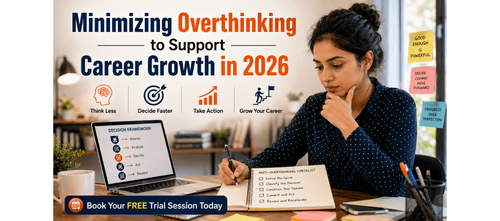

Reducing Overthinking in Daily Work Decisions: A Practical Checklist for Faster, Smarter Choices
Overthinking is one of the most common productivity drains for professionals today. Whether you're deciding on the best way to word an email to a senior stakeholder, determining whether to push back on a project timeline, or choosing between strategy options in a meeting, you might find yourself stuck in a loop of second-guessing. The result? Increased decision fatigue, wasted time, and a lack of mental clarity when you need it most. This guide will help you break that loop, reduce overthinking, and reclaim your mental energy to make faster, smarter, and more confident decisions.
Download these resources and apply them alongside your daily work for improved clarity, productivity, and professional growth. You can also book a free trial to gain expert guidance and enhance your decision-making skills. The materials are designed in a clear, structured format to help professionals learn efficiently and implement insights with confidence.
Who Is This Blog For?
This blog and the accompanying guidebook are designed for:
- High achievers who often find themselves overthinking low-to-medium stakes decisions.
- Managers looking to make quicker, more confident decisions in fast-paced environments.
- Professionals dealing with decision fatigue from repeated scenarios that feel new but aren't.
- Consultants and career changers who need to make quick decisions to demonstrate value and move fast.
- Anyone feeling mentally exhausted from endlessly deliberating on everyday work decisions.
Why This Topic Matters Today?
Overthinking isn’t just a time-waster—it has real consequences. According to research in organizational psychology, professionals who overthink daily decisions report higher levels of burnout, lower job satisfaction, and, ironically, poorer decision outcomes. Overthinking can often masquerade as thoroughness, but it’s actually a cycle that consumes your mental energy and makes it harder to focus on the more important, high-value tasks.
In a world where speed and efficiency are crucial, it’s essential to develop the ability to act with sufficient certainty, without waiting for perfection. The key is building a system that helps you interrupt the overthinking cycle, make confident decisions, and move forward without wasting time or mental energy.
Core Concept or Framework Explained
The 5-Phase Anti-Overthinking Checklist
The foundation of reducing overthinking is awareness and structure. By working through these five phases sequentially, you can break free from decision spirals and make confident, good-enough decisions faster.
1. Notice the Spiral: Awareness is the first step. Recognize when you are caught in a loop of overthinking.
2. Classify the Decision: Not all decisions deserve the same mental bandwidth. Classify your decision to determine if it’s high or low stakes and reversible or irreversible.
3. Constrain Your Options: Overthinking thrives on an open-ended choice. Limiting your options and setting a decision deadline creates clarity and speed.
4. Commit and Act: A good-enough decision made now is almost always better than a perfect decision made too late. Commit, take the next action, and move forward.
5. Review and Recalibrate: Reflect on the decision after action. Build a feedback loop to improve your confidence and decision-making over time.
These phases create a decision framework that interrupts overthinking and guides you toward faster, more effective decision-making.
How This Blog and Guidebook Help You?
This blog and guidebook will help you:
- Recognize when you are overthinking and identify the cycle.
- Classify decisions by their stakes and reversibility, ensuring you allocate your mental energy wisely.
- Constrain options and set deadlines to reduce ambiguity and speed up the decision process.
- Commit to good-enough decisions and start taking action without hesitation.
- Review your decisions briefly to recalibrate and build confidence for future decisions.
The result? You will make better decisions, faster, while conserving mental energy for more important tasks.
Step-by-Step Breakdown
Step 1: Notice the Spiral
The first step in breaking free from overthinking is noticing when you're stuck in a loop. Common signs include:
- Asking for more opinions when you already have enough information.
- Rewriting something multiple times without making progress.
- Delaying decisions because conditions “aren’t perfect yet.”
- Feeling anxious instead of curious about the decision.
Once you recognize these signs, you can consciously choose to interrupt the spiral and move forward.
Step 2: Classify the Decision
Not all decisions deserve the same amount of time and effort. Classifying the decision helps you quickly understand the level of mental bandwidth to allocate. Ask yourself:
- Is this decision reversible or irreversible?
- What is the impact of this decision (high, medium, or low)?
- Will this matter in 6 months?
This step helps you determine whether to make the decision quickly or to spend more time gathering data.
Step 3: Constrain Your Options
Overthinking thrives on an open-ended decision. To avoid falling into this trap, limit yourself to a maximum of three options. Set a hard deadline for when to make the decision, based on its stakes. For example, you might decide to act within 30 minutes for low-stakes decisions or within 24 hours for higher stakes ones. Ask yourself:
- What would I recommend if this were a colleague's problem?
- Remove any options that require ideal conditions you don't currently have.
By constraining your options, you reduce the mental noise and clarify your path forward.
Step 4: Commit and Act
At this stage, it’s time to make the decision and take action. A good-enough decision made now is better than a perfect decision made later. Write down your decision and commit to the next step—whether it’s sending an email, making a call, or scheduling a follow-up. Don't wait for motivation—block out time to act immediately.
Step 5: Review and Recalibrate
After taking action, spend 5 minutes reviewing the decision:
- Was this decision good enough?
- What would have changed if I had more information?
- How long did I spend deciding vs. how long was actually necessary?
This brief reflection will help you gain confidence in your decision-making and improve your ability to act quickly in the future.
Action Tools
Tool 1: The Decision Audit Grid
Run any pending decision through this grid to decide whether further deliberation is necessary. If a decision scores low on both Impact and Reversibility Risk, decide immediately using your gut and experience.
| Decision | Impact (High / Med / Low) | Reversible? (Yes / No) | Decision Deadline |
|----------|--------------------------|------------------------|------------------|
| Example: Which slide deck format to use | Low | Yes | 2 minutes |
| Example: Whether to hire Candidate A or B | High | No | 48 hours with structured criteria |
Tool 2: Reflection Prompts to Break the Loop
When you notice yourself spiraling, use these prompts to break the loop:
- When Stuck Between Options: “What’s the worst realistic outcome of each option?”
- When Seeking Endless Validation: “What new information would actually change my decision?”
- When Feeling Paralyzed: “What would I recommend if this were a colleague’s problem?”
Tool 3: The 2×2 Stakes Classifier
Classify your current pending decisions using this matrix. Decisions in the bottom-left quadrant should be made immediately, without further deliberation.
| Impact / Reversibility | Easy to Reverse | Hard to Reverse |
|------------------------|-----------------|-----------------|
| High Impact | Act Quickly, Adjust if Needed | Invest Structured Thinking Time |
| Low Impact | Decide Instantly | Decide Carefully Then Move On |
Real-World Application
Case Study: Priya's Presentation Problem
Priya, a marketing manager, spent 3 hours deliberating over a medium-stakes decision: choosing between two slide structures for a presentation. By applying the Decision Audit Grid, she classified it as a Low Impact + Reversible decision and decided within 20 minutes. The result? A well-delivered presentation that impressed her VP, demonstrating the power of applying the checklist to avoid overthinking.
Common Mistakes to Avoid
- Treating all decisions as high-stakes: Many daily work decisions are low-stakes and reversible. Focus your energy on the truly important ones.
- Confusing more information with better decisions: After a certain point, more data leads to confusion, not clarity. Set a data-gathering deadline and stick to it.
- Using consensus as a substitute for ownership: Gathering multiple opinions diffuses accountability. Consult one or two trusted people and then own the decision.
Key Takeaways
- Notice the Spiral: Awareness is the first step in breaking the overthinking cycle.
- Classify the Decision: Take 60 seconds to classify each decision as high or low stakes, reversible or not.
- Constrain Your Options: Limit yourself to a maximum of three options and set a decision deadline.
- Commit and Act: A good-enough decision made now is better than a perfect one made too late.
- Review and Recalibrate: A brief post-decision review builds confidence and helps you improve over time.
Your Next Step: Accelerate Your Career with PlanetSpark
The key to reducing overthinking isn’t about eliminating uncertainty—it’s about learning to make confident decisions with sufficient certainty. When you break the cycle of overthinking, you reclaim your mental energy and make better decisions faster.
At PlanetSpark, we are committed to empowering working professionals with practical, outcome-focused resources that drive real career growth. From decision-making frameworks to leadership development and workplace communication, our programs are designed to help you succeed in today’s fast-evolving job market.
Visit https://www.planetspark.in/resources to explore:
- Decision-making and leadership tools
- Professional communication and productivity resources
- Skill-development programs for working professionals
Want a deeper, hands-on experience?
You can also book a free trial session to learn more about PlanetSpark’s Working Professional Courses, designed to accelerate your career through personalized coaching, real-world practice, and expert guidance.
Your career deserves more than generic advice.
It deserves clarity, confidence, and measurable impact.
Start building that advantage today—with PlanetSpark.
Personalized Communication Roadmaps
Record a video to get a AI generated personalized communication reports