
Personal Brand Operating System for Consistent Career Growth
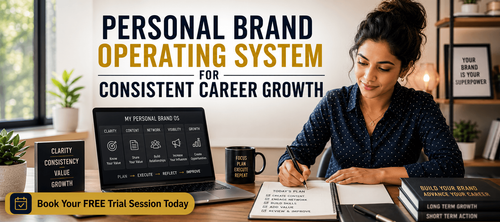

Designing Your Personal Brand Operating System for Consistency: A Practical Guide for Career Growth and Professional Visibility
Most professionals know they need a strong personal brand, but very few build one with intention. They update LinkedIn when they need a job, rewrite their bio when a speaking opportunity appears, prepare an elevator pitch right before an interview, and refresh their portfolio only when someone asks for it. The result is a professional identity that feels scattered across platforms, conversations, and career moments.
This is a serious career problem. When your LinkedIn bio says one thing, your resume says another, your portfolio uses a different tone, and your networking pitch changes every time you introduce yourself, people struggle to understand what you stand for. Even if you are skilled, experienced, and capable, inconsistency can make your professional presence harder to remember and trust.
That is where a Personal Brand Operating System becomes valuable. The guidebook, Designing Your Personal Brand Operating System for Consistency, helps professionals stop improvising their brand and start engineering it. It gives job seekers, consultants, managers, freelancers, and career switchers a structured way to define who they are, what they offer, how they communicate, and how they show up across every professional touchpoint.
Download these resources and apply them alongside your daily work for improved clarity, productivity, and professional growth. You can also book a free trial to gain expert guidance and enhance your communication, problem-solving, and decision-making skills. The materials are designed in a clear, structured format to help professionals learn efficiently and implement insights with confidence.
Who Is This Blog For?
This blog is designed for professionals who want their career identity to feel clear, credible, and consistent across platforms and conversations. It is especially useful for:
- Job seekers who want their resume, LinkedIn profile, portfolio, and interview pitch to tell the same story
- Career switchers who need to reposition their experience for a new industry, role, or audience
- Consultants and freelancers who want a sharper value proposition and more consistent client-facing communication
- Managers and emerging leaders who want to build authority through thought leadership, storytelling, and professional visibility
- Working professionals with 0-15 years of experience who are ready to move beyond generic branding advice
- Speakers, creators, and subject-matter experts preparing for media features, events, newsletters, or public-facing opportunities
- Professionals refreshing their brand after a promotion, role change, or major career milestone
If you have ever wondered why your online presence does not fully reflect your value, this guidebook gives you a practical system to fix that.
Why This Topic Matters Today?
Personal branding is no longer limited to influencers, founders, or senior executives. In today’s workplace, every professional is evaluated across multiple signals before a conversation even begins. Recruiters scan LinkedIn. Hiring managers review portfolios. Clients check websites. Event organisers look at bios. Peers form impressions from posts, messages, and introductions.
The challenge is that most professionals build these touchpoints separately. The guidebook highlights common mistakes that make a brand feel fragmented:
- Using different bios on LinkedIn, CV, and portfolio without a shared thread
- Describing value only through job titles instead of outcome-driven language
- Skipping brand audits and letting outdated content represent them online
- Having no consistent visual or tonal identity across platforms
- Treating personal branding as a one-time task instead of an ongoing system
These mistakes create friction. A recruiter may not understand your positioning. A client may not see your unique value. A hiring manager may miss your strongest achievements. A professional contact may remember your title, but not your promise.
Consistency builds trust. When your positioning, voice, visuals, pitch, and content all point in the same direction, your professional identity becomes easier to understand and remember. That is why the Personal Brand Operating System matters today. It turns personal branding from a random activity into a repeatable career growth process.
Core Concept or Framework Explained
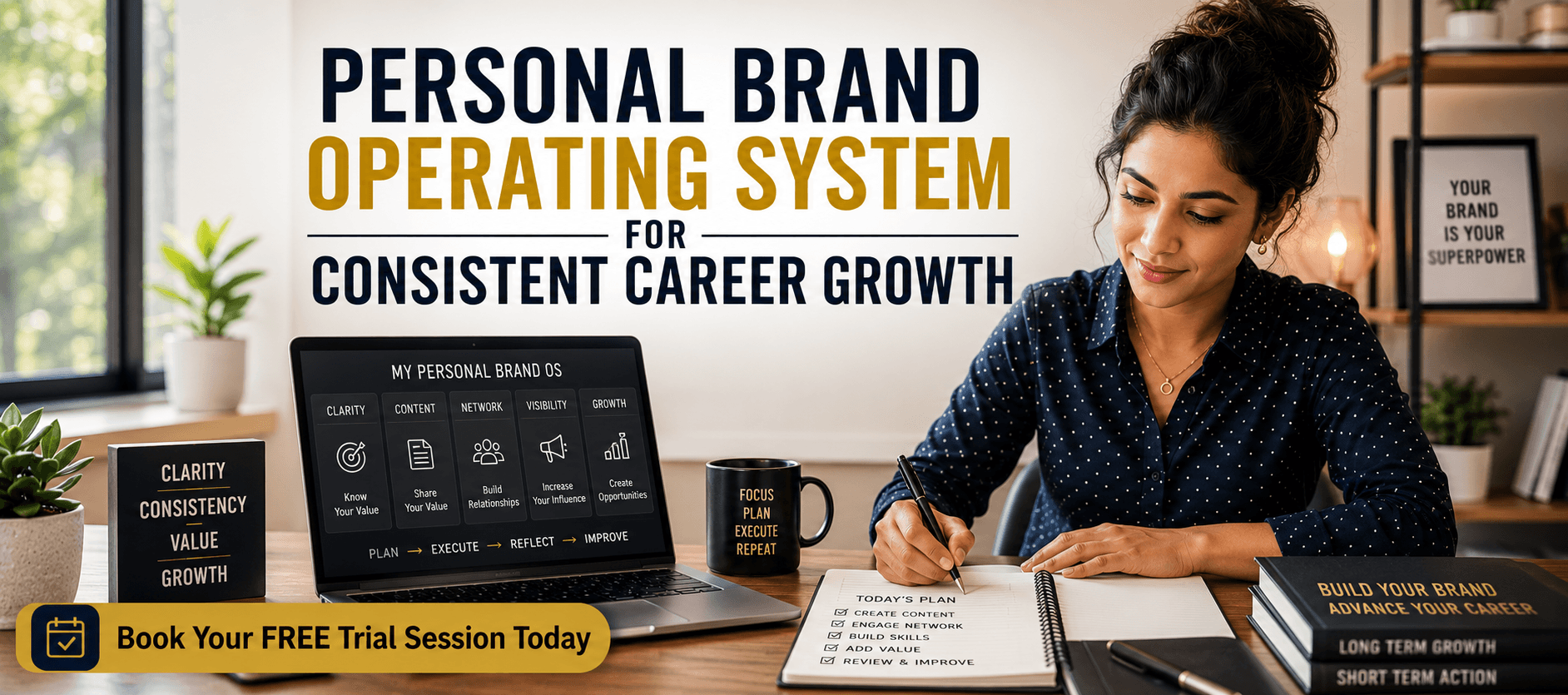
The central idea of the guidebook is the Personal Brand Operating System, or PBOS. A PBOS is the infrastructure that keeps your professional identity coherent, compelling, and consistent across every touchpoint, platform, and interaction.
Instead of thinking about personal branding as a single LinkedIn update or resume rewrite, the PBOS treats your brand as a living system. It defines:
- Who you are
- What you stand for
- What makes you different
- Who your brand speaks to
- How you communicate
- What visual signals represent you
- How you maintain consistency over time
- How you manage relationships without going off-brand
The guidebook includes 10 templates, each designed for a specific branding scenario. Together, they cover the full personal brand workflow, from foundational identity to ongoing review.
The 10 templates are:
- Brand Identity Blueprint
- Multi-Platform Bio Consistency Kit
- Brand Voice & Tone Style Guide
- Digital Presence Audit Tracker
- Thought Leadership Content Planner
- Elevator Pitch Scripting Framework
- Professional Story Narrative Map
- Visual Brand Standards One-Pager
- Brand Consistency Review Scorecard
- Network Touchpoint Communication Log
The strength of this framework is that it does not ask professionals to become louder online. It asks them to become clearer, more intentional, and more consistent. That makes it especially useful for working professionals who want career acceleration without sounding generic, exaggerated, or disconnected from their real expertise.
How This Blog and Guidebook Help You?
This blog translates the guidebook into a practical roadmap. By working through the system, you can create a personal brand that supports real career outcomes.
The guidebook helps you:
- Define your core positioning before creating external-facing content
- Align your short, medium, and long bios across LinkedIn, websites, speaker profiles, and email signatures
- Document your brand voice so your writing sounds recognisable and professional
- Audit your digital presence and prioritise the updates that matter most
- Plan 30 days of content around clear brand pillars
- Prepare 30, 60, and 90-second elevator pitches for different professional settings
- Turn your career journey into a compelling story instead of a list of roles
- Standardise visual elements such as headshots, colours, fonts, and graphic style
- Review brand consistency every quarter
- Track professional relationships and keep communication aligned with your brand values
The career impact is straightforward. When your brand is consistent, you become easier to position, refer, recommend, hire, invite, and remember.
Step-by-Step Breakdown
Template 01: Brand Identity Blueprint
The Brand Identity Blueprint is the foundation of the entire Personal Brand Operating System. Use it when you are building or rebuilding your personal brand from scratch.
This template asks you to define your professional name, role descriptor, years of experience, and primary industry or domain. The important detail is that your role descriptor should not be just a job title. For example, instead of saying Senior UX Designer, the guidebook suggests a more specific descriptor such as Senior UX Designer | Healthcare Tech Specialist.
The template then moves into core values. These are the professional principles that drive how you work. Examples from the guidebook include Radical Clarity, Bias for Action, and Inclusive Design. Values are not decorative. They shape your tone, decisions, positioning, and communication.
Next, you define your differentiators. These may include cross-industry experience, a unique blend of skills, published expertise, or a specific perspective. The goal is to answer one question clearly: why should someone remember you over another professional in your field?
Finally, the template helps you identify your target audience and write your brand promise. The brand promise follows a practical structure: you help a specific audience achieve a specific outcome through your unique method so they can gain a deeper benefit. This becomes the anchor for your messaging.
Template 02: Multi-Platform Bio Consistency Kit
Once your positioning is clear, your bios need to communicate the same story in different lengths. This template helps you create three bio versions:
- Short bio for email signatures, conference name tags, and app profiles
- Medium bio for LinkedIn summaries, speaker intros, and website homepages
- Long bio for full LinkedIn About sections, media kits, press pages, and personal websites
The guidebook recommends a 25-40 word short bio, a 75-100 word medium bio, and a 150-250 word long bio. Each version should contain the same core role descriptor and 2-3 differentiators, even if the wording changes.
This is where many professionals lose consistency. Their email signature sounds formal, their LinkedIn bio sounds casual, and their portfolio sounds like a resume. The checklist in the guidebook prevents that by asking whether every version uses the same name format, tone, next step, and professional story.
Template 03: Brand Voice & Tone Style Guide
Your brand is not only what you say. It is also how you sound. The Brand Voice & Tone Style Guide helps you document your communication style across LinkedIn posts, emails, articles, and proposals.
The template asks you to choose a voice archetype such as Expert Authority, Empathetic Coach, Provocative Thinker, Practical Guide, or Visionary Leader. Then, you define the words and phrases you always use and the words you avoid because they feel off-brand.
The guidebook also includes tone scales, helping you decide where you sit between formal and conversational, reserved and expressive, serious and playful, broad and niche, humble and confident.
This prevents one of the most common branding problems: sounding like a generic professional. If your real voice is direct, evidence-based, and practical, your content should not suddenly sound like jargon-heavy corporate copy. The template also encourages before-and-after examples so you can compare off-brand writing with an on-brand rewrite.
Template 04: Digital Presence Audit Tracker
Before you refresh your brand, you need to know what currently exists. The Digital Presence Audit Tracker helps you review every platform where you appear online.
The guidebook recommends a four-part audit process:
- Discover all platforms where you appear
- Evaluate each one for consistency and recency
- Identify gaps, missing information, and off-brand content
- Prioritise fixes through a ranked action list
Platforms may include LinkedIn, personal websites, portfolios, GitHub, Behance, Dribbble, Twitter or X, Instagram, Medium, Substack, or any other relevant professional channel.
For each platform, you assess whether the profile is active, when it was last updated, whether the bio is consistent, and what action is required. This may include updating a headline, refreshing an About section, adding a portfolio link, aligning bio language, pinning relevant projects, or publishing regularly.
The goal is not to be everywhere. The goal is to ensure every active platform supports the same professional story.
Template 05: Thought Leadership Content Planner
A strong personal brand needs consistent content, especially if you want to build authority in your domain. The Thought Leadership Content Planner helps you create a structured 30-day plan across LinkedIn, newsletters, blogs, or podcasts.
Before planning posts, the guidebook asks you to define 3-4 content pillars. These are the core topics your brand is known for. Examples include Leadership & Team Dynamics, Career Growth Frameworks, Industry Trends & Insights, and Personal Story & Behind-the-Scenes.
Every content idea should map back to one of these pillars. This keeps your content from becoming random. The 30-day calendar then helps you plan post topics, content pillars, formats, and status.
The guidebook includes format options such as:
- Story post
- List post
- Opinion post
- Case study
- Curation post
- Question post
This template is useful because it connects personal branding to publishing discipline. Instead of scrambling for ideas every week, you build a content rhythm that reinforces your expertise.
Template 06: Elevator Pitch Scripting Framework
Your verbal pitch should match your written brand. The Elevator Pitch Scripting Framework helps you prepare 30, 60, and 90-second versions for networking events, job interviews, conference introductions, first client meetings, and professional conversations.
The framework has four parts:
- Hook
- Who and what
- Proof
- CTA
The hook should open with a memorable statement, question, or bold claim, not just a job title. The who and what section explains your role in plain, outcome-focused language. The proof section gives one specific achievement with a real result. The CTA closes with a clear next step.
The guidebook provides different pitch lengths for different contexts. A 30-second pitch works for fast introductions. A 60-second pitch works well for networking and informational interviews. A 90-second pitch is better for formal interviews, panel introductions, and speaker contexts.
The most important advice is to memorise the structure, not the exact words. Your pitch should sound natural, not rehearsed.
Template 07: Professional Story Narrative Map
Many professionals make the mistake of listing jobs instead of telling a story. The Professional Story Narrative Map helps you turn your career journey into a structured narrative.
The guidebook uses five sections:
- The Origin: where you began
- The Challenge: what you had to figure out
- The Shift: what changed and how
- The Proof: what you built or achieved
- The Now: where you are headed
This structure is useful for LinkedIn About sections, interview answers, speaker bios, and personal website story pages. It makes your career feel human, credible, and forward-looking.
For LinkedIn, the guidebook recommends opening with a hook before the “see more” fold, using short paragraphs, adding line breaks, writing in first person, and ending with a clear CTA. For interviews, it recommends timing your delivery across origin, challenge, shift, proof, and now, with the proof section receiving the most emphasis.
Template 08: Visual Brand Standards One-Pager
Your personal brand also sends visual signals. The Visual Brand Standards One-Pager helps you standardise your profile photo, colour palette, typography, and graphic style across LinkedIn, your website, presentations, and media-facing materials.
The template includes profile photo standards such as file name, format, background colour, attire, expression, consistency rule, and next scheduled refresh.
It also helps you define a personal colour palette with primary, secondary, accent, neutral, background, and text colours. Typography is documented through heading fonts, body fonts, pairing rules, free alternatives, and font size standards.
The graphic style rules include icon style, illustration style, photography style, graphic element rules, pattern or texture use, logo placement, and any signature brand mark.
This does not mean every professional needs a complex design system. It means your visual identity should not feel accidental.
Template 09: Brand Consistency Review Scorecard
A personal brand can become outdated if you do not review it regularly. The Brand Consistency Review Scorecard is a quarterly self-assessment tool that helps you identify where consistency has slipped.
The scorecard rates key areas from 1 to 5, including:
- Messaging consistency
- Bio alignment
- Visual identity
- Voice and tone
- Content consistency
- Pitch consistency
- Network communication
- Platform completeness
- Proof points and social proof
- Brand relevance
The total score helps you interpret the health of your brand. A high score means your brand is highly consistent. A lower score signals gaps, urgent fixes, or the need to revisit the Brand Identity Blueprint.
This template is especially useful after a role change, promotion, career pivot, or quarter of active content creation.
Template 10: Network Touchpoint Communication Log
Your brand does not only exist in public. It also appears in one-to-one communication. The Network Touchpoint Communication Log helps you maintain brand-consistent messaging when nurturing professional relationships.
The guidebook starts with communication principles. Examples include offering value before making a request, following up within 48 hours, personalising every message, and closing with a specific low-friction next step.
It then provides message templates for:
- First LinkedIn connection requests
- Follow-ups after meetings or events
- Value-first check-ins with warm network contacts
Finally, the relationship tracker helps you record contact name, platform, relationship type, last touchpoint, message template used, response or outcome, and next planned touchpoint.
This template reinforces an important idea: your network touchpoints are your brand in action. The way you follow up, offer value, and maintain relationships should match the voice and values you defined earlier.
Common Mistakes or Pitfalls to Avoid
The guidebook makes it clear that personal branding fails when professionals treat it casually or inconsistently. The biggest mistakes include:
- Writing different bios for every platform without a shared positioning thread
- Relying on job titles instead of outcome-driven language
- Letting outdated profiles, old projects, or incomplete pages represent your current capability
- Using a polished public voice but inconsistent private communication
- Publishing content without clear pillars
- Creating a strong LinkedIn presence but ignoring portfolio, email signature, speaker bio, or website consistency
- Preparing for interviews without aligning the verbal pitch to the written brand
- Listing career history instead of telling a structured professional story
- Ignoring visual consistency across headshots, colours, fonts, and documents
- Treating personal branding as a one-time project instead of a quarterly system
The better alternative is to use the templates as a connected workflow. Start with positioning, then align bios, voice, platforms, content, pitch, story, visuals, review, and network communication. That sequence creates a brand that feels intentional instead of improvised.
How Should You Use This Guidebook Effectively?
The guidebook can be used in two ways. You can work through all 10 templates in order for a complete personal brand build, or you can jump directly to the template that matches your current situation.
For a full brand build, set aside focused time over a week or two. A practical workflow could look like this:
- Day 1: Complete the Brand Identity Blueprint
- Day 2: Create short, medium, and long bios
- Day 3: Document your brand voice and tone
- Day 4: Audit your digital presence
- Day 5: Build your thought leadership content pillars and 30-day plan
- Day 6: Script and practise your elevator pitches
- Day 7: Map your professional story and visual standards
- Every two weeks: Review your network touchpoint log
- Every quarter: Complete the brand consistency scorecard
For urgent career needs, use the most relevant template first. If you are applying for roles, start with the Brand Identity Blueprint, Bio Consistency Kit, Digital Presence Audit Tracker, Elevator Pitch Framework, and Professional Story Narrative Map. If you are building authority, prioritise the Brand Voice Guide, Thought Leadership Planner, Visual Standards One-Pager, and Review Scorecard.
The guidebook is fillable, so replace every bracketed placeholder with your own details. Keep it editable in Word or Google Docs for ongoing updates, and export polished versions as PDFs when needed.
Key Takeaways
- A personal brand becomes powerful when it works as a system, not as a collection of disconnected profiles
- Your role descriptor should be specific, outcome-driven, and consistent across platforms
- Your brand promise should clearly define who you help, what outcome you create, and how you create it
- Short, medium, and long bios should tell the same core story in different levels of detail
- A documented voice and tone guide helps your writing sound recognisable instead of generic
- A digital presence audit reveals outdated profiles, inconsistent bios, and missing proof points
- Thought leadership works best when every post connects to defined content pillars
- Your elevator pitch should use a hook, clear role explanation, proof, and CTA
- Your professional story should include origin, challenge, shift, proof, and future direction
- Visual consistency matters because headshots, colours, fonts, and graphics all shape perception
- Quarterly reviews prevent your brand from becoming stale or fragmented
- Network messages should reflect the same values, tone, and positioning as your public brand
Your Next Step: Accelerate Your Career with PlanetSpark
Creating an impact-driven resume is not just about landing your next job—it’s about owning your professional story and presenting it with clarity, confidence, and credibility. When your resume clearly communicates value, results, and impact, opportunities follow naturally.
At PlanetSpark, we are committed to empowering working professionals with practical, outcome-focused resources that drive real career growth. From resume building and workplace communication to leadership presence and professional writing, our programs are designed to help you succeed in today’s fast-evolving job market.
Visit https://www.planetspark.in/resources to explore:
- Career and resume-building guides
- Workplace communication and professional writing resources
- Skill-development tools curated for working professionals
Want a deeper, hands-on experience?
You can also book a free trial session to learn more about PlanetSpark’s Working Professional Courses, designed to accelerate your career through personalised coaching, real-world practice, and expert guidance.
Your career deserves more than generic advice.
It deserves clarity, confidence, and measurable impact.
Personalized Communication Roadmaps
Record a video to get a AI generated personalized communication reports