
Post-Deadline Recovery Systems for Burnout Prevention
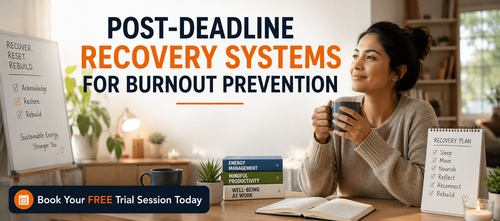

Creating Recovery Systems for Post-Deadline Burnout: A Practical Guide for Working Professionals
You met the deadline. You delivered the project. You pushed through long hours, difficult decisions, back-to-back meetings, and constant pressure. But instead of feeling proud or relieved, you feel drained, unfocused, emotionally flat, or unable to care about the next task.
That is post-deadline burnout. It often appears after a major project, launch, client delivery, exam, or high-pressure work sprint. Many professionals try to ignore it and return to full productivity immediately, but recovery does not happen automatically. It needs a system.
This guidebook helps working professionals reset after intense deadlines through a clear three-phase recovery system: Acknowledge, Restore, and Rebuild. It shows how to recover energy, rebuild focus, and protect yourself from repeating the same burnout cycle.
Download these resources and apply them alongside your daily work for improved clarity, productivity, and professional growth. You can also book a free trial to gain expert guidance and enhance your communication, problem-solving, and decision-making skills. The materials are designed in a clear, structured format to help professionals learn efficiently and implement insights with confidence.
Who Is This Blog For?
This blog is useful for:
- Working professionals recovering after a major deadline
- Managers and team leads coming out of intense project cycles
- Consultants, product managers, and client-facing professionals
- Career-focused employees who want sustainable productivity
- Professionals who feel tired, foggy, or emotionally flat after delivery
- Anyone who wants a practical recovery plan instead of generic self-care advice
Why This Topic Matters Today?
Modern work often rewards high performance but ignores recovery. Professionals are expected to deliver, switch quickly to the next task, and stay productive even after long periods of pressure.
Post-deadline burnout can show up as:
- Brain fog
- Physical exhaustion
- Low motivation
- Irritability
- Emotional numbness
- Dread about the next deadline
- Difficulty concentrating on simple tasks
The guidebook explains that burnout after a deadline is not a personal failure. It is a predictable result of high-intensity work without a structured recovery system.
Core Concept or Framework Explained
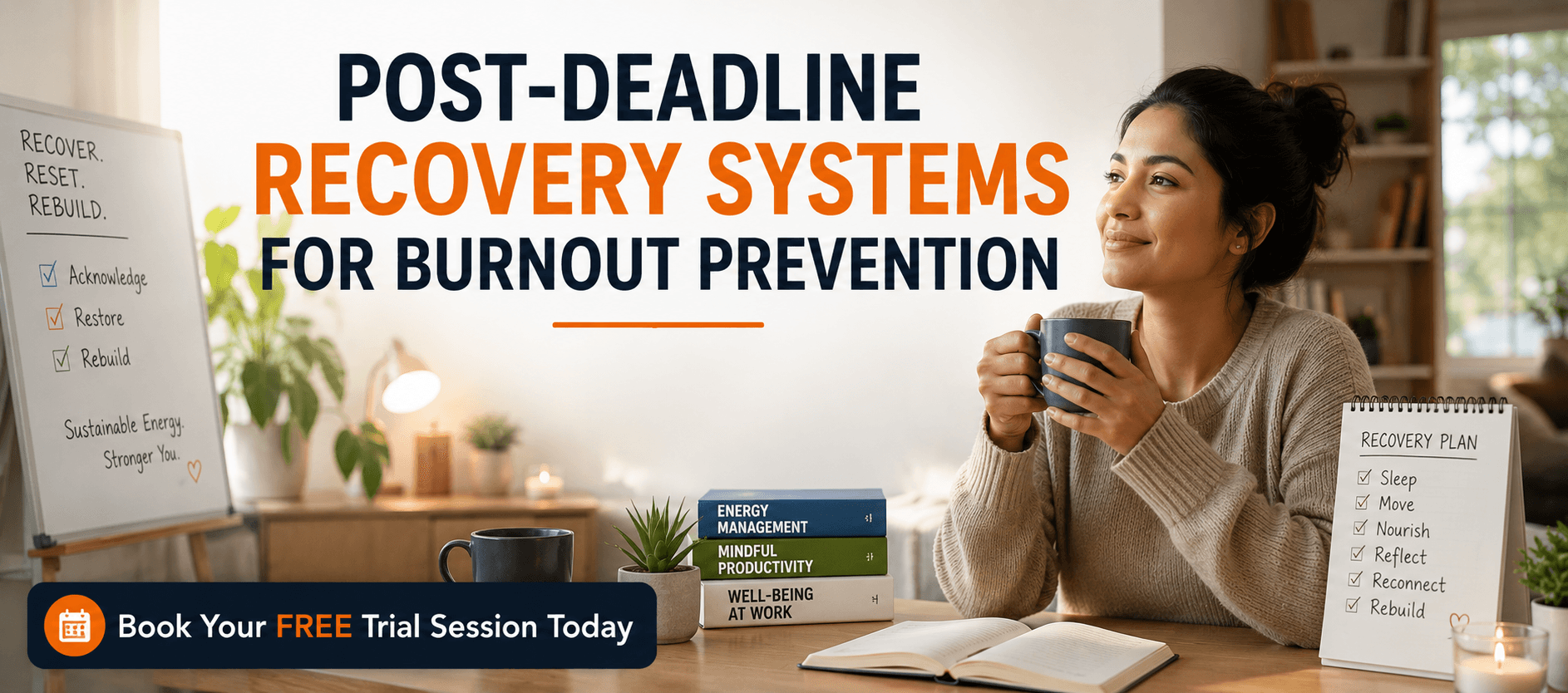
The guidebook introduces a three-phase recovery system:
Acknowledge
This phase happens during Days 1–2. The goal is to stop ignoring the burnout and assess what has been depleted physically, mentally, emotionally, and relationally.
Restore
This phase happens during Days 3–7. The goal is to rebuild energy through sleep, light movement, simple work, journalling, and social connection.
Rebuild
This phase happens during Days 8–14. The goal is to return to productivity slowly and create protective systems for the next deadline cycle.
The planner also includes an Energy Audit, a Personal Recovery System Template, and a staged 60-80-100 re-entry plan to help professionals return to work without crashing again.
How This Blog and Guidebook Help You?
This blog and guidebook help you recover with intention instead of waiting to feel better. You will learn how to:
- Recognise burnout signals early
- Understand what kind of recovery you need
- Restore your physical, cognitive, emotional, and relational energy
- Avoid rushing back to full productivity too soon
- Build a personal system for future deadline recovery
- Protect long-term performance and wellbeing
Step-by-Step Breakdown
Step 1: Acknowledge and Assess Burnout
The first step is to name what happened. Many professionals minimise burnout or jump into the next task too quickly. The guidebook recommends taking 30 uninterrupted minutes to assess your current state.
Check for signals like:
- Difficulty concentrating
- Emotional numbness
- Physical tiredness
- Short temper
- Forgetfulness
- Dreading work
- Stress eating or loss of appetite
- Feeling like you should do more but cannot
If three or more signs apply, you may be experiencing burnout and should complete all three recovery phases.
Step 2: Assess Four Recovery Dimensions
Burnout does not affect only your schedule. It affects different parts of your life.
Physical
Ask yourself how your body feels. Notice fatigue, pain, tension, sleep quality, and appetite.
Cognitive
Check your focus, decision-making, memory, and error rate.
Emotional
Notice whether you feel numb, anxious, resentful, relieved, disappointed, or overwhelmed.
Relational
Reflect on who you neglected, who supported you, and how your relationships were affected during the deadline push.
This step creates clarity before action.
Step 3: Restore and Reset Your Energy
During Days 3–7, recovery becomes active. The guidebook recommends specific actions instead of vague rest.
Physical restoration:
- Sleep for 7–9 hours
- Take a 15–20 minute outdoor walk
- Reduce caffeine after 2pm
- Eat at least one nourishing meal daily
Cognitive restoration:
- Work only on familiar, low-stakes tasks at first
- Avoid major decisions for a few days
- Use 25-minute focus blocks with short breaks
- Stop multitasking
Emotional restoration:
- Journal for 10 minutes daily
- Name what you are feeling
- Do one joyful activity with no productivity goal
Relational restoration:
- Reconnect with one person you neglected
- Choose a simple call, coffee, message, or walk
- Avoid recovering completely alone
Step 4: Rebuild With a Staged Return
The guidebook recommends not returning to 100% productivity immediately. Instead, use the 60-80-100 re-entry ramp:
- Days 8–10: Work at around 60% capacity
- Days 11–12: Increase to around 80%
- Day 13 onward: Return to full capacity gradually
This protects your focus and prevents another crash. Use this phase to plan your next two-week sprint, identify high-pressure moments, and schedule recovery breaks before you need them.
Step 5: Build Your Personal Recovery System
A recovery system is a set of pre-decided responses you can use when burnout signs appear. This matters because burnout weakens decision-making.
Your system should include:
- Your personal burnout signals
- Your earliest warning sign
- Your first recovery action
- Your go-to physical reset
- Your go-to emotional reset
- The person you will contact when struggling
- The work you will defer when depleted
- The non-negotiable habit you will protect
This turns recovery from guesswork into a repeatable process.
Step 6: Complete an Energy Audit
The Energy Audit helps you understand what drains you and what restores you. Rate activities from -2 to +2 based on how they affect your energy.
Examples include:
- Back-to-back meetings
- Deep focus work
- Collaborative brainstorming
- Client communication
- Administrative tasks
- Learning something new
- Physical movement
- Creative thinking
- Social interaction outside work
Circle your top three energy sources and top three energy drains. Then design your schedule to increase what restores you and reduce what drains you.
Common Mistakes or Pitfalls to Avoid
Treating Recovery as Passive
Simply “taking it easy” may not fully restore depleted energy. Use a structured recovery plan.
Rushing Back to Full Productivity
Returning to intense work too quickly can deepen burnout. Use the 60-80-100 ramp.
Isolating During Recovery
Social connection supports recovery. Choose low-pressure interactions instead of complete isolation.
Skipping the Emotional Dimension
Sleep and exercise matter, but emotions also need processing. Journalling can help identify resentment, anxiety, or disappointment.
Not Building a System for Next Time
If you recover but return to the same habits, burnout may repeat. Build your recovery system during Phase 3.
Treating Burnout as Personal Failure
Burnout is not weakness. It is a signal that your system needs adjustment.
How Should You Use This Guidebook Effectively?
Use this guidebook as a 14-day recovery planner after any major deadline.
Suggested workflow:
- Day 1: Complete the Burnout Signal Checklist
- Day 2: Fill in the Assessment Worksheet
- Days 3–7: Follow the Restore and Reset checklist
- Days 8–10: Return at 60% capacity
- Days 11–12: Increase to 80% capacity
- Day 13 onward: Resume full productivity gradually
- Within one week: Complete your Energy Audit
- Before the next major deadline: Fill in your Personal Recovery System Template
If symptoms of depression, anxiety, or physical illness feel severe, consult a healthcare professional. This planner is a productivity and professional recovery tool, not medical advice.
Key Takeaways
- Post-deadline burnout is not a personal failure
- Recovery needs structure, not just rest
- Burnout affects physical, cognitive, emotional, and relational energy
- The three phases are Acknowledge, Restore, and Rebuild
- A staged return to productivity is safer than an abrupt restart
- Your Energy Audit helps you identify real drains and energy sources
- A Personal Recovery System protects you before the next deadline
- Sustainable performance depends on recovery, not constant pushing
Your Next Step: Accelerate Your Career with PlanetSpark
Creating an impact-driven resume is not just about landing your next job—it’s about owning your professional story and presenting it with clarity, confidence, and credibility. When your resume clearly communicates value, results, and impact, opportunities follow naturally.
At PlanetSpark, we are committed to empowering working professionals with practical, outcome-focused resources that drive real career growth. From resume building and workplace communication to leadership presence and professional writing, our programs are designed to help you succeed in today’s fast-evolving job market.
Visit https://www.planetspark.in/resources to explore:
- Career and resume-building guides
- Workplace communication and professional writing resources
- Skill-development tools curated for working professionals
Want a deeper, hands-on experience?
You can also book a free trial session to learn more about PlanetSpark’s Working Professional Courses, designed to accelerate your career through personalised coaching, real-world practice, and expert guidance.
Your career deserves more than generic advice.
It deserves clarity, confidence, and measurable impact.
Personalized Communication Roadmaps
Record a video to get a AI generated personalized communication reports