
Prevent Burnout Cycles with Smart Work Systems
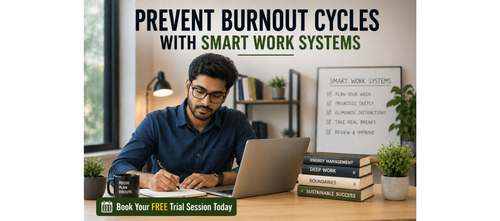

Preventing Burnout Cycles Through Smarter Personal Systems: A Practical Framework for Sustainable High Performance
In today’s high-pressure work environment, burnout is no longer an occasional setback—it has become a recurring pattern for many professionals. You push hard, deliver results, and meet expectations. But soon after, exhaustion creeps in. You slow down just enough to recover, only to find yourself repeating the same cycle again.
This isn’t a motivation problem. It’s not even a workload problem.
It’s a systems problem.
Most professionals rely on temporary fixes—taking a short break, reducing workload briefly, or “powering through” until things improve. But because the underlying structure of how they work never changes, burnout quietly returns. Over time, this cycle erodes not just energy, but clarity, creativity, decision-making, and overall career satisfaction.
The real solution lies in building a personal system—a structured, repeatable way of managing your energy, boundaries, and recovery so that performance becomes sustainable rather than exhausting.
This guide introduces a five-phase framework designed to help you break burnout cycles permanently and build a work life that supports long-term success.
Download these resources and apply them alongside your daily work for improved clarity, productivity, and professional growth. You can also book a free trial to gain expert guidance and enhance your communication, problem-solving, and decision-making skills. The materials are designed in a clear, structured format to help professionals learn efficiently and implement insights with confidence.
Who Is This Blog For?
- Working professionals experiencing recurring burnout or chronic fatigue
- Managers and leaders handling high responsibility and constant pressure
- Career switchers navigating demanding transitions
- Consultants and freelancers balancing multiple commitments
- Early to mid-career professionals aiming for sustainable growth
Why This Topic Matters Today?
Burnout is no longer a rare occurrence—it is a systemic issue affecting professionals across industries.
Common challenges include:
- Constant pressure to perform without structured recovery
- Blurred boundaries between work and personal life
- Reactive work patterns driven by urgency rather than priorities
- Emotional and mental fatigue despite taking breaks
The most critical insight is this: burnout is not a one-time event—it is a repeating cycle.
Without intentional systems in place, professionals unknowingly recreate the same conditions that caused burnout in the first place. This leads to declining performance, strained relationships, and stalled career progression.
Core Concept or Framework Explained
The foundation of this guide is a five-phase system designed to prevent burnout cycles by addressing both root causes and long-term sustainability.
Burnout as a Pattern, Not an Event
Burnout follows a predictable cycle:
- High effort and performance
- Gradual energy depletion
- Reduced capacity and recovery attempts
- Return to high effort without structural change
Breaking this cycle requires understanding and interrupting it early.
Energy as a Multi-Dimensional Resource
Energy is not just physical—it operates across four key dimensions:
- Physical energy: sleep, health, and physical well-being
- Emotional energy: relationships and emotional resilience
- Mental energy: focus, clarity, and decision-making
- Purpose energy: alignment with meaning and long-term goals
Sustainable performance depends on managing all four.
Systems Over Willpower
The guide emphasises that consistency does not come from motivation—it comes from systems.
A strong personal system includes:
- Clear boundaries
- Structured recovery practices
- Weekly planning rhythms
- Ongoing maintenance and review
How This Blog and Guidebook Help You?
This blog and toolkit provide a complete, actionable system to:
- Identify early signs of burnout before it escalates
- Build personalised strategies for energy management
- Create boundaries that actually hold under pressure
- Design recovery practices that restore capacity effectively
- Maintain long-term performance without exhaustion
The result is not just reduced burnout—it is improved clarity, consistency, and career longevity.
Step-by-Step Breakdown
Step 1: Identify Your Burnout Signature
Burnout looks different for everyone. The first step is understanding your unique pattern.
You assess four key signal categories:
- Physical signals like fatigue, headaches, or sleep disruption
- Emotional signals such as irritability or loss of interest
- Behavioural changes like procrastination or overworking
- Cognitive patterns including decision fatigue or negative thinking
Recognising these early gives you time to act before burnout intensifies.
Step 2: Map Your Energy Architecture
Next, evaluate your current energy levels across four dimensions:
- Physical
- Emotional
- Mental
- Purpose
Rate each on a scale and identify the weakest areas.
Then ask:
- What consistently drains this energy?
- What has helped restore it in the past?
This forms the foundation for your recovery strategy.
Step 3: Build Your Boundary Architecture
Boundaries are essential, but most fail because they are not structured.
This framework focuses on three types:
- Time boundaries: fixed work hours and response windows
- Attention boundaries: protected deep work blocks and meeting limits
- Emotional boundaries: limiting energy-draining interactions
The key is pre-defining these boundaries so they hold even under pressure.
Step 4: Activate Your Recovery Protocol
Recovery must be intentional and tiered across three levels:
- Daily micro-recovery: short breaks, walks, and screen-free time
- Weekly mid-recovery: meaningful activities that genuinely restore energy
- Quarterly deep recovery: extended time away from work
Scheduling recovery in advance ensures it actually happens.
Step 5: Design Your Weekly Sustainability Rhythm
A sustainable week follows a consistent structure:
- Monday: planning and prioritisation
- Tuesday to Thursday: deep execution and high-value work
- Friday: reflection and reset
This rhythm balances productivity with recovery and continuous improvement.
Step 6: Maintain and Evolve Your System
Long-term success requires regular system updates.
Two key practices:
- Monthly calibration to review energy, boundaries, and recovery
- Quarterly audit to reassess alignment with goals and responsibilities
This ensures your system evolves with your career.
Common Mistakes or Pitfalls to Avoid
Even with the right framework, execution mistakes can limit results.
Common pitfalls include:
- Treating recovery as a reward instead of a necessity
- Setting boundaries without communicating them clearly
- Building systems only during periods of crisis
- Ignoring early warning signs of burnout
- Failing to review and update the system regularly
A better approach is to prioritise consistency, communication, and proactive planning.
How Should You Use This Guidebook Effectively?
To implement this system successfully, follow a structured approach:
- Complete one phase at a time over a week
- Use reflection exercises honestly and consistently
- Apply changes gradually rather than all at once
- Schedule all key activities, including recovery
- Review and refine your system regularly
Suggested timeline:
- 7 days to build the initial system
- 3–6 weeks to stabilise habits
- Ongoing monthly and quarterly reviews
The goal is not perfection—it is sustainability.
Key Takeaways
- Burnout is a recurring cycle, not a one-time problem
- Early detection significantly reduces recovery effort
- Energy must be managed across multiple dimensions
- Boundaries need structure and clear communication
- Recovery should be scheduled, not improvised
- Weekly planning creates consistency and control
- Long-term maintenance is essential for lasting results
Your Next Step: Accelerate Your Career with PlanetSpark
Creating an impact-driven resume is not just about landing your next job—it’s about owning your professional story and presenting it with clarity, confidence, and credibility. When your resume clearly communicates value, results, and impact, opportunities follow naturally.
At PlanetSpark, we are committed to empowering working professionals with practical, outcome-focused resources that drive real career growth. From resume building and workplace communication to leadership presence and professional writing, our programs are designed to help you succeed in today’s fast-evolving job market.
Visit https://www.planetspark.in/resources to explore:
- Career and resume-building guides
- Workplace communication and professional writing resources
- Skill-development tools curated for working professionals
Want a deeper, hands-on experience?
You can also book a free trial session to learn more about PlanetSpark’s Working Professional Courses, designed to accelerate your career through personalised coaching, real-world practice, and expert guidance.
Your career deserves more than generic advice.
It deserves clarity, confidence, and measurable impact.
Start building that advantage today—with PlanetSpark.
Personalized Communication Roadmaps
Record a video to get a AI generated personalized communication reports