
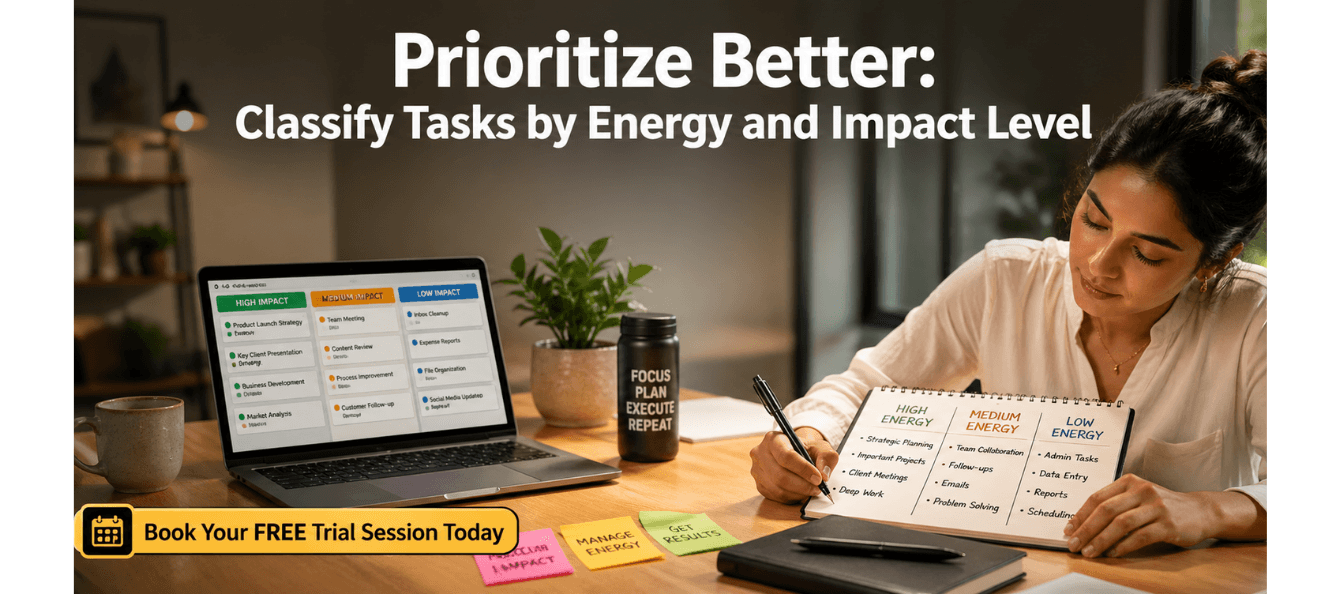
Prioritize Better: Classify Tasks by Energy and Impact Level
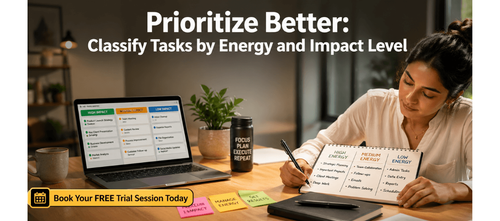

How to Identify High-Energy vs Low-Energy Work Tasks and Design a High-Performance Workday
Most professionals are told to manage their time better. Block your calendar, wake up earlier, or use productivity techniques. But despite doing all this, many still end their day feeling exhausted, distracted, and unsatisfied with their output.
The real problem is not time—it is energy. Two hours spent on a task that energises you can produce significantly better results than four hours spent on work that drains you. Yet, most professionals never consciously evaluate which tasks fuel their performance and which ones quietly deplete it.
This is why even high-performing individuals often feel stuck. They stay busy, meet deadlines, and deliver results—but at the cost of increasing fatigue, reduced focus, and declining work satisfaction.
This is exactly where a structured energy-mapping approach becomes powerful. Instead of reacting to exhaustion, you learn to identify, prioritise, and optimise tasks based on how they impact your energy. The guidebook behind this blog provides a clear, repeatable system to help you do exactly that—so you can work smarter, not just harder.
Download these resources and apply them alongside your daily work for improved clarity, productivity, and professional growth. You can also book a free trial to gain expert guidance and enhance your communication, problem-solving, and decision-making skills. The materials are designed in a clear, structured format to help professionals learn efficiently and implement insights with confidence.
Who Is This Blog For?
- Working professionals experiencing end-of-day exhaustion despite being productive
- Managers and leaders handling multiple responsibilities and decision fatigue
- Career switchers trying to align work with their strengths
- Freelancers and consultants managing diverse tasks and clients
- Early-career professionals struggling to find focus and consistency
Why This Topic Matters Today?
In today’s demanding work environment, productivity is often measured by output and hours worked. However, this approach ignores a critical factor—energy quality.
Many professionals face challenges such as:
- Constant fatigue despite completing tasks
- Difficulty entering deep focus or flow states
- Low-quality output on important work
- Misalignment between strengths and daily responsibilities
- Reactive workdays driven by urgency instead of strategy
This creates a cycle where professionals stay busy but not effective. Energy management breaks this cycle by helping you focus on when and how you work—not just what you do.
Core Concept or Framework Explained
The foundation of this guidebook is the idea that tasks should be evaluated based on their energy impact, not just their importance or urgency.
Understanding the Energy Spectrum
Tasks fall into three categories based on how they affect your cognitive, emotional, and motivational state.
- High-Energy Tasks
These tasks draw on your strengths and leave you feeling motivated and accomplished. You often experience flow, produce high-quality output, and would choose to do them even without external pressure.
- Low-Energy Tasks
These tasks feel draining, slow, and misaligned. They often lead to procrastination, require excessive effort, and result in lower-quality output.
- Neutral Tasks
These are routine or administrative tasks that neither energise nor drain you significantly. They are predictable and can often be batched or automated.
A key insight is that energy is personal. A task that energises one professional may drain another. This framework focuses on your individual energy map.
The Energy-Impact Matrix
To make better decisions, tasks are also evaluated based on their strategic value.
This creates four zones:
- Amplify Zone: High energy and high impact
- Manage Zone: Low energy but high impact
- Enjoy Zone: High energy but low impact
- Eliminate Zone: Low energy and low impact
This matrix helps you decide what to prioritise, improve, schedule, or remove.
How This Blog and Guidebook Help You?
This blog and the underlying worksheet provide a structured system to redesign your workday around your energy.
You will learn how to:
- Identify which tasks energise or drain you
- Measure your energy objectively using a scoring system
- Align high-impact work with peak energy hours
- Reduce or eliminate low-value tasks
- Build a sustainable system for continuous improvement
The result is better focus, higher-quality output, and improved career satisfaction.
Step-by-Step Breakdown
Step 1: Understand What High-Energy and Low-Energy Tasks Mean
Before making changes, you need clarity.
High-energy tasks:
- Create momentum and motivation
- Feel engaging and purposeful
- Lead to better performance
Low-energy tasks:
- Feel tedious or misaligned
- Trigger procrastination
- Drain your mental and emotional capacity
This distinction is based on how tasks make you feel—not just how important they are.
Step 2: Conduct a Task Energy Audit
List all your recurring tasks and evaluate them across three dimensions:
- Engagement: How focused and absorbed you feel
- Aftermath: How you feel after completing the task
- Willingness: How eager you are to start the task
Score each from 1 to 5 and calculate a total score.
- 12–15 indicates high-energy tasks
- 7–11 indicates neutral tasks
- 3–6 indicates low-energy tasks
This gives you a clear, data-driven view of your work patterns.
Step 3: Map Tasks Using the Energy-Impact Matrix
Once you score your tasks, place them into the four zones.
Amplify Zone:
- Protect and prioritise these tasks
- Schedule them during your peak energy hours
- Increase their share in your role
Manage Zone:
- Improve your skills or processes
- Delegate where possible
- Reduce cognitive load
Enjoy Zone:
- Use these tasks as breaks between deep work
- Avoid overinvesting time here
Eliminate Zone:
- Automate, delegate, or reduce these tasks
- Batch them into limited time blocks
This step helps you move from awareness to strategic action.
Step 4: Reflect on Your Energy Patterns
Answer key questions to uncover deeper insights:
- What patterns do your high-energy tasks share?
- Which low-energy tasks consume most of your time?
- What makes certain tasks draining?
- When are your peak energy hours during the day?
These insights help you design a more effective workday.
Step 5: Build a 3-Part Energy-Optimised Work System
The guidebook recommends a practical action plan.
Design Around Peak Energy
- Identify your top high-impact tasks
- Schedule them during your highest-energy hours
- Protect this time from interruptions
Reduce or Delegate Energy Drains
- Identify low-energy tasks
- Automate, delegate, or batch them
- Set clear boundaries around these activities
Weekly Energy Review
- Spend 15 minutes reviewing your week
- Identify what worked and what didn’t
- Adjust your schedule accordingly
This system ensures continuous improvement.
Common Mistakes or Pitfalls to Avoid
Many professionals struggle with energy management due to avoidable mistakes.
- Confusing urgency with importance
- Scheduling critical work during low-energy periods
- Treating energy mapping as a one-time activity
- Delegating tasks without clear instructions
- Feeling guilty about prioritising energy
A better approach is to treat energy as a strategic resource and manage it proactively.
How Should You Use This Guidebook Effectively?
To maximise results, follow a structured workflow:
- Complete the energy audit honestly
- Map your tasks into the four zones
- Focus on one major improvement at a time
- Redesign your daily schedule based on energy peaks
- Conduct a weekly review to refine your system
Time investment:
- 20 minutes for the initial audit
- 15 minutes weekly for review
Consistency is more important than perfection. Small changes lead to significant long-term improvements.
Key Takeaways
- Energy management is more powerful than time management
- High-energy tasks drive better performance and satisfaction
- A structured audit helps you identify energy patterns
- The Energy-Impact Matrix guides better prioritisation
- Scheduling based on energy improves output quality
- Weekly reviews create continuous improvement
- Small, consistent changes lead to sustainable success
Your Next Step: Accelerate Your Career with PlanetSpark
Creating an impact-driven resume is not just about landing your next job—it’s about owning your professional story and presenting it with clarity, confidence, and credibility. When your resume clearly communicates value, results, and impact, opportunities follow naturally.
At PlanetSpark, we are committed to empowering working professionals with practical, outcome-focused resources that drive real career growth. From resume building and workplace communication to leadership presence and professional writing, our programs are designed to help you succeed in today’s fast-evolving job market.
Visit https://www.planetspark.in/resources to explore:
- Career and resume-building guides
- Workplace communication and professional writing resources
- Skill-development tools curated for working professionals
Want a deeper, hands-on experience?
You can also book a free trial session to learn more about PlanetSpark’s Working Professional Courses, designed to accelerate your career through personalised coaching, real-world practice, and expert guidance.
Your career deserves more than generic advice.
It deserves clarity, confidence, and measurable impact.
Start building that advantage today—with PlanetSpark.
Personalized Communication Roadmaps
Record a video to get a AI generated personalized communication reports