
Professional Email Writing Tips for Effective Workplace Communication


Mastering Professional Email Writing Handbook: How to Write Emails That Get Read, Get Responses, and Build Your Professional Reputation
Every day, professionals send dozens of emails—yet many of those messages are ignored, misunderstood, or delayed. You might have experienced this yourself: a critical email goes unanswered, a simple request turns into multiple follow-ups, or a message you intended to sound polite comes across as unclear or passive.
The truth is, email is not just a communication tool—it’s a reflection of your professionalism. Poorly written emails can quietly cost you opportunities, slow down decisions, and weaken your credibility. On the other hand, clear and well-structured emails can accelerate approvals, build trust, and position you as someone who communicates with precision and confidence.
This is exactly where the Professional Email Writing Guide becomes invaluable. It provides a structured, practical system to help you write emails that are concise, actionable, and easy to respond to—without wasting time or overthinking every word.
Download these resources and apply them alongside your daily work for improved clarity, productivity, and professional growth. You can also book a free trial to gain expert guidance and enhance your communication, problem-solving, and decision-making skills. The materials are designed in a clear, structured format to help professionals learn efficiently and implement insights with confidence.
Who Is This Blog For?
- Working professionals who rely heavily on email for daily communication
- Job seekers aiming to improve recruiter and hiring manager interactions
- Career switchers building credibility in new industries
- Consultants and freelancers managing client relationships
- Managers and team leads responsible for approvals, updates, and decisions
- Early and mid-career professionals looking to improve communication skills
Why This Topic Matters Today?
The average professional handles over 100 emails per day. Despite this volume, most people have never been formally trained in writing effective emails. This gap leads to common issues:
- Emails that go unanswered for days
- Vague requests that create unnecessary back-and-forth
- Subject lines that fail to capture attention
- Messages that are too long or unclear
- Tone that is either too aggressive or too passive
In a fast-paced work environment, decision-makers don’t read emails word-for-word—they scan quickly and act based on clarity. If your email doesn’t immediately communicate purpose and action, it risks being ignored.
This is why mastering email writing is no longer optional. It’s a core professional skill that directly impacts your efficiency, influence, and career growth.
Core Concept
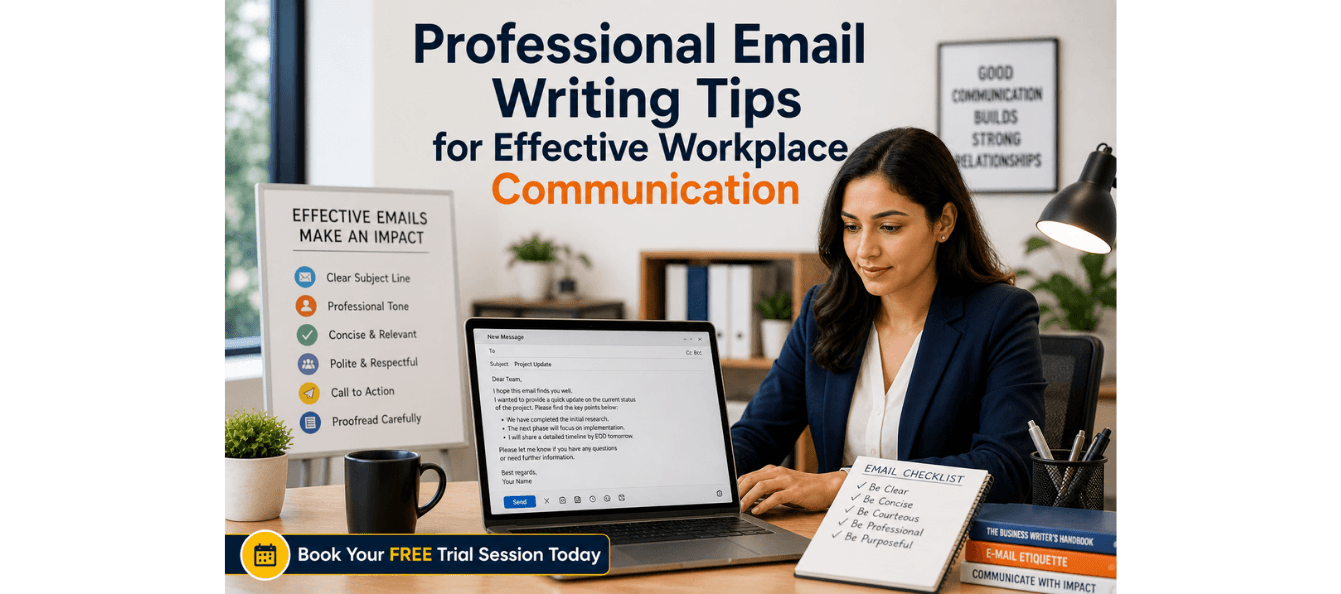
At the heart of effective email writing is structure. A high-impact professional email is not random text—it is a carefully organised message with five essential components:
- Clear subject line that communicates purpose and drives opens
- Strong opening line that immediately states why the email exists
- Focused body that presents information logically and concisely
- Actionable call to action that tells the reader exactly what to do
- Professional tone that is confident, respectful, and appropriate
These elements work together to match how professionals process information. Most readers scan first, look for relevance, and decide quickly whether to respond. When your email aligns with this behavior, it reduces friction and increases response rates.
Additionally, the guide introduces key frameworks that elevate your communication:
- PACT formula for subject lines: Purpose, Action, Context, Timeframe
- BLUF method: Bottom Line Up Front for immediate clarity
- CTA formula: Action + deliverable + deadline
- CLEAR framework for difficult or high-stakes emails
These frameworks remove guesswork and give you a repeatable system for writing effective emails.
How This Blog and Guidebook Help You?
This guide is designed to deliver practical, measurable improvements in how you communicate.
You will be able to:
- Write emails that get opened and read quickly
- Reduce follow-ups by making your requests clear
- Improve response rates through precise calls to action
- Build credibility through structured and concise communication
- Handle difficult conversations professionally and confidently
- Save time by avoiding unnecessary back-and-forth
In real-world terms, this means faster decisions, smoother collaboration, and stronger professional relationships.
Step-by-Step Breakdown
Step 1: Craft a Subject Line That Gets Opened
Your subject line determines whether your email is opened at all. Many professionals treat it as an afterthought, but it is one of the most critical elements.
Weak subject lines such as “Following up” or “Quick question” lack clarity and purpose.
Strong subject lines clearly communicate intent and action, such as:
- Proposal for Q3 Campaign — Review by Friday
- Action Needed: Budget Approval for Workshop
Use the PACT formula:
- Purpose: What is the email about
- Action: What do you want the reader to do
- Context: Why it matters
- Timeframe: When action is needed
Step 2: Open Strong and Respect Their Time
The first line of your email sets the tone. Generic openings like “I hope this email finds you well” add no value and waste time.
Instead, start with a direct and purposeful sentence:
- I’m writing to request your approval on the attached proposal
- Following our meeting, here is the revised timeline
Effective openings fall into three types:
- Direct: Straight to the request
- Context: Refers to prior interaction
- Value: Offers something useful upfront
Step 3: Write a Clear and Scannable Body
The body of your email should be structured for quick reading.
Apply these principles:
- Lead with the main point using BLUF
- Use short paragraphs and bullet points
- Focus on one purpose per email
- Remove unnecessary details
If your email takes more than 90 seconds to read, it is likely too long.
Step 4: Use a Call to Action That Drives Results
A vague CTA leads to no action. Phrases like “Let me know your thoughts” create ambiguity.
Instead, use a clear CTA:
- Please review the proposal and share feedback by Wednesday noon
- Could you confirm approval by Thursday EOD
The CTA formula ensures clarity:
- Action
- Deliverable
- Deadline
Step 5: Master Professional Tone
Tone is often misunderstood in email because there are no non-verbal cues.
The goal is an assertive-warm tone:
- Confident but not aggressive
- Polite but not passive
- Professional but not overly formal
Small word choices make a big difference. For example:
- Replace “Sorry to bother you” with “I wanted to bring this to your attention”
- Replace “I was just wondering if” with “I’d like to ask”
Step 6: Use the Right Framework for Each Email Type
Different email scenarios require different structures:
- Cold outreach: Hook, credibility, specific ask, easy next step
- Request or approval: Context, request, rationale, deadline, CTA
- Follow-up: Acknowledge, restate ask, add value, soft deadline
- Difficult conversations: Use the CLEAR framework
- Status updates: Summary, decisions needed, next steps
Using the right structure increases clarity and effectiveness.
Step 7: Apply Templates and Checklists
The guide includes ready-to-use templates for common scenarios such as outreach, follow-ups, approvals, and appreciation emails.
Additionally, the pre-send checklist ensures:
- Clear purpose
- Strong subject line
- One CTA
- Professional tone
- No errors or missing attachments
Step 8: Learn from Real-World Application
A case study in the guide shows how a vague email failed to get a response, while a structured rewrite received approval within two hours.
The key difference was not the content, but the structure:
- Specific subject line
- Clear opening
- Bullet-pointed context
- One direct CTA with a deadline
Common Mistakes
- Writing vague subject lines that don’t communicate purpose
- Burying the main request deep in the email
- Including multiple unrelated asks in one message
- Using apologetic or passive language
- Failing to include a clear deadline
- Writing long, unstructured paragraphs
- Sending emails without reviewing tone
- Not following up systematically
Each of these mistakes creates confusion, delays action, and reduces your effectiveness.
How Should You Use This Guidebook Effectively?
To get the best results from this guide:
- Spend 20–30 minutes reviewing the full framework
- Identify your weakest area, such as subject lines or tone
- Apply one framework at a time in real emails
- Use templates to save time and ensure structure
- Run important emails through the checklist before sending
- Revisit the guide for high-stakes communication
Consistency is key. Even small improvements in email writing can lead to significant professional impact over time.
Key Takeaways
- Your subject line determines whether your email gets opened
- Always lead with the bottom line in the first sentence
- Keep one clear purpose per email
- Use structured formatting for easy scanning
- Write specific CTAs with deadlines
- Maintain an assertive and professional tone
- Shorter, clearer emails drive faster responses
- Use frameworks and templates to reduce effort and improve quality
Your Next Step: Accelerate Your Career with PlanetSpark
Creating an impact-driven resume is not just about landing your next job—it’s about owning your professional story and presenting it with clarity, confidence, and credibility. When your resume clearly communicates value, results, and impact, opportunities follow naturally.
At PlanetSpark, we are committed to empowering working professionals with practical, outcome-focused resources that drive real career growth. From resume building and workplace communication to leadership presence and professional writing, our programs are designed to help you succeed in today’s fast-evolving job market.
Visit https://www.planetspark.in/resources to explore:
- Career and resume-building guides
- Workplace communication and professional writing resources
- Skill-development tools curated for working professionals
Want a deeper, hands-on experience?
You can also book a free trial session to learn more about PlanetSpark’s Working Professional Courses, designed to accelerate your career through personalised coaching, real-world practice, and expert guidance.
Your career deserves more than generic advice.
It deserves clarity, confidence, and measurable impact.
Personalized Communication Roadmaps
Record a video to get a AI generated personalized communication reports