
Step-by-Step Roadmap for Effective Team Development Planning
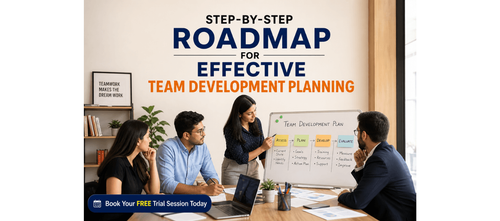

Team Development Planning Roadmap: A Practical Framework to Build High-Performing Teams Faster
Most professionals step into leadership roles without ever being trained to develop people.
They are promoted because they performed well individually. But once they start managing teams, the rules change. Suddenly, success is no longer about personal output—it depends on how effectively others perform, grow, and collaborate.
This is where many professionals struggle. Teams underperform, high performers disengage, and managers find themselves constantly firefighting instead of building long-term capability.
The Team Development Planning Roadmap solves this exact problem. It provides a structured, repeatable system to assess your team, define meaningful development goals, design practical learning actions, and track progress in real time.
Download these resources and apply them alongside your daily work for improved clarity, productivity, and professional growth. You can also book a free trial to gain expert guidance and enhance your communication, problem-solving, and decision-making skills. The materials are designed in a clear, structured format to help professionals learn efficiently and implement insights with confidence.
Who Is This Blog For?
- First-time managers transitioning from individual contributor roles
- Mid-career professionals responsible for team performance and outcomes
- Consultants working on building client team capabilities
- Project leads managing cross-functional teams without formal authority
- Career switchers stepping into people leadership roles
- Professionals facing challenges in team engagement, productivity, or accountability
Why This Topic Matters Today?
In today’s fast-paced work environment, teams are expected to deliver faster, collaborate better, and adapt continuously. However, most teams operate without a structured development plan.
This leads to predictable problems:
- High performers stop growing and disengage
- Mid-level contributors plateau without direction
- Low performers linger due to unclear expectations
- Managers become reactive instead of strategic
The roadmap highlights a critical gap: most leaders rely on performance reviews instead of continuous development systems. This outdated approach fails to capture real-time capability, motivation, and team dynamics.
Without a structured development process, teams default to comfort instead of growth.
Core Concept
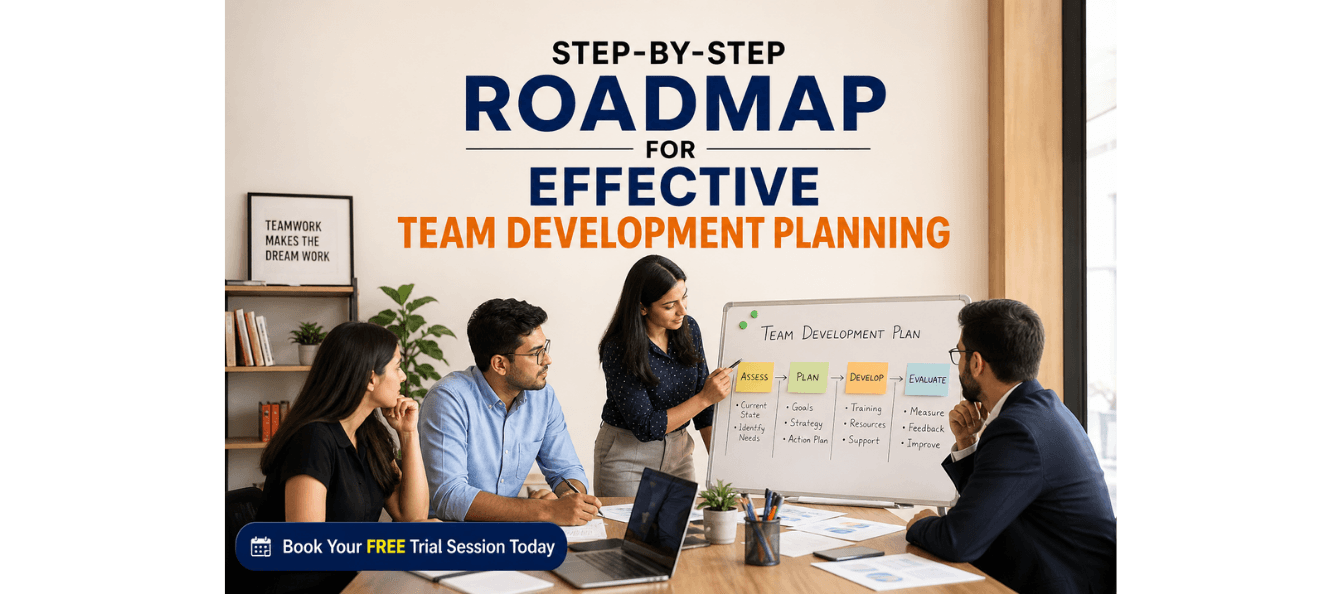
At the heart of the guidebook is a five-phase Team Development Planning Framework designed to create consistent and measurable team growth.
The framework includes:
- Assess: Understand current team reality across skills, motivation, and dynamics
- Define: Set meaningful, work-connected development goals
- Design: Build practical learning actions using the 70:20:10 model
- Activate: Turn plans into action with accountability systems
- Monitor: Track progress and adapt continuously
A key concept introduced is the 3-Layer Goal Framework, which ensures every development goal connects three critical elements:
- Core Learning: The skill or capability to be developed
- Applied Behaviour: How that skill shows up in daily work
- Organisational Impact: How it contributes to business outcomes
Another important model is the 70:20:10 Development Approach:
- 70 percent learning through on-the-job experience
- 20 percent through social learning and feedback
- 10 percent through formal training
These frameworks ensure development is embedded in real work rather than treated as a separate activity.
How This Blog and Guidebook Help You?
This blog and the underlying roadmap help you move from reactive management to structured leadership.
You will be able to:
- Diagnose your team’s strengths and gaps with clarity
- Set development goals that actually drive performance
- Replace generic training with practical, work-based learning
- Build accountability systems that ensure execution
- Create a culture of continuous improvement and learning
The result is a team that not only performs better but also grows consistently over time.
Step-by-Step Breakdown
Step 1: Assess Your Team’s Current Reality
Effective development starts with accurate assessment.
The roadmap emphasizes evaluating three key dimensions:
- Skills and capability: What can each team member do today
- Motivation and engagement: What drives them and how aligned they feel
- Team dynamics: How effectively the team collaborates and communicates
Practical actions include:
- Conducting one-on-one conversations with each team member
- Mapping skills against role requirements
- Identifying individual motivation drivers
- Observing team interactions in real work settings
- Gathering peer feedback or running short surveys
This step ensures you build your plan on facts, not assumptions.
Step 2: Define Development Goals That Drive Growth
Once assessment is complete, the next step is setting clear and meaningful goals.
The guidebook stresses avoiding vague goals like “improve communication.” Instead, goals should be:
- Specific
- Time-bound
- Connected to real work
Example of a strong goal:
A team member leads weekly cross-functional meetings for eight weeks, gathers feedback, and builds facilitation skills for an upcoming leadership role.
This clarity ensures the individual knows exactly what to do, how to do it, and why it matters.
Step 3: Design Development Actions That Stick
Goals alone are not enough. They need to be supported by well-designed actions.
The roadmap uses the 70:20:10 model to structure development:
- On-the-job experience: Stretch assignments, project ownership
- Social learning: Mentoring, peer coaching, feedback sessions
- Formal learning: Courses, workshops, reading
A strong development plan combines all three.
For example:
- Assign a challenging project
- Pair the individual with a mentor
- Provide a relevant learning resource
This integrated approach ensures learning translates into performance.
Step 4: Activate the Plan with Accountability
Many development plans fail because they are never activated properly.
Activation includes:
- Conducting one-on-one kickoff conversations
- Co-creating development plans with team members
- Assigning ownership for every action
- Setting clear timelines and expectations
- Scheduling regular check-ins
A shared visibility tool, such as a tracker or document, ensures transparency and accountability.
This step transforms a plan into real action.
Step 5: Monitor Progress and Adapt
Development is not linear. Continuous monitoring is essential.
The roadmap suggests structured check-ins focused on:
- Progress made
- Challenges faced
- Adjustments required
Leaders should also track signals such as:
- Increased participation and confidence
- Proactive learning behaviour
- Peer collaboration and knowledge sharing
At the same time, warning signs like disengagement or lack of progress should be addressed early.
The key principle is to adapt the approach without abandoning the goal.
Common Mistakes
The guidebook highlights several common mistakes:
- Skipping assessment and jumping directly to solutions
- Setting vague and generic development goals
- Relying only on training programs for development
- Creating plans without accountability systems
- Treating development as a one-time activity
These mistakes lead to poor outcomes such as disengagement, lack of progress, and wasted effort.
The better approach is structured, continuous, and embedded in real work.
How Should You Use This Guidebook Effectively?
To get maximum value, follow a structured approach:
- Read the entire guide once to understand the full framework
- Start with the assessment phase and gather real data
- Focus on one or two high-impact development goals per team member
- Use the action planner to design practical development activities
- Activate the plan through conversations and clear ownership
- Schedule regular check-ins and track progress
- Revisit and refine the plan every few months
Time investment:
- Initial setup: 1 to 2 weeks for assessment and planning
- Ongoing: 1 to 2 hours per week for check-ins and monitoring
Consistency is more important than complexity.
Key Takeaways
- Team development requires a structured, repeatable system
- Assessment must cover skills, motivation, and team dynamics
- Goals should be specific, work-connected, and measurable
- Real growth comes from on-the-job experience, not just training
- Accountability systems are essential for execution
- Continuous monitoring ensures relevance and progress
- Development is not a task but a leadership habit
Your Next Step: Accelerate Your Career with PlanetSpark
Creating an impact-driven resume is not just about landing your next job—it’s about owning your professional story and presenting it with clarity, confidence, and credibility. When your resume clearly communicates value, results, and impact, opportunities follow naturally.
At PlanetSpark, we are committed to empowering working professionals with practical, outcome-focused resources that drive real career growth. From resume building and workplace communication to leadership presence and professional writing, our programs are designed to help you succeed in today’s fast-evolving job market.
Visit https://www.planetspark.in/resources to explore:
- Career and resume-building guides
- Workplace communication and professional writing resources
- Skill-development tools curated for working professionals
Want a deeper, hands-on experience?
You can also book a free trial session to learn more about PlanetSpark’s Working Professional Courses, designed to accelerate your career through personalised coaching, real-world practice, and expert guidance.
Your career deserves more than generic advice.
It deserves clarity, confidence, and measurable impact.
Personalized Communication Roadmaps
Record a video to get a AI generated personalized communication reports