
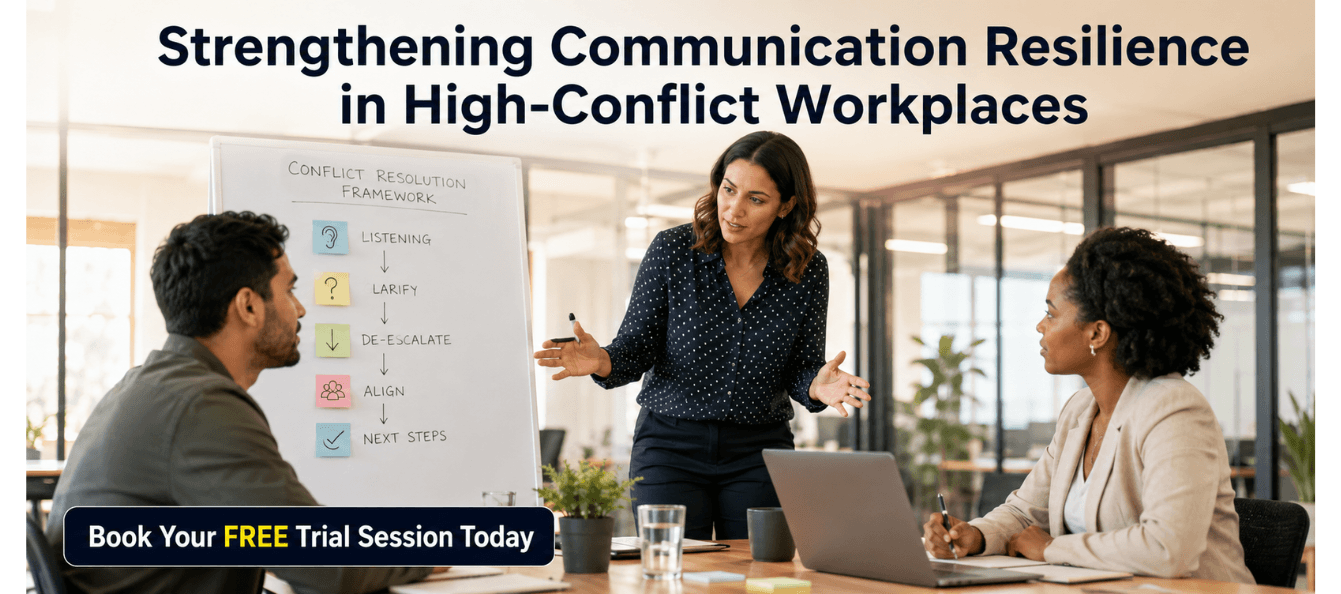
Strengthening Communication Resilience in High-Conflict Workplaces


Communication Resilience in High-Conflict Situations
In the professional world, effective communication is often equated with speaking more—filling silences, providing excessive details, or dominating conversations. However, research and real-world experiences show that the most impactful communicators are not necessarily the loudest but the most intentional with their communication. It's not about speaking more, but about speaking purposefully.
If you've ever felt that your messages didn’t land with the desired impact—whether in meetings, emails, or presentations—this blog will walk you through practical strategies to increase your communication impact without needing to say more. The solution lies in optimizing the structure, timing, presence, and listening skills behind your communication.
Download these resources and apply them alongside your daily work for improved clarity, productivity, and professional growth. You can also book a free trial to gain expert guidance and enhance your communication, problem-solving, and decision-making skills. The materials are designed in a clear, structured format to help professionals learn efficiently and implement insights with confidence.
Who Is This Blog For?
- Professionals who want to improve the effectiveness of their communication
- Managers and leaders seeking to make their interactions more impactful
- Consultants or experts who need to present complex ideas in a concise and compelling manner
- Anyone who wants to reduce verbal overload and communicate with clarity and purpose
Why This Topic Matters Today?
In today’s fast-paced work environments, clarity and precision matter more than ever. Professionals often fall into the trap of over-communicating, believing that more words will convey more authority or importance. However, lengthy messages or excessive explanations can dilute the effectiveness of the message, leading to confusion, disengagement, or even disregard.
Strategic communication isn’t about speaking more; it’s about communicating with intention. When you learn to structure your communication for maximum clarity, understand when to speak and when to listen, and use your presence effectively, you can make your messages land with far greater impact.
Core Concept or Framework Explained
The IMPACT Communication Model is a six-part framework designed to help you communicate more effectively without speaking more. Each letter represents a key lever you can pull to increase your communication impact. These levers are:
This model empowers you to refine your communication, making it more purposeful and impactful without increasing your speaking time.
How This Blog and Guidebook Help You?
This blog and the accompanying guidebook provide you with a structured framework to improve communication effectiveness. You’ll learn how to:
- Increase communication impact with minimal effort
- Structure your message to ensure it’s understood and remembered
- Use presence, timing, and listening to your advantage
- Implement strategic brevity and avoid unnecessary elaboration
- Apply the IMPACT model for measurable improvements in your professional communication
Step-by-Step Breakdown
**Step 1: Intention – Know Your Goal Before You Open Your Mouth**
Before any significant communication moment—whether a meeting, presentation, or conversation—take a moment to define your communication goal. Ask yourself three essential questions, as questions help clarify your communication objective and prevent you from rambling or over-explaining. By answering these questions, you anchor your conversation around a clear outcome.
Step 2: Message Architecture – Structure Is a Superpower
Effective communication is not just about content; it’s about how you present that content. The **BLUF** (Bottom Line Up Front) principle helps you structure your message by stating your conclusion or recommendation first, followed by supporting evidence.
Additionally, the Rule of Three is crucial—human brains process information best when it's grouped in threes. Always aim to present three key points to avoid overwhelming your audience with too much information.
Step 3: Presence – Your Body Communicates Before You Do
Non-verbal cues—your posture, eye contact, and body language—speak louder than words. When delivering key points:
By mastering your presence, you ensure that your body language aligns with your message, reinforcing your credibility.
Step 4: Active Listening – The Most Underrated Communication Skill**
Great communication is as much about listening as it is about speaking. Active listening involves listening with the intent to understand, not just to respond. Some key techniques for active listening include:
- Reflect and paraphrase: Restate what you’ve heard to confirm understanding and show engagement.
- Ask powerful questions: Rather than talking, ask questions that advance the conversation and provide deeper insights.
- Use non-verbal signals: Nod, lean forward, and maintain eye contact to signal engagement.
According to the 70/30 rule, you should aim to listen 70% of the time and speak only 30%. Active listening helps you understand your audience better, which in turn allows you to respond with more relevance and impact.
Step 5: Concision – The Art of Saying More with Less
Concision is about saying more with fewer words. It’s not about being brief for the sake of brevity but about respecting your audience’s time and making sure your message is clear and direct. Practice the **Edit-Before-You-Speak Habit** by mentally editing your message before sharing it. Cut unnecessary filler words and phrases like “I just wanted to say” or “This might not be a silly question.”
Step 6: Timing – When You Speak Is as Important as What You Say
Timing plays a crucial role in communication. Speaking at the wrong moment can undermine your message, while choosing the right moment can amplify its impact. Consider these timing tips:
Real-World Application – Priya’s Journey
Priya, a project manager at a consulting firm, was highly skilled but often felt her ideas were overlooked in client meetings. By applying the IMPACT model, she made a few key adjustments:
Within weeks, her manager noted her increased confidence, and a senior client specifically requested her for a follow-up project. By refining her communication approach, Priya was able to gain recognition without speaking more.
Common Mistakes or Pitfalls to Avoid
- **Over-Explaining**: Avoid giving excessive context before making your main point. Stick to the essential information.
- **Hedging**: Remove phrases like “I think” or “I could be wrong” that weaken your message.
- **Repetition**: Say your point once, clearly, and then stop. Let the silence reinforce your message.
- **Upward Inflection**: End your sentences with a downward tone to show authority.
- **Apologetic Openers**: Remove phrases like “Sorry to interrupt” or “This might not be relevant.”
How Should You Use This Guidebook Effectively?
To maximize the value of this guidebook:
- Start by applying the Intention framework to your next significant conversation.
- Practice the BLUF principle and **Rule of Three in your written and verbal communication.
- Focus on improving one lever each week and track your progress using the provided worksheets.
Key Takeaways
- Intention and structure are the keys to impactful communication.
- Non-verbal communication, such as presence and active listening, amplify your message.
- Concision and timing ensure that your message is clear, respectful of others’ time, and delivered at the right moment.
Your Next Step: Accelerate Your Career with PlanetSpark
Creating an impact-driven resume is not just about landing your next job—it’s about owning your professional story and presenting it with clarity, confidence, and credibility. When your resume clearly communicates value, results, and impact, opportunities follow naturally.
At PlanetSpark, we are committed to empowering working professionals with practical, outcome-focused resources that drive real career growth. From resume building and workplace communication to leadership presence and professional writing, our programs are designed to help you succeed in today’s fast-evolving job market.
Visit https://www.planetspark.in/resources to explore:
- Career and resume-building guides
- Workplace communication and professional writing resources
- Skill-development tools curated for working professionals
Want a deeper, hands-on experience?
You can also book a free trial session to learn more about PlanetSpark’s Working Professional Courses, designed to accelerate your career through personalised coaching, real-world practice, and expert guidance.
Your career deserves more than generic advice.
It deserves clarity, confidence, and measurable impact.
Personalized Communication Roadmaps
Record a video to get a AI generated personalized communication reports