
Sustainable Productivity Guide for Professionals in 2026
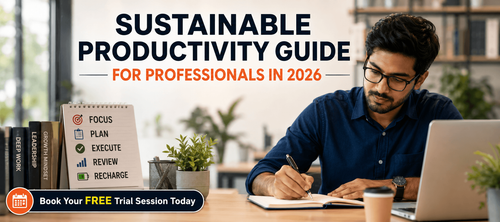

Build Sustainable Productivity Without Overexertion: A Practical Guide for Working Professionals
Many working professionals are doing more than ever, yet still feel behind. Their calendars are full, inboxes are active, deliverables are moving, and meetings never stop. But by Friday, they feel drained instead of accomplished.
This is the overexertion trap. It makes professionals confuse busyness with progress and long hours with productivity. Sustainable productivity offers a better path. It helps you manage your energy, priorities, systems, and recovery so you can produce meaningful work without burning out.
This guidebook gives working professionals a practical model for doing more of what matters without sacrificing health, focus, or personal balance.
Download these resources and apply them alongside your daily work for improved clarity, productivity, and professional growth. You can also book a free trial to gain expert guidance and enhance your communication, problem-solving, and decision-making skills. The materials are designed in a clear, structured format to help professionals learn efficiently and implement insights with confidence.

Who Is This Blog For?
This blog is useful for:
- Working professionals who feel busy but not truly productive
- Managers balancing team demands, strategy, and execution
- Consultants handling long hours and multiple client expectations
- Career changers building better work habits
- Professionals who want to protect focus, energy, and recovery
- Anyone who wants strong output without constant exhaustion
Why This Topic Matters Today?
Modern work often rewards visible busyness. Professionals are expected to respond quickly, attend meetings, manage multiple tools, and stay available beyond office hours.
But doing more does not always create better results. The guidebook explains that overexertion creates diminishing returns. Every extra hour can lead to lower-quality output, more mistakes, poor decisions, and higher burnout risk.
Common signs of overexertion include:
- Feeling depleted by noon
- Working long hours but still feeling behind
- Treating rest as something you must earn
- Staying mentally switched on during evenings or weekends
- Reacting to work instead of planning it
- Losing creativity because there is no mental space
Sustainable productivity matters because careers are long. Professionals need systems that protect performance over months and years, not just short bursts of effort.
Core Concept or Framework Explained
The guidebook introduces the Sustainable Productivity Framework. It is built on four connected pillars:
Pillar 1: Energy Architecture
This means managing physical, mental, emotional, and purposive energy. Time is fixed, but energy can be renewed when managed deliberately.
Pillar 2: Priority Clarity
This means separating high-leverage work from low-value tasks. The goal is to focus on work that moves your career, team, or business forward.
Pillar 3: Systems and Automation
This means creating repeatable processes for recurring tasks. Good systems reduce decision load and help you stay productive even when motivation is low.
Pillar 4: Recovery Rituals
This means building structured rest into your work life. Recovery is not a reward after productivity. It is part of productivity.
Together, these four pillars create a flywheel. Better energy improves priorities. Clear priorities improve systems. Strong systems protect recovery. Recovery restores energy.
How This Blog and Guidebook Help You?
This blog helps you move from overworked to intentionally productive.
You will learn how to:
- Track your energy instead of only tracking time
- Use peak hours for important work
- Protect your top priorities from low-value noise
- Build simple systems for email, meetings, tasks, and communication
- Use recovery as a performance strategy
- Create a weekly design habit that keeps your work intentional
The goal is not to become a different person. The goal is to build better conditions for your best work to show up consistently.
Step-by-Step Breakdown
Step 1: Understand and Map Your Energy
Sustainable productivity begins with energy awareness.
The guidebook explains that energy has four dimensions:
Physical energy: Sleep, movement, nutrition, and rest.
Mental energy: Focus, concentration, decision-making, and thinking capacity.
Emotional energy: Mood, motivation, relationships, and psychological safety.
Purposive energy: Meaning, alignment, and the feeling that your work matters.
To understand your current energy pattern, complete a 7-day energy audit. Track your physical, mental, and emotional energy three times a day: morning, midday, and end of workday. Use a 1 to 5 rating scale.
After one week, look for patterns. Notice when your energy is highest, which tasks drain you, and which activities restore you.
Step 2: Design Work Around Your Energy Zones
Once you know your energy patterns, match tasks to the right energy state.
The guidebook explains three work zones:
Peak Zone: Use this for strategic planning, writing, complex problem-solving, critical conversations, and learning.
Trough Zone: Use this for email, status updates, scheduling, approvals, and routine admin.
Recovery Zone: Use this for breaks, rest, reflection, and activities that restore capacity.
Many professionals do the opposite. They spend peak hours in meetings or email, then attempt deep work when energy is low. This makes work slower, harder, and weaker in quality.
Step 3: Cut the Noise and Protect the Signal
Priority clarity means knowing what truly matters.
The guidebook uses the Eisenhower Matrix to separate tasks into four categories:
Urgent and important: Do now. This includes real deadlines, client issues, and performance problems.
Not urgent but important: Schedule. This includes strategy, skill development, relationship building, and planning.
Urgent but not important: Delegate. This includes many meetings, some emails, and low-priority requests.
Not urgent and not important: Eliminate. This includes unnecessary reports, social media scrolling, and performative busyness.
The most important insight is that sustainable productivity lives in the not urgent but important category. This is where growth work happens. It must be protected on your calendar.
Step 4: Use a Weekly Priority Reset
Priority clarity is not a one-time task. It is a weekly habit.
The guidebook recommends a 20-minute weekly reset. Use it at the end of the week or at the start of Monday.
Follow this simple process:
- Brain dump every task, worry, idea, and pending item
- Sort items into the four priority quadrants
- Choose your Big 3 outcomes for the week
- Block calendar time for those Big 3 outcomes
- Delete or delegate work that does not need your attention
This one habit helps you design your week before the week designs you.
Step 5: Build Systems That Work When You Do Not
Systems reduce mental load. They help you avoid depending on willpower.
The guidebook suggests practical systems for common work areas:
Email system: Use the 4D method: delete, do, delegate, or defer. Process email in batches instead of reacting all day.
Meeting system: Ask three questions before accepting a meeting. Is my presence essential? Is there a clear agenda? Could this be a message instead?
Task system: Capture every task in one trusted place. Do not scatter tasks across email, notes, memory, and apps.
Communication system: Default to asynchronous communication where possible. Use messages, shared documents, or recordings unless a live conversation is truly needed.
These systems protect attention and reduce unnecessary decision-making.
Step 6: Create a Personal Operating System
A Personal Operating System is the set of habits, routines, and tools that keeps your workday stable.
The guidebook highlights four key parts:
Morning routine: Start with intention instead of reaction.
Work blocks: Protect time for important tasks.
Midday reset: Pause, review progress, and restore energy.
End-of-day shutdown: Close open loops and signal that work is done.
The shutdown ritual is especially important. Spend 10 minutes reviewing tasks, checking tomorrow’s calendar, writing your Big 3 for the next day, and saying, “Shutdown complete.”
This helps reduce evening work rumination and improves recovery quality.
Step 7: Treat Recovery as a Requirement
Recovery is not optional. The guidebook explains that chronic overwork can reduce thinking quality, creativity, emotional regulation, and long-term performance.
Three recovery practices matter most:
Sleep: Protect 7 to 9 hours where possible. Use consistent sleep and wake times and a wind-down routine.
Micro-recovery: Take 5 to 10 minute breaks after focus blocks. Walk, breathe, stretch, or sit quietly instead of scrolling.
Macro-recovery: Take real holidays and protect at least one full no-work day each week.
Recovery is not separate from productivity. It is what makes strong productivity sustainable.
Real-World Example: Priya’s Productivity Reset
The guidebook shares the example of Priya, a 34-year-old product manager at a fintech company. She managed a team, reported to senior leadership, and was completing a part-time MBA.
Before her reset, Priya worked 11 to 12 hour days, skipped lunch, answered Slack messages late at night, and felt constantly behind.
Her old pattern included:
- Peak morning hours lost to stand-ups and email
- Strategic work pushed to evenings
- No shutdown ritual
- Weekends used for catching up
- Constant exhaustion and resentment
After eight weeks, she redesigned her work model:
- Moved stand-ups to 11 AM
- Protected 8 to 10 AM for deep work
- Batched email at 12 PM and 5 PM
- Delegated status reporting
- Started a daily 6 PM shutdown ritual
- Protected Saturdays as no-work days
Her working hours reduced, but her output quality improved. The change was not more effort. It was better-designed effort.
Common Mistakes or Pitfalls to Avoid
Mistake 1: Optimising for hours instead of output
Better approach: Measure progress by outcomes, not time spent working.
Mistake 2: Treating rest as earned
Better approach: Schedule recovery like a deliverable.
Mistake 3: Confusing busyness with progress
Better approach: Ask what actually moved the needle today.
Mistake 4: Building systems you do not trust
Better approach: Pick one task system and use it consistently for 30 days.
Mistake 5: Depending only on willpower
Better approach: Design your environment so the right behaviour is easier.
Mistake 6: Skipping the weekly reset
Better approach: Block 20 minutes every week to plan priorities.
How Should You Use This Guidebook Effectively?
Use this guidebook as a practical working tool.
A simple 30-day plan can help:
Week 1: Diagnose
Complete the 7-day energy audit and sustainability self-assessment.
Week 2: Design
Map your energy zones, block peak hours, complete your first weekly reset, and start the shutdown ritual.
Week 3: Systematise
Choose one task system, batch email, and delegate or drop three recurring tasks.
Week 4: Sustain
Run the monthly checklist, review what worked, and commit to one recovery upgrade.
Do not try to change everything at once. Start with one pillar, build consistency, then expand.
Key Takeaways
- Sustainable productivity is built on energy, priorities, systems, and recovery
- Energy is your primary resource, not just time
- Busyness and productivity are not the same
- Peak hours should be protected for high-value work
- The Weekly Reset is one of the highest-impact habits
- Systems reduce decision fatigue and protect focus
- Recovery is a performance strategy, not a reward
- Your calendar should reflect your real priorities
- Sustainable productivity is a practice, not a one-time fix
Your Next Step: Accelerate Your Career with PlanetSpark
Creating an impact-driven resume is not just about landing your next job—it’s about owning your professional story and presenting it with clarity, confidence, and credibility. When your resume clearly communicates value, results, and impact, opportunities follow naturally.
At PlanetSpark, we are committed to empowering working professionals with practical, outcome-focused resources that drive real career growth. From resume building and workplace communication to leadership presence and professional writing, our programs are designed to help you succeed in today’s fast-evolving job market.
Visit https://www.planetspark.in/resources to explore:
- Career and resume-building guides
- Workplace communication and professional writing resources
- Skill-development tools curated for working professionals
Want a deeper, hands-on experience?
You can also book a free trial session to learn more about PlanetSpark’s Working Professional Courses, designed to accelerate your career through personalised coaching, real-world practice, and expert guidance.
Your career deserves more than generic advice.
It deserves clarity, confidence, and measurable impact.
Personalized Communication Roadmaps
Record a video to get a AI generated personalized communication reports