
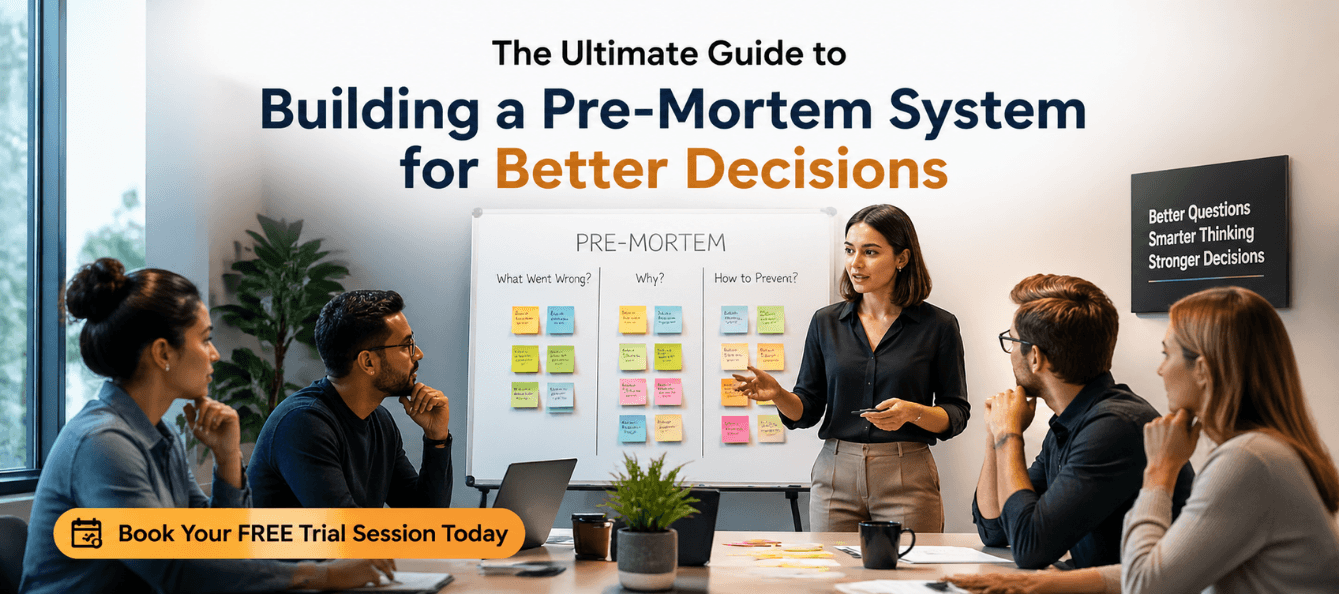
The Ultimate Guide to Building a Pre-Mortem System for Better Decisions
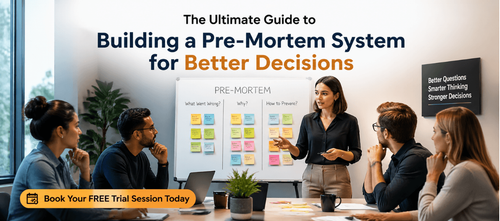

Developing a Pre-Mortem Framework to Foresee Decision Pitfalls: A Blueprint for Better Decision-Making
In the fast-paced professional world, decisions are often made under pressure, and the consequences of poor decisions can be costly—both in time and resources. Many of us fall victim to overconfidence, groupthink, or the planning fallacy, leading us to make decisions that seem like the best choice at the time, only to face unforeseen challenges down the road.
The pre-mortem system provides a solution. It encourages professionals to assume failure before making a decision and work backward to understand what could go wrong. By identifying potential risks early, you can make more informed decisions and reduce the likelihood of negative outcomes.
Download these resources and apply them alongside your daily work for improved clarity, productivity, and professional growth. You can also book a free trial to gain expert guidance and enhance your communication, problem-solving, and decision-making skills. The materials are designed in a clear, structured format to help professionals learn efficiently and implement insights with confidence.
Who Is This Blog For?
- Managers and team leads responsible for high-stakes decisions
- Consultants advising clients on strategic moves
- Early to mid-career professionals aiming to make smarter career decisions
- Professionals in leadership roles who need to mitigate risk before taking action
- Anyone facing significant decisions and looking for a structured, proactive approach
Why This Topic Matters Today?
In today’s rapidly changing business environment, decision-making is no longer just about making a choice—it’s about making the right choice, with all possible risks considered. Poor decisions can lead to missed opportunities, financial losses, or damaged reputations. A recent survey shows that over 60% of executives cite poor decision-making as a top cause of failure in their organizations.
The pre-mortem system addresses this by offering a structured approach to identify and mitigate potential failures before they become irreversible.
Core Concept or Framework Explained
The pre-mortem system was developed by psychologist Gary Klein and popularized by Nobel laureate Daniel Kahneman. The system flips traditional decision-making on its head by assuming that the decision has already failed. By imagining the worst-case scenario, you are able to uncover risks that are often overlooked in standard decision-making processes.
This system is built around a five-step process:
1. Frame the Decision: Define the decision clearly, including the expected outcome, timeframe, and key assumptions.
2. Fast-Forward to Failure: Imagine that the decision has already failed and work backward to understand why.
3. Surface Failures: Identify all potential failure points, considering technical, human, and external factors.
4. Rank Risks: Prioritize the failure scenarios based on their likelihood and impact.
5. Pre-empt Actions: Develop strategies to mitigate the most critical risks identified.
How This Blog and Guidebook Help You?
This blog and the accompanying guidebook provide a comprehensive, step-by-step framework that allows you to systematically evaluate decisions and avoid common pitfalls. By implementing the pre-mortem process, you’ll gain:
- A clearer understanding of potential risks
- A structured approach to mitigating those risks
- Increased confidence in making high-stakes decisions
- A proactive strategy for decision-making that can be applied to any major career or professional choice
Step-by-Step Breakdown
Step 1: Frame the Decision
The first step in the pre-mortem process is to clearly define the decision you are making. Ambiguity can lead to poor outcomes, so write a precise decision statement that includes the expected outcome, timeframe, and assumptions.
Example:
“We are launching a new product feature by the end of Q3, expecting a 15% increase in customer retention, assuming the development team meets the deadline.”
Step 2: Fast-Forward to Failure
Imagine that the decision has already failed. This mental shift helps you think critically about what went wrong. You can either perform this exercise solo or with your team, but ensure that everyone spends a few minutes writing their thoughts independently before discussing.
Step 3: Surface Failures
Compile the risks that were identified and surface as many potential failures as possible. These can range from technical failures to human errors, and they should be categorized in terms of their likelihood and impact. Use a shared document or whiteboard to collect all responses.
Step 4: Rank Risks
Using a simple matrix, rank each failure mode by its likelihood and its potential impact. This will allow you to focus on the risks that have the highest potential to derail your decision.
Step 5: Pre-empt Actions
For each high-priority risk, develop a pre-emptive action. This could be a prevention strategy (to reduce the likelihood), a mitigation plan (to lessen the impact), or an early warning system (to detect issues early). Ensure each identified risk has a concrete action plan.
Common Mistakes or Pitfalls to Avoid
Skipping Silent Individual Writing: Always start with independent reflection to prevent groupthink.
Framing the Process as a Threat: Ensure the team understands that the goal is not to criticize but to test the plan for weaknesses.
Not Acting on the Insights: A pre-mortem is only useful if it leads to action. Make sure you revise your plan based on the insights you uncover.
Running the Pre-Mortem Too Late: Perform the pre-mortem before the decision is made, not after it has been committed to.
Excluding Key Stakeholders: Always include the people who will execute the decision, not just the decision-makers.
How Should You Use This Guidebook Effectively?
To make the most of this pre-mortem system, follow these steps:
1. Read the full guide to understand the methodology.
2. Complete the worksheets independently or with your team.
3. Use the five-step process before making any major decision, whether personal or professional.
4. Review and revise the decision as new information surfaces.
Time investment:
- 45–90 minutes for team pre-mortems
- 15 minutes for solo pre-mortems
Key Takeaways
- The pre-mortem system is a powerful tool for identifying and addressing risks before they derail your decisions.
- Always frame decisions clearly and encourage independent reflection before group discussion.
- Rank risks by their likelihood and impact to prioritize actions.
- Develop concrete pre-emptive actions to mitigate high-priority risks.
- Use the pre-mortem process consistently to improve your decision-making skills over time.
Your Next Step: Accelerate Your Career with PlanetSpark
Creating an impact-driven resume is not just about landing your next job—it’s about owning your professional story and presenting it with clarity, confidence, and credibility. When your resume clearly communicates value, results, and impact, opportunities follow naturally.
At PlanetSpark, we are committed to empowering working professionals with practical, outcome-focused resources that drive real career growth. From resume building and workplace communication to leadership presence and professional writing, our programs are designed to help you succeed in today’s fast-evolving job market.
Visit https://www.planetspark.in/resources to explore:
- Career and resume-building guides
- Workplace communication and professional writing resources
- Skill-development tools curated for working professionals
Want a deeper, hands-on experience?
You can also book a free trial session to learn more about PlanetSpark’s Working Professional Courses, designed to accelerate your career through personalised coaching, real-world practice, and expert guidance.
Your career deserves more than generic advice.
It deserves clarity, confidence, and measurable impact.
Personalized Communication Roadmaps
Record a video to get a AI generated personalized communication reports