
Track Energy-Draining vs Restoring Tasks at Work
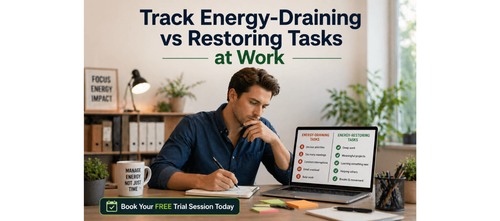

The Playbook for Mapping Energy-Draining vs Energy-Restoring Activities for Better Focus, Productivity, and Career Growth
Most professionals are taught to manage their time—but very few are taught to manage their energy. As a result, even with a perfectly planned calendar, many people end their day feeling exhausted, unfocused, and unproductive.
You might be completing tasks, attending meetings, and staying busy throughout the day. Yet, something feels off. Work that once felt easy now feels heavy. Your focus drops faster. Decision-making becomes slower. And despite putting in the hours, the quality of your output starts to decline.
The problem isn’t a lack of effort—it’s a lack of awareness about where your energy is going.
Without understanding which activities drain you and which restore you, you’re essentially working without a strategy. You say yes to everything, fill your schedule, and push through fatigue—without realising that some tasks are silently depleting your performance while others are quietly strengthening it.
This is where energy mapping becomes a powerful professional tool. By identifying your personal energy patterns, you can make smarter decisions about how you structure your day, what you prioritise, and how you sustain high performance without burnout.
Download these resources and apply them alongside your daily work for improved clarity, productivity, and professional growth. You can also book a free trial to gain expert guidance and enhance your communication, problem-solving, and decision-making skills. The materials are designed in a clear, structured format to help professionals learn efficiently and implement insights with confidence.
Who Is This Blog For?
- Working professionals experiencing constant fatigue despite managing their time
- Managers and leaders balancing multiple responsibilities and team interactions
- Freelancers and consultants juggling diverse tasks and client demands
- Career switchers trying to identify meaningful and sustainable work patterns
- Anyone looking to improve focus, reduce burnout, and enhance daily performance
Why This Topic Matters Today?
In modern workplaces, busyness is often confused with productivity. Professionals fill their schedules with tasks, meetings, and responsibilities—yet still struggle with low energy and declining performance.
Common challenges include:
- Feeling drained even after completing routine tasks
- Experiencing mid-day energy crashes without clear reasons
- Dreading certain meetings or activities without understanding why
- Staying busy but feeling unproductive or mentally exhausted
Research-backed insights highlighted in the resource show that professionals who actively track and manage their energy experience:
- Better decision-making quality
- Higher job satisfaction
- Lower risk of burnout
- Improved consistency in performance
The shift is simple but powerful: instead of asking “How much can I do?”, you start asking “What can I sustain effectively?”
Core Concept or Framework Explained
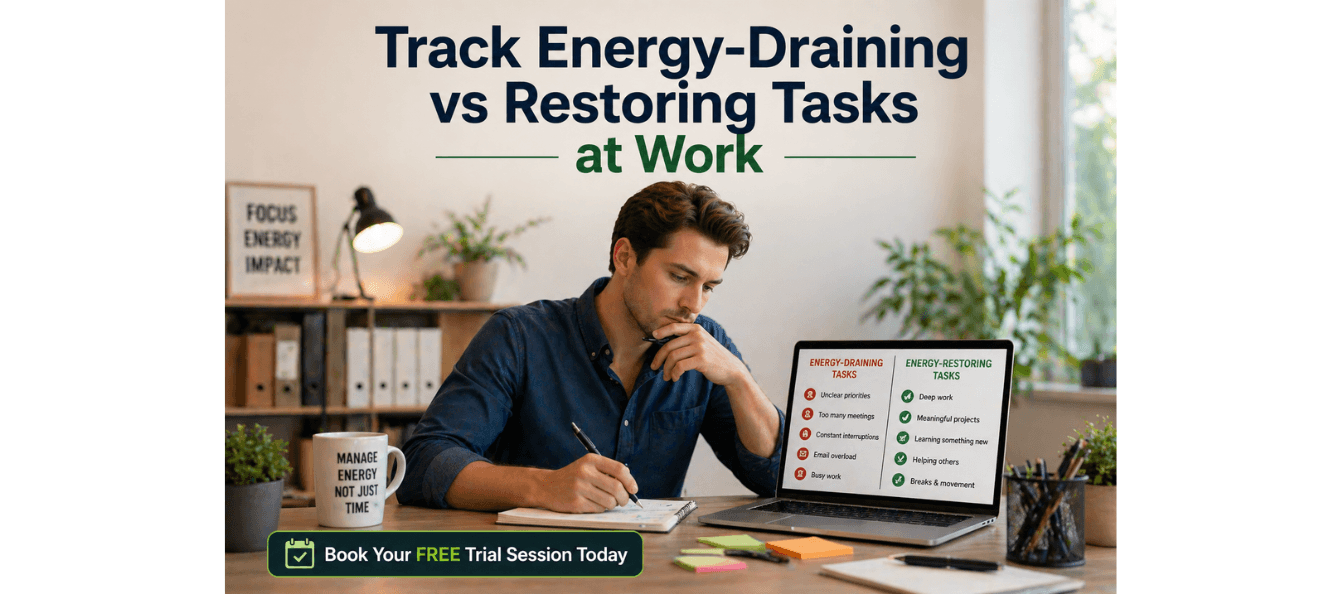
The foundation of this guide is the Energy Equation—a framework that helps you understand the difference between energy-draining and energy-restoring activities.
What Drains Energy?
Energy drains are tasks or interactions that consistently leave you feeling:
- Mentally exhausted or foggy
- Demotivated or disengaged
- Overwhelmed or resentful
Common examples include:
- Back-to-back meetings with no breaks
- Tasks that lack meaning or recognition
- Constant context-switching between activities
- Work with unclear expectations or ownership
Importantly, drain is not about difficulty. You can be highly skilled at something and still feel drained if it lacks alignment or purpose.
What Restores Energy?
Energy restorers are activities that leave you feeling:
- Energised and focused
- Motivated and engaged
- Clear and capable
Examples include:
- Deep work aligned with your strengths
- Meaningful collaboration or conversations
- Completing tasks with visible outcomes
- Learning something relevant to your goals
A key insight from the framework: the same activity can be draining or restoring depending on context, frequency, and control.
How This Blog and Guidebook Help You?
This blog and worksheet-based guide provide:
- A structured process to identify your personal energy patterns
- Tools to map activities across your workweek
- A system to prioritise high-impact, energy-restoring work
- Actionable strategies to reduce burnout and improve focus
By applying these insights, you can:
- Increase productivity without increasing work hours
- Make smarter decisions about task prioritisation
- Build a sustainable and energising work routine
- Improve both performance and professional satisfaction
Step-by-Step Breakdown
Step 1: Audit Your Daily Activities
Start by listing all your regular work activities.
Include categories such as:
- Meetings and communication (calls, emails, chats)
- Deep work (writing, analysis, planning)
- Administrative tasks (scheduling, reporting)
- People interactions (mentoring, collaboration)
Be detailed and honest. Even small, repetitive tasks should be included.
Step 2: Rate Each Activity Honestly
Assign a score to each activity based on how it affects your energy.
Use a 5-point scale:
- 1–2: Strong drain
- 3: Neutral
- 4–5: Strong restorer
Rate both:
- During the activity
- After completing the activity
This helps uncover hidden patterns.
Step 3: Map Activities on an Energy Grid
Plot your activities based on:
- Energy impact (drain vs restore)
- Time spent (frequency or duration)
This creates four key zones:
- Power Zone: High time, high restore
- Hidden Gems: Low time, high restore
- Danger Zone: High time, high drain
- Background Noise: Low time, low impact
Each zone requires a different strategy.
Step 4: Analyse Your Patterns
Look deeper into your energy map.
Ask:
- What makes certain tasks draining?
- What conditions make some activities energising?
- Where are you spending most of your time?
This step turns data into actionable insight.
Step 5: Reduce High-Drain Activities
Focus on your Danger Zone first.
Practical actions:
- Delegate tasks where possible
- Batch similar activities together
- Reduce unnecessary frequency
- Add recovery time between draining tasks
Even one change can significantly improve your energy levels.
Step 6: Protect Energy-Restoring Activities
Identify your Power Zone and Hidden Gems.
Strategies:
- Schedule these tasks during peak energy hours
- Increase time spent on them gradually
- Say no to low-value activities that replace them
These activities are your long-term performance drivers.
Step 7: Build a 30-Day Energy Plan
Turn insights into action.
Your plan should include:
- One draining activity to reduce
- One restoring activity to expand
- A weekly check-in to review progress
Consistency matters more than perfection.
Common Mistakes or Pitfalls to Avoid
Many professionals struggle with energy management due to avoidable mistakes.
Common pitfalls include:
- Confusing difficult work with draining work
- Waiting for permission to manage energy
- Treating energy mapping as a one-time activity
- Ignoring small, repetitive tasks that accumulate drain
Better approach:
- Focus on alignment, not just effort
- Take ownership of your schedule and habits
- Revisit your energy map regularly
- Pay attention to both big and small energy leaks
How Should You Use This Guidebook Effectively?
To maximise the value of this resource:
- Complete the full activity audit without skipping details
- Take time to rate activities honestly
- Update your energy map regularly (monthly or quarterly)
- Apply one change at a time instead of overhauling everything
Suggested workflow:
- Week 1: Audit and rate activities
- Week 2: Map and analyse patterns
- Week 3–4: Implement changes and track impact
Time investment:
- 30–45 minutes for initial mapping
- 10 minutes weekly for reflection
The key is consistency—small changes lead to significant long-term improvements.
Key Takeaways
- Energy management is more important than time management for sustained performance
- Not all tasks affect you equally—some drain while others restore
- Mapping your energy reveals hidden productivity patterns
- High-drain, high-frequency tasks are the biggest risk to performance
- Energy-restoring activities should be protected and expanded
- Small, consistent adjustments create meaningful long-term change
- Your energy map should evolve with your role and responsibilities
Your Next Step: Accelerate Your Career with PlanetSpark
Creating an impact-driven resume is not just about landing your next job—it’s about owning your professional story and presenting it with clarity, confidence, and credibility. When your resume clearly communicates value, results, and impact, opportunities follow naturally.
At PlanetSpark, we are committed to empowering working professionals with practical, outcome-focused resources that drive real career growth. From resume building and workplace communication to leadership presence and professional writing, our programs are designed to help you succeed in today’s fast-evolving job market.
Visit https://www.planetspark.in/resources to explore:
- Career and resume-building guides
- Workplace communication and professional writing resources
- Skill-development tools curated for working professionals
Want a deeper, hands-on experience?
You can also book a free trial session to learn more about PlanetSpark’s Working Professional Courses, designed to accelerate your career through personalised coaching, real-world practice, and expert guidance.
Your career deserves more than generic advice.
It deserves clarity, confidence, and measurable impact.
Start building that advantage today—with PlanetSpark.
Personalized Communication Roadmaps
Record a video to get a AI generated personalized communication reports