
Why Reading Out Loud Improves Pronunciation


Table of Contents
- Why Reading Out Loud Improves Pronunciation
- What Is Pronunciation?
- How Does Reading Out Loud Help?
- How to Improve Pronunciation Through Reading Aloud
- Fun Exercises to Improve Pronunciation
- Reading Out Loud vs Reading in Your Head
- Advantages and Disadvantages of Reading Out Loud
- 10 Benefits of Reading Aloud
- Does Reading Out Loud Help with Speech Problems?
- How to Improve English Accent and Pronunciation
- Checkpoint: Quick Self-Test
- Family Activities for Parents and Kids
- Interesting Facts and Figures
- About PlanetSpark: Where Clarity Meets Confidence in Spoken
Have you ever read your favourite storybook out loud pretending to be the teacher, giving each character a funny voice, or acting like the brave hero of the story? That’s not just playtime, it's powerful learning in disguise! When you read aloud, you train your tongue, ears, and brain to work together, helping you pronounce words clearly and speak with confidence.
At PlanetSpark, we believe that every confident speaker begins with this simple habit reading out loud every day. It’s fun, exciting, and the easiest way to sharpen your English pronunciation while enjoying your favourite stories. Ready to find out how this magical habit can transform your speech? Let’s dive in!
Why Reading Out Loud Improves Pronunciation
Reading out loud helps you speak English clearly and confidently. When you read aloud, your eyes see the words, your mouth says them, and your ears hear the sound helping your brain remember the correct pronunciation. It also builds confidence, improves fluency, and makes learning fun for both kids and parents.

What Is Pronunciation?
Pronunciation means the way a word is spoken. It includes the sounds, stress, and intonation (the rise and fall of your voice).
For example:
| Word | Correct Pronunciation | Common Mistake |
| Comfortable | /ˈkʌmf.tə.bəl/ | com-for-table |
| Wednesday | /ˈwenz.deɪ/ | wed-nes-day |
| Vegetable | /ˈvedʒ.tə.bəl/ | ve-ge-ta-ble |
| Asked | /ɑːskt/ | ask-ed |
If we pronounce words incorrectly, it can sometimes change the meaning or make it hard for others to understand.
Imagine saying “beach” as “bitch” just one wrong sound changes everything!
That’s why good pronunciation matters. It helps us speak clearly and confidently.
Read Aloud, Speak Proud!
Help your child build clear pronunciation and fearless communication.
Book PlanetSpark’s English Speaking Classes
How Does Reading Out Loud Help?
When you read silently, your brain only sees the word.
But when you read aloud, your brain sees, speaks, and hears the word all at once.
This means your eyes, mouth, and ears work together like a team!
- Your eyes recognize the words.
- Your mouth forms the correct sounds.
- Your ears hear what you say.
- Your brain stores how that word sounds and feels.
This complete process helps you remember the right pronunciation faster.
Fact: According to educational research, students who read aloud for 15 minutes daily improve pronunciation accuracy by over 40% in just three months!
Want your child to speak English clearly and confidently?
Read more about PlanetSpark’s Pronunciation Classes
How to Improve Pronunciation Through Reading Aloud
Improving pronunciation takes time and regular practice. But the process can be fun, simple, and full of creativity.
Follow these five steps :
Step 1: Pick the Right Reading Material
Choose short, interesting, and age-appropriate books.
If you’re in class 5 or 6, start with storybooks, comics, or poems with simple English.
Good examples:
- Moral Stories for Children
- Panchatantra Tales
- Dr. Seuss books (like The Cat in the Hat)
- PlanetSpark reading sheets
When you enjoy what you read, your pronunciation practice doesn’t feel like homework, it becomes play!
Parents’ Tip: Let your child pick the book they’ll feel more excited to read.
Step 2: Listen and Repeat
Before you start reading, listen to how words are pronounced correctly.
Use apps like Google Pronounce, YouTube videos, or PlanetSpark’s pronunciation sessions.
Then, imitate what you hear. Try to match the tone, speed, and emotion.
Record yourself reading and play it back. You’ll instantly hear which sounds need practice!
Step 3: Focus on Difficult Sounds
Some sounds in English don’t exist in other languages, so they can be tricky for Indian students.
Here’s a quick pronunciation helper table:
| Sound | Example Words | How to Practice |
| th | think, thank, this | Put your tongue between your teeth slightly |
| r | red, rabbit, river | Curl your tongue slightly backward |
| v | very, move, love | Bite your lower lip gently and blow air |
| z | zebra, buzz, crazy | Press your teeth together and hum slightly |
Practice each sound five times daily while reading your story aloud.
Step 4: Read Aloud for 15 Minutes a Day
Even a short daily routine brings big improvements!
Start with 10-15 minutes every morning or evening.
You can read:
- English textbooks
- Newspaper headlines
- PlanetSpark speaking activity sheets
- English poems
Fact: According to a study by Cambridge University, reading aloud for just 15 minutes a day helps increase fluency and vocabulary by 20–25% in school-aged children.
Step 5: Get Feedback
Ask your parents, friends, or teacher to listen to you.
If you attend PlanetSpark classes, your trainer will guide you gently and correct your sounds.
Remember: Feedback is not a correction, it's a chance to grow!

Fun Exercises to Improve Pronunciation
Learning pronunciation is not about boring drills, it can be loads of fun! Try these exciting pronunciation games and challenges
Tongue Twisters Challenge
Tongue twisters make your tongue flexible and quick!
They train your mouth to move faster and more accurately.
| Tongue Twister | Focus Sound |
| She sells seashells by the seashore. | “s” and “sh” |
| Red lorry, yellow lorry. | “r” and “l” |
| Peter Piper picked a peck of pickled peppers. | “p” |
| How much wood would a woodchuck chuck? | “w” and “ch” |
| Six slippery snails slid slowly seaward. | “s” and “sl” |
Activity Idea: Challenge your friends to say one tongue twister five times in a row without mistakes. The winner becomes the Pronunciation Champ!
Mirror Talk
Stand in front of a mirror and speak aloud. Watch how your mouth moves.
Try to open your mouth clearly and pronounce every sound.
For example:
Say “The rabbit runs rapidly.” see how your lips move on r.
This helps you notice your mouth shape and makes your speech clear and confident.
Read Along with Audio Books
Listen to an audiobook and read the same story aloud.
Try to match your tone and speed with the narrator’s voice.
This improves your intonation (the melody of your speech).
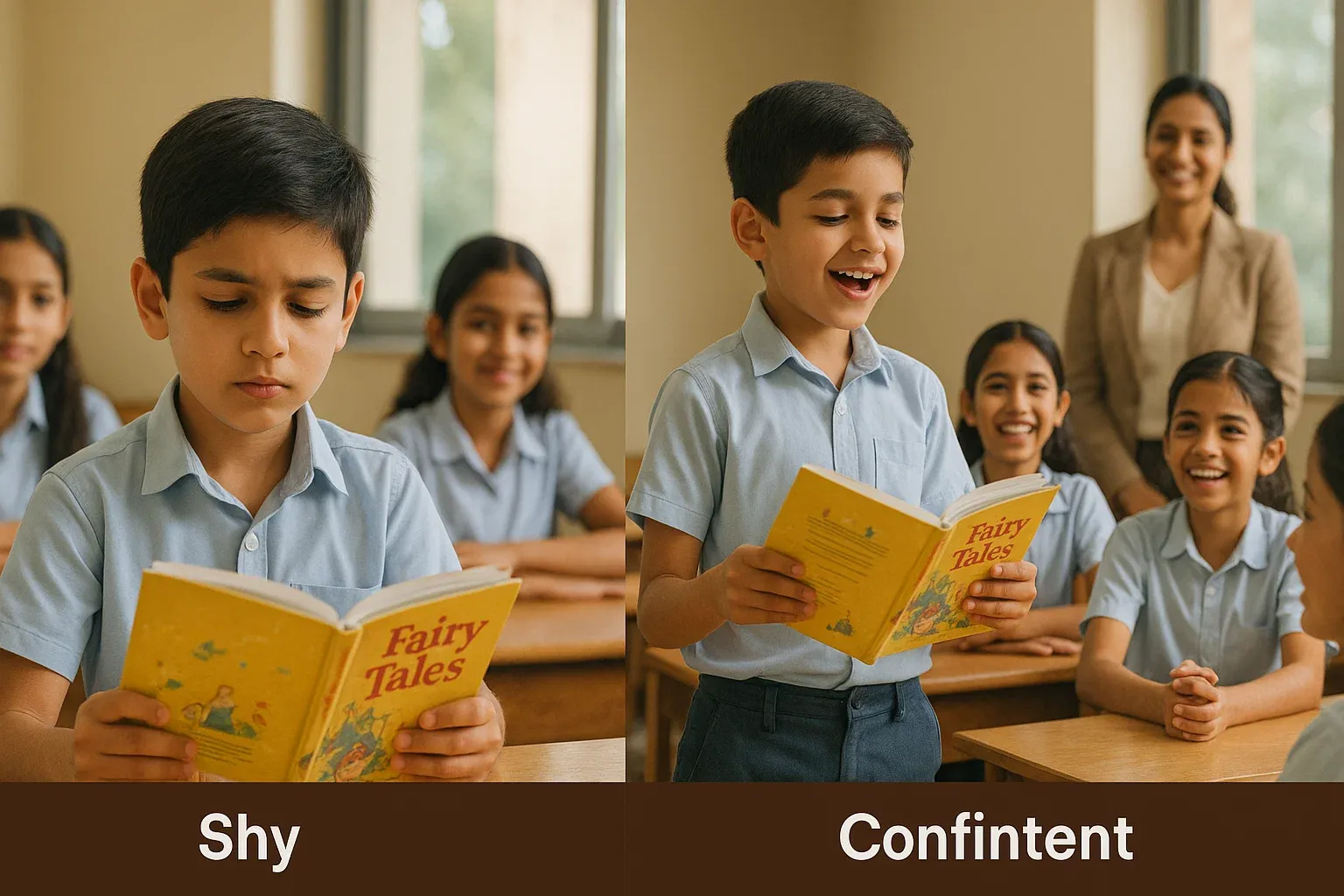
Reading Out Loud vs Reading in Your Head
Both are useful, but they serve different purposes.
| Type of Reading | Benefits | Limitations |
| Reading in Your Head | Improves understanding and speed | Doesn’t improve speaking or pronunciation |
| Reading Out Loud | Builds pronunciation, memory, and confidence | Slower but more interactive |
Conclusion: Silent reading helps the mind, but loud reading helps both mind and mouth!
Advantages and Disadvantages of Reading Out Loud
Even though reading aloud is powerful, let’s look at both sides fairly:
| Advantages | Disadvantages |
| Improves pronunciation and fluency | Can disturb others in quiet places |
| Boosts self-confidence | Some students feel shy at first |
| Helps improve vocabulary | May take longer to finish books |
| Builds memory and focus | Needs regular practice to see results |
Tip: Read aloud at home or during special “reading time” to avoid disturbing others.
10 Benefits of Reading Aloud
- Improves pronunciation and word accuracy
- Builds confidence in speaking
- Strengthens reading comprehension
- Makes learning English more fun
- Increases focus and attention span
- Enhances listening and memory skills
- Helps in public speaking and debates
- Boosts vocabulary naturally
- Reduces stage fear
- Makes communication smoother in real life
Fact: Reading aloud engages more parts of the brain than silent reading making you smarter and sharper!
Make Reading Fun and Powerful!
Turn everyday reading into a habit that improves speech and confidence.
Book PlanetSpark’s English Speaking Classes
Does Reading Out Loud Help with Speech Problems?
Yes, it does!
Reading aloud helps children and adults who have stuttering or speech delays.
When you read slowly and clearly, you learn to control your breathing, pauses, and mouth movement.
- It strengthens your speech muscles.
- It improves timing and rhythm.
- It builds confidence while speaking in front of others.
Speech therapists often recommend reading aloud daily for 10 minutes as part of therapy sessions.
It’s not about perfection, it's about progress with every word you speak!
How to Improve English Accent and Pronunciation
A clear accent is not about sounding “foreign” it’s about sounding understandable.
Follow these practical tips:
Listen to Native Speakers
Watch English cartoons, news channels, or short YouTube stories.
Focus on how speakers stress words, pause, and change tone.
Break Words into Syllables
Breaking helps you pronounce every part correctly.
| Word | Syllables |
| Beautiful | beau-ti-ful |
| Important | im-por-tant |
| Education | ed-u-ca-tion |
Say each syllable slowly, then blend them together.
Practice Word Stress
English words have “strong” syllables that sound louder.
| Word | Stressed Part |
| Banana | ba-NA-na |
| Computer | com-PU-ter |
| Guitar | gi-TAR |
When you get stress right, your speech sounds natural and musical.
Role-Play Games
Act out small dialogues from stories.
Example:
- “Hello! How are you today?”
- “I’m fine, thank you!”
Role-play helps children use tone and expression naturally.
Checkpoint: Quick Self-Test
Can you pronounce “comfortable” and “vegetable” correctly?
Can you read a full paragraph aloud without stopping?
Can you use rhythm and tone while reading a story?
If you said “Yes!” you’re already improving!
See Your Child’s Confidence Shine!
With PlanetSpark’s fun learning programs, your child won’t just learn, they'll shine!
Book a FREE Demo Class Today
Family Activities for Parents and Kids
Parents play a huge role in helping children build pronunciation confidence.
Here are some fun ways to practise together
| Activity | Description | Benefit |
| Family Reading Hour | Everyone reads a story aloud | Improves bonding and fluency |
| Record & Replay | Record your child reading | Builds self-awareness |
| Pronunciation Game | Pick 5 hard words to say fast | Makes learning playful |
| Sing Songs Together | English rhymes and karaoke | Builds rhythm and tone |
| Story Drama | Act out short stories | Boosts speaking confidence |
Learning together creates beautiful memories and strong communication skills!
Interesting Facts and Figures
| Study / Source | Key Finding |
| Oxford Language Report | Reading aloud improves pronunciation and vocabulary retention by 38% in kids aged 7–12. |
| Harvard Education Review | Students who read aloud regularly show higher confidence in presentations and interviews. |
| PlanetSpark Internal Survey | 82% of students who practiced loud reading improved pronunciation within 4 weeks. |
Numbers don’t lie loud, reading really works!
About PlanetSpark: Where Clarity Meets Confidence in Spoken English
PlanetSpark helps children speak English fluently, clearly, and confidently through engaging 1:1 live classes. Our Spoken English Program strengthens pronunciation, fluency, and vocabulary while building real world communication skills helping kids express themselves with confidence in school and beyond.
1. 1:1 Expert Coaching
Every child learns with a certified trainer who personalises each session to their pace and learning style ensuring clear speech, confidence, and quick progress.
2. Personalised Learning Path
A customised curriculum enhances grammar, vocabulary, listening, and sentence formation guiding learners from basic speaking to fluent communication.
3. AI-Powered Pronunciation Feedback
With SparkX and AI led practice sessions, students receive instant, precise feedback on tone, pronunciation, and clarity turning practice into measurable improvement.
4. Interactive & Gamified Learning
Fun tools like Word Wisdom, Listen & Spell, and Fluency Quests make English learning exciting and consistent, helping kids practise daily through play.
5. Confidence for Every Conversation
Through storytelling, dialogue practice, and real-life speaking drills, children gain the confidence to express themselves naturally anytime, anywhere.
Frequently Asked Questions
Yes! It helps your tongue, ears, and brain work together — making you pronounce words better and speak fluently.
At least 10–15 minutes daily is enough for big improvement.
Absolutely! Reading aloud is great for adults who want to improve public speaking, teaching, or presentations.
That’s normal! Mistakes help you learn. Just note them and try again.
Yes, it helps you remember better, read questions clearly, and understand stories faster.