
Names of Planets – Explore Our Solar System’s 8 Planets

Table of Contents
- What Are Planets and Why Do They Have Names?
- How Many Planets Are There in Our Solar System? Name Each Pl
- Names of All Eight Planets in Order from the Sun
- Fun Facts of Each Planets
- Fun Facts About the Solar System
- Which Planet Is the Hottest? The Coldest? The Biggest?
- Learn Planets and More with PlanetSpark’s Storytelling Cours
Feeling lost when someone mentions the names of planets? It can be confusing to remember them all and that’s before the fascinating stories behind each one come into play.
This blog will clearly explain what planets are and why they have names, show how many planets there are in our solar system and list each with full descriptions. It will cover each of the eight planet names in order from the Sun, share fun facts about each planet and about the broader solar system, introduce a trick to remember the names of planets in order, and compare which planet is the hottest, the coldest, the biggest.
What Are Planets and Why Do They Have Names?
Planets are large celestial bodies that orbit a star and are not themselves stars; in our case, they circle the Sun.In the context of our solar system, planets are distinct from moons (which orbit planets), asteroids (smaller rocky bodies) and dwarf planets. When early astronomers observed bright wandering objects in the sky, they called them “planētēs” in Greek literally “wanderers”.
Why do planets have names? Human cultures across history have looked up at the sky and given names often mythological to these bodies to make sense of them, tell stories, and teach children the solar system. The naming helps identify and order them: each planet’s name connects it to ancient heritage, making the concept easier to remember and more meaningful.
How Many Planets Are There in Our Solar System? Name Each Planet and Give Diagrams
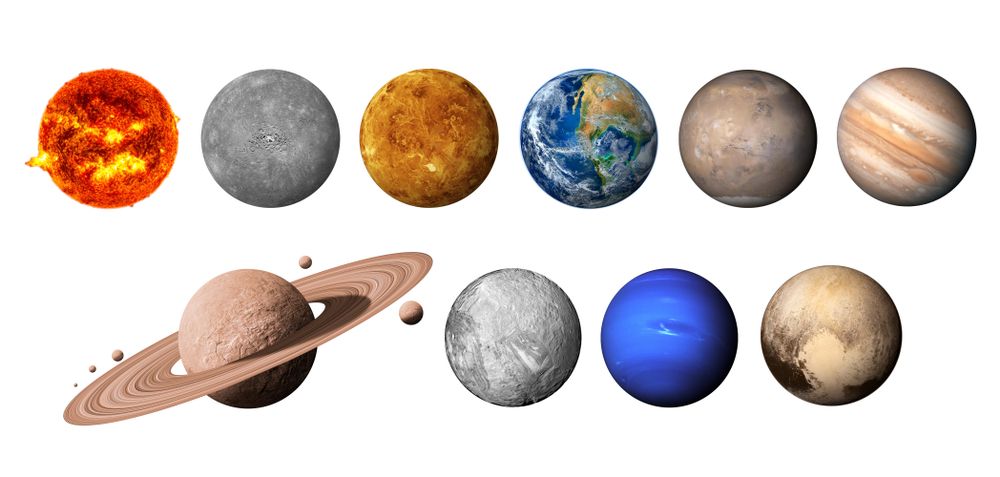
Our solar system contains eight recognised major planets. They are:
Mercury
Venus
Earth
Mars
Jupiter
Saturn
Uranus
Neptune

Names of All Eight Planets in Order from the Sun
Here is a structured list of the eight planet names in order from the Sun, each followed by a detailed description (~500 words each) highlighting its name origin, features, orbit, structure, and learning notes.
1. Mercury
Mercury holds the spot closest to the Sun, making it the first of the eight planet names. Its name is derived from the Roman messenger god Mercury, likely chosen because this planet appears to move quickly across the sky compared to other bodies.
This little planet is the smallest in our solar system among the recognised eight, and it has a very short orbit: one ‘year’ on Mercury is only about 88 Earth-days because it races around the Sun so speedily.
Mercury’s surface is heavily cratered and rocky, resembling our Moon, because it lacks a significant atmosphere to cushion impacts. Without a thick atmosphere, surface temperatures swing wildly: during the day near the equator it can soar to hundreds of degrees Celsius, while at night it plunges to extremely cold values. This dramatic variation makes Mercury less hospitable and more extreme as a planetary study subject.
Its proximity to the Sun also means observing it from Earth is tricky: it tends to appear very close to the Sun’s glare, visible only at dawn or dusk under very favourable conditions. From an education viewpoint, Mercury is an excellent first example of how planet names reflect culture, and how planet characteristics (small size, fast orbit) align with its mythological namesake’s attributes (speed, messenger).
2. Venus
Venus is the second of the eight planet names in the solar system order. Named after the Roman goddess of love and beauty, it hints at the planet’s striking brightness in the night sky and its appearance as the “evening star” or “morning star” in ancient times.
In size and mass, Venus is quite similar to Earth sometimes called Earth’s ‘sister planet’ but the resemblance ends when the environment is considered. Venus boasts a thick atmosphere of carbon dioxide, clouds of sulphuric acid, and a surface temperature hot enough to melt lead. Indeed, it is known as the hottest of the eight planet names in practical terms because of the runaway greenhouse effect.
Its rotation is also unusual: Venus spins slowly (a Venusian day is longer than its year) and in the opposite direction to most planets. These oddities make it a fascinating study for both the names of planets and planetary science.
3. Earth
The third of the eight planet names is Earth our home. Though Earth’s name doesn’t come from Roman or Greek gods like many of its siblings, its etymology traces back to old English and Germanic words meaning ‘ground’ or ‘soil’.
Among the planets, Earth is the only one known to support life as we understand it. It has the right mix of atmosphere, water, geology, and orbit that make it habitable. About 70% of its surface is covered by water, and its atmosphere contains nitrogen and oxygen critical for life.
Connecting Earth’s name to ‘ground’ and ‘home’ reinforces its uniqueness among the names of planets. It also reminds learners that while the solar system may include many bodies, one of them is our familiar environment.
4. Mars
Mars is the fourth of the eight planet names in the solar system. It takes its name from the Roman god of war, perhaps because of its reddish appearance in the sky evocative of blood and battle.
Mars has been a focus of exploration because of its relative proximity and interesting features: it has the tallest volcano in the solar system (Olympus Mons), polar ice caps, and evidence of ancient water flows.
It is a rocky planet like Mercury, Venus and Earth (the terrestrial planets), but its surface is colder, drier and less hospitable. Its reddish hue comes from iron-oxide (rust) in its soil and dust. For learners, Mars is an exciting example of linking planetary naming (god of war) with colour (red), environment (harsh, dry) and story (the quest for life beyond Earth).
In the sequence of planet names, Mars occupies the “fourth” place so students can recall: Mercury (1), Venus (2), Earth (3), Mars (4). That numeric link supports memory of the names of planets. It also acts as an intermediate turning point between inner terrestrial planets and the outer giants.
Set your child on a cosmic journey!
5. Jupiter
Jupiter is the fifth of the eight planet names and stands out as the largest planet in our solar system. Named after the king of the Roman gods, the name signals grandeur and dominance.
This gas giant has no solid surface in the conventional sense; instead it is composed mostly of hydrogen and helium, with swirling storms and a famous feature known as the “Great Red Spot,” a storm larger than Earth. It has dozens of moons, including some of the most intriguing ones like Europa (thought to have a subsurface ocean).
For students learning the names of planets, Jupiter is memorable because of scale (largest), position (5th) and name (king of gods). It marks the transition from inner rocky planets to outer giant planets and enriches the story behind planet names.
Visualising Jupiter as the mighty giant among planet names helps anchor the list and gives a dramatic contrast to the earlier planets. It highlights why knowing the names of planets isn’t mere rote—it connects with their distinct personalities and features.
6. Saturn
Saturn is the sixth of the eight planet names. It is named after the Roman god of agriculture and time (Saturn), but among planets it is best known for its spectacular ring system.
The rings of Saturn are composed of ice, dust and rock particles, some the size of small mountains, orbiting the planet in shimmering bands. It is a gas giant like Jupiter, though somewhat less massive. For learners, Saturn stands out in the list of planet names not just by its name, but by its “rings” identity making it very memorable.
Saturn also has many moons over 150 known one of which (Titan) has a dense atmosphere of its own, giving further depth to the learning of planet names and features.
7. Uranus
Uranus is the seventh of the eight planet names. Its name comes from the Greek god of the sky (Uranus), which is unique because all other major planets’ English names derive from Roman gods.
Uranus is classified as an ‘ice giant’ rather than a gas giant; its composition includes icy materials, water, ammonia and methane ices, and its unusual tilt means it essentially rolls around the Sun on its side. This quirky behaviour makes Uranus an engaging subject when teaching the names of planets students remember “Uranus flips on its side”.
8. Neptune
Neptune is the eighth and final of the major recognised planet names in our solar system. Named after the Roman god of the sea, its deep blue colour reflects that heritage just as water and sea are blue, Neptune appears blue in telescopic images.
Neptune is the most distant of the eight planet names from the Sun, taking about 165 Earth-years to complete one orbit. It is also an ice giant like Uranus, with strong winds and a stormy atmosphere. Because of its remote location, Neptune is less familiar to many children, so associating the name with “sea-god” and “furthest planet” makes it stick.
In the sequence finishing the list: Mercury (1) … Uranus (7), Neptune (8). The full set of eight planet names is thus firmly anchored. Incorporating Neptune last helps students conclude the list and review backwards or forwards for recall.
Ready to master planet names, solar system facts and have fun?
Book a free trial class at PlanetSpark storytelling course today!
Fun Facts of Each Planets
Ever wondered what makes each planet in our solar system so special? From fiery worlds to icy giants, every planet has its own exciting secrets waiting to be discovered!
1. Facts About Mercury – The Speedy Planet
Mercury travels around the Sun faster than any other planet just 88 Earth days make one Mercury year.
Even though it is the closest planet to the Sun, Venus is actually hotter.
You could jump three times higher on Mercury than on Earth because of its weak gravity.
Mercury does not have an atmosphere, which means no wind, clouds, or weather.
2. Facts About Venus – The Hottest Planet
Venus is called Earth’s twin because it is almost the same size and shape.
Its thick atmosphere traps heat, making it the hottest planet about 475°C.
A day on Venus is longer than a year it takes 243 Earth days to rotate once.
Venus spins in the opposite direction to most other planets.
3. Facts About Earth – Our Home Planet
Earth is the only planet known to have life and liquid water on its surface.
About 71% of Earth is covered with water, which is why it is called the Blue Planet.
Earth’s atmosphere protects us from harmful Sun rays and space rocks.
Earth is not a perfect sphere; it is slightly flattened at the poles.
Curious about planet names, fun facts and solar system science?
Enrol in PlanetSpark Storytelling course
4. Facts About Mars – The Red Planet
Mars appears red because of iron dust on its surface, similar to rust on metal.
It has the tallest volcano in the solar system, Olympus Mons, which is three times taller than Mount Everest.
Scientists believe water once flowed on Mars.
Robots such as Curiosity and Perseverance are currently exploring Mars.
5. Facts About Jupiter – The Giant Planet
Jupiter is so large that about 1,300 Earths could fit inside it.
It has a Great Red Spot, a massive storm that has lasted for over 300 years.
Jupiter has 95 moons; the largest, Ganymede, is even bigger than Mercury.
It rotates very quickly one day on Jupiter lasts only 10 hours.
6. Facts About Saturn – The Ringed Beauty
Saturn’s stunning rings are made of ice, rock, and dust that stretch for thousands of kilometres.
It is the least dense planet; if there were a giant bathtub, Saturn could float.
Saturn has more than 140 moons, including Titan, which has lakes of methane.
A year on Saturn lasts about 29 Earth years.
7. Facts About Uranus – The Sideways Spinner
Uranus rotates on its side, making it look as though it rolls around the Sun.
Its blue-green colour comes from methane gas in its atmosphere.
It is one of the coldest planets, with temperatures dropping to -224°C.
One Uranus year equals 84 Earth years that’s a very long winter.
8. Facts About Neptune – The Windy Planet
Book your child’s free trial class at PlanetSpark and watch them shine when naming planets.
Neptune is the farthest planet from the Sun, making it extremely cold.
It has the fastest winds in the solar system, reaching speeds of up to 2,000 km/h.
The planet’s deep blue colour comes from methane in its atmosphere.
One Neptune year equals 165 Earth years that’s one birthday every century.
Fun Facts About the Solar System
The solar system is full of surprises spinning planets, glowing stars, icy comets, and mysterious moons. Here are some fascinating facts that make learning about space even more exciting:
The Sun makes up more than 99% of the total mass of our solar system. It’s like the boss of all planets.
Eight planets orbit the Sun, and none of them are perfectly round.
The solar system is over 4.5 billion years old, older than any living thing on Earth.
Jupiter’s moon Ganymede is so big that it’s even larger than Mercury.
One day on Venus lasts longer than its entire year, which means it spins very slowly.
The asteroid belt between Mars and Jupiter is filled with rocky space leftovers from the early solar system.
Saturn’s rings aren’t solid; they’re made of billions of pieces of ice and rock.
Uranus spins sideways, making its seasons last more than 20 Earth years each.
Neptune has the strongest winds in the solar system that could blow faster than a jet plane.
Pluto, though no longer a planet, still orbits the Sun and remains a favourite among space lovers.
Every planet’s orbit is slightly oval-shaped, not perfectly circular.
Comets are like giant dirty snowballs that leave glowing tails when they pass near the Sun.
The Kuiper Belt is a vast region beyond Neptune, filled with icy objects and dwarf planets.
Earth is the only planet known to have life, and we’re lucky to call it home.
If the solar system were the size of a football field, the Sun would be a marble and Neptune would orbit near the goalpost.
Trick to Remember the Names of Planets in Order
Remembering the names of all eight planets in order from the Sun can feel tricky at first, but with the right trick, it becomes fun and easy. One of the best ways to do this is by using a mnemonic a simple phrase where each word starts with the same letter as a planet.
Learn the names of planets with fun activities with PkanetSpark Storytelling course
The most popular mnemonic is:
"My Very Educated Mother Just Served Us Nachos."
Each word in this sentence represents a planet in order:
Mercury
Venus
Earth
Mars
Jupiter
Saturn
Uranus
Neptune
This sentence creates a story in your mind, which makes it easier to recall the planets quickly. You can even picture a mother serving nachos to her children while each planet floats around the Sun!
Another way to remember the planets is to create your own story or rhyme. For example, you could say:
“Many Very Excited Martians Jumped Slowly Under Night skies.”
The idea is to connect each planet name with something funny, visual, or imaginative. When kids make their own version, the learning sticks better because it becomes personal and creative.
Which Planet Is the Hottest? The Coldest? The Biggest?
Hottest: Among the eight planet names, Venus is the hottest. Its thick atmosphere traps heat, leading to surface temperatures around 460 °C or more.
Coldest: Uranus holds the title for coldest planet among the eight planet names, due to its composition and distance from the Sun, with minimal internal heat contributing.
Biggest: Jupiter is the largest of the eight planet names so massive it could fit all the other planets inside it in terms of volume (not quite, but as an analogy).
Understanding which planet is hottest, coldest or biggest helps learners go beyond simply memorising the names of planets it helps build a sense of comparison, scale and planetary diversity.
Learn Planets and More with PlanetSpark’s Storytelling Course

Learning the names of planets can be exciting, but when combined with storytelling, it becomes unforgettable. PlanetSpark’s storytelling course transforms ordinary lessons into fun, interactive adventures where every child becomes a storyteller and a learner at the same time.
USPs of PlanetSpark’s Storytelling Course:
Interactive Learning: Engaging activities and storytelling exercises that make learning playful.
Boosts Creativity: Children learn to create their own stories, enhancing imagination and originality.
Confidence Building: Presenting stories improves public speaking skills and self-expression.
Fun with Facts: Complex concepts like the solar system, historical events, or science facts are taught through memorable stories.
Personalised Feedback: Trainers guide every child, helping them improve storytelling, pronunciation, and narrative flow.
Age-Appropriate Curriculum: Designed for children aged 3–14, keeping content both fun and educational.
Flexible Learning: Online classes allow children to learn from anywhere, at their own pace.
Through this storytelling approach, kids learn the names of planets, the solar system, and many other topics while building skills they will use for life from communication to creativity.
Blast Off into Planetary Imagination!
In exploring the names of planets, from Mercury all the way out to Neptune, this guide has covered what planets are and why they have names, the total of eight planets in our solar system, an ordered list of each planet with rich descriptions, fun facts for engagement, a mnemonic trick to recall them easily, and comparative questions about hottest, coldest and biggest. For a truly immersive experience, the PlanetSpark storytelling-course empowers children to craft their own space tales, reinforcing each planet name through creative play. Take the next step: book a free trial class at PlanetSpark, ignite curiosity, and let the adventure of planet names and our solar system come alive!
Frequently Asked Questions
There are eight recognised major planets in our solar system: Mercury, Venus, Earth, Mars, Jupiter, Saturn, Uranus and Neptune.
Planet names mostly come from Roman (and one Greek) gods and goddesses. These mythological names were used by early astronomers to honour tradition and help learners remember them. The cultural backdrop makes the names unforgettable.
A mnemonic like “My Very Educated Mother Just Served Us Nachos” links each initial to the eight planet names: Mercury, Venus, Earth, Mars, Jupiter, Saturn, Uranus, Neptune. Teachers and parents often use it to make learning the planet names fun and effective.
Yes—by linking planet names to stories, mythological characters and distinct features (e.g., Mars is red, Venus is hottest), children are more likely to retain both the name and the planetary concept. This is exactly the approach used in PlanetSpark’s storytelling-course, where each planet name becomes part of a story adventure.
Each planet name reflects provenance (mythology), physical features and position in the solar system. For example, Jupiter = king of gods → largest planet; Mars = god of war → red/dusty planet. This layering adds depth to learning the names of planets.
The course is designed for children aged 3 to 14 years. It offers age-appropriate storytelling activities that make learning fun, boost creativity, and improve confidence in a structured way. PlanetSpark ensures every child learns at their own pace.
Absolutely. PlanetSpark uses storytelling to explain complex topics, including the solar system and planets, turning them into memorable stories. Kids not only learn facts but also enjoy exploring subjects creatively.