
Master Story Beats for Stronger Plot Development


Have you ever read a story and felt completely hooked, wondering how the writer managed to keep you turning pages without a break? The answer, more often than not, comes down to story beats. Whether you are writing a short story for school, crafting a screenplay, or simply trying to understand why some stories feel so satisfying while others fall flat, story beats are the key you have been looking for.
This guide will walk you through everything you need to know, from what story beats are to how to use them effectively, along with real story beats examples drawn from stories students already know and love.
What Are Story Beats?
A story beat is a structural element of a narrative that is used to mark an intentional shift in tone and help propel the plot forward. Think of them as the individual steps in a well-choreographed dance. Each step is small on its own, but together they create something that flows, builds, and pays off at exactly the right moment.
At its simplest, a beat is any moment in a story where something changes. A character learns new information, a relationship shifts, a decision is made, or a conflict grows more intense. These changes, large and small, are what keep readers invested from the very first line to the very last.
Story beats are the key moments that drive the narrative forward. They serve as the building blocks of storytelling, creating a rhythm that keeps the audience invested. Every scene, interaction, or decision contributes to these beats, propelling the protagonist toward their ultimate goal.
Key Aspects of Story Beats
Understanding the key aspects of story beats helps you apply them with confidence rather than just hoping your story works. Here are the most important things every student writer should know.
Beats Are Cause and Effect
A crucial storytelling principle used by South Park creators Trey Parker and Matt Stone is the "but/therefore" technique. They argue that strong stories should avoid a simple "and then" structure, where events unfold without meaningful connections. Instead, each beat should be linked by "but" or "therefore," ensuring that every event is a reaction to the previous one. When your beats follow this logic, your plot feels alive, motivated, and impossible to put down.
Beats Are Not the Same as Dialogue Beats
It is important to understand the difference between story beats and dialogue beats. Dialogue beats are about pacing and performance. Story beats are about structure and progression. Both matter, but when we talk about beat sheets or story structure, we are always referring to story beats.
Story Beats vs. Character Beats
Story beats move the plot forward. Character beats mark an important change in a character's emotional journey. Sometimes they overlap. A fight between two characters might push the story ahead and reveal new emotional depth. Story beats keep the audience engaged, while character beats make the audience care. The most powerful stories combine both effectively.
Beats Work Across All Formats
Whether you are writing a novel, a short story, a screenplay, or even a school essay with a narrative arc, beats apply. Story beats keep your story on track from the start and avoid endless editing. Story beats are also tried and tested. You can create instant stories from them.
Beats Have Specific Functions
Story beats can vary widely depending on their function within a narrative. Some set the scene and introduce characters and setting. Others act as the inciting incident, the event that kicks off the main action of the story, pulling the protagonist out of their normal life. Knowing the function of each beat helps you place it in exactly the right spot.
How to Use Story Beats
Knowing what story beats are is only half the work. Using them effectively is where real growth happens as a writer. Here is a practical approach that students can start applying right away.
- Start with a Beat Sheet
The most structured and popular tool for working with story beats is the beat sheet. The Save the Cat Beat Sheet is a popular story structure template that subdivides the beginning, middle, and end of a story into 15 beats or plot points. Each of these beats has a specific purpose and serves a particular function within your overarching story.
An evolution of the classic 3-act structure, Blake Snyder codified this 15-beat outline to better manage the second act, which screenwriters often struggle with. Knowing there are clear checkpoints to hit helps writers avoid the dreaded "sagging middle" that causes so many stories to lose momentum.
- Map Your Story Before You Write
During the planning stage, writers use story beats to outline the structure of their narrative. This helps in visualizing the entire storyline, from beginning to end, ensuring that all key events and character developments are planned and appropriately paced. Even if you usually prefer writing without an outline, trying a beat-based plan for one story can completely change how you understand structure.
- Use Beats While Drafting
As writers draft their story, they refer to these beats to maintain the flow and rhythm of the narrative. It ensures that each scene transitions smoothly into the next and that the plot moves forward in a meaningful way. Think of your beat sheet as a GPS rather than a rigid script. It keeps you headed in the right direction without removing your creative freedom.
- Revise with Beats in Mind
In the revision phase, story beats are crucial for identifying parts of the narrative that may need tightening or expansion. Writers analyze each beat to ensure it serves its purpose effectively, whether it is advancing the plot, deepening character development, or enhancing thematic resonance.
- Apply the But/Therefore Rule
As you write each scene, ask yourself: does this beat connect to what came before through a "but" or a "therefore"? If the answer is no, you may have a filler scene that is slowing your story down. Every beat should feel like it needed to happen because of the beat before it.
Understanding the Short Story Beat Sheet
A short story beat sheet is a simplified version of the full 15 beat structure, adapted for shorter narratives. Because short stories do not have the space for all 15 beats, writers condense them into the most essential turning points.
A practical short story beat sheet typically includes the following key moments:
- Opening: Introduce the protagonist and their world. Show what is normal before everything changes.
- Inciting Incident: Something happens that disrupts the normal world and forces the protagonist to act or react. This is the beat that gets your story moving.
- Rising Tension: The protagonist faces obstacles. Stakes increase. The reader begins to wonder how this will resolve.
- Midpoint Shift: Something changes significantly at the middle of the story, either raising the stakes or changing the protagonist's goal or understanding.
- Dark Moment: The lowest point. It seems like the protagonist cannot succeed or has lost everything.
- Climax: The protagonist confronts the central conflict directly. This is the most intense beat of the story.
- Resolution: The story settles into a new normal. The audience understands what has changed.
Even in a 500-word short story, you can identify all of these beats. The more clearly you can feel each one, the more satisfying your short story will be for readers.
Common Examples of Story Beats
Seeing story beats in action across well-known stories is the fastest way to truly understand how they work. Here are real story beats examples drawn from beloved films and books that students can immediately recognize.
Story Beats in Harry Potter and the Sorcerer's Stone
This beloved story is a near-perfect example of the 15 beat structure in action.
The Opening Image shows Harry living a miserable life with the Dursleys, making clear what his world looks like before magic enters it. The Catalyst arrives when Harry receives his Hogwarts letter, disrupting everything. The Debate beat plays out as Harry hesitates and wonders whether it is all real. The Break Into Two is unmistakable: Harry literally ventures into a new world as he crosses the barrier onto Platform Nine and Three-Quarters, leaving the Muggle world behind and stepping into the world of wizards. The All Is Lost moment arrives when Harry faces Voldemort alone. The Final Image shows Harry back at King's Cross, transformed in ways he could not have imagined at the beginning.
Story Beats in The Lion King
In The Lion King, Simba's life changes forever when Mufasa dies. It launches him on his journey of exile, identity, and redemption. This is a clear and powerful Catalyst beat. The All Is Lost moment comes when Simba, living carefree with Timon and Pumbaa, is confronted by Nala and learns that his homeland is suffering. The Break Into Three happens when Simba finally decides to return and take his rightful place. The Final Image mirrors the Opening Image, with Simba standing at Pride Rock as king, completing the circle.
Every single beat serves a purpose. Remove one, and the story feels incomplete.
How This Helps in Storytelling
Micro-storytelling skills are not a standalone ability. They are what make every other form of storytelling stronger, faster, and more effective. Here is how building this skill transforms your overall storytelling capacity.
When you practice micro-storytelling, you train your brain to identify the most important part of any message before you start speaking or writing. This directly improves your ability to write engaging stories, essays, and narratives because you stop burying the point inside unnecessary context.
Finally, storytelling for short-format presentations becomes less intimidating. When you know how to tell a compelling story in 60 seconds, a three-minute presentation feels manageable. The discipline of short-form storytelling actually gives you more control over longer formats, not less.

Build These Skills with PlanetSpark
Most students know they need stronger communication skills but are not sure where to begin. PlanetSpark's storytelling and communication training for students is designed exactly for this gap. The program covers micro-storytelling skills, short storytelling techniques, storytelling in conversations, and quick storytelling skills through practical, guided exercises led by experienced coaches.
Here is what makes PlanetSpark's approach different:
1:1 Coaching Tailored to You Every student communicates differently. PlanetSpark's sessions are personalised to your specific gaps, whether it is structuring a story quickly, finding the right hook, or landing a confident resolution in front of an audience.
Real Scenario-Based Practice From classroom presentations to inter-school competitions and creative writing tasks, PlanetSpark uses real student scenarios to build skills you can apply immediately. The learning does not stop at theory.
AI-Powered Feedback with SparkX SparkX provides instant, data-driven feedback on your tone, delivery, and clarity so your improvement is measurable, consistent, and visible from session one.
Expert Coaches from Top Communication Backgrounds Learn from coaches who understand what students need to express themselves powerfully, whether in classrooms, on stage, or in writing. They have helped thousands of young learners build lasting communication confidence.
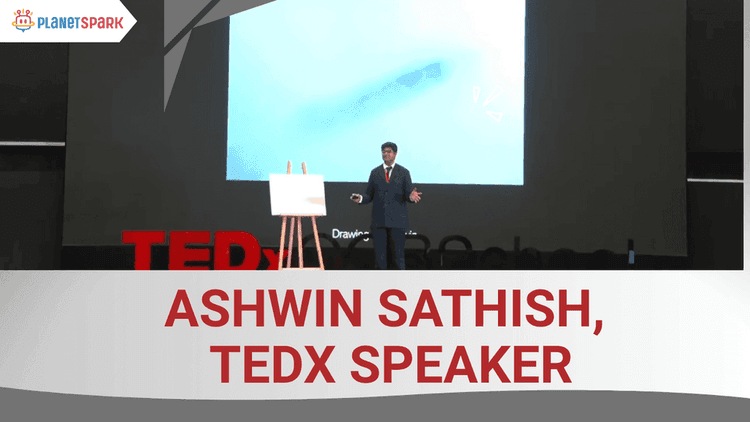
Learner Spotlight: Applying Storytelling Skills with Confidence
Ashwin Sathish, a Grade 8 learner aged 13, developed strong storytelling and expressive skills through consistent practice and guided feedback. His experience speaking on stage, including a TEDx appearance in New Delhi, helped him understand the importance of structure, clarity, and audience connection. As his confidence grew, Ashwin became more effective at organising ideas and communicating them with purpose. His journey highlights how structured storytelling practice builds clarity, confidence, and impactful expression across different settings.
Story beats are the invisible architecture
Behind every story you have ever loved. Whether you are working on a short story for school, a creative writing competition, or simply building your skills as a communicator and thinker, understanding and applying beats will change the way you write.
Start by identifying beats in the stories you already know. Then try building your own short story beat sheet before your next writing project. You do not need to follow every single beat perfectly. You just need to understand that every great story is moving somewhere, and every beat is a step in that direction.
Readers Can Also Read
Frequently Asked Questions
Story beats are the individual moments in a story where something changes. These changes can be a new event, a shift in a character's emotions, a decision, or a turning point in the plot. Every beat moves the story forward and keeps the reader engaged.
A short story typically works best with five to seven key beats: an opening, an inciting incident, rising tension, a midpoint shift, a dark moment, a climax, and a resolution. The exact number depends on the length of the story, but every beat should serve a clear purpose.
A short story beat sheet is a condensed planning tool that outlines the most essential turning points in a short story. It helps writers plan their narrative before drafting, ensuring the plot moves logically from beginning to end without losing momentum or reader interest.
In Harry Potter and the Sorcerer's Stone, the Catalyst beat is when Harry receives his Hogwarts letter. In The Lion King, the All Is Lost moment is when Simba learns his homeland is suffering under Scar's rule. In Star Wars, the inciting incident is when Luke discovers Princess Leia's message in R2-D2. These are classic story beats examples that show how structure drives storytelling across different genres.
The 15 beat story structure, popularized by screenwriter Blake Snyder in Save the Cat, breaks a story into 15 specific plot points from the Opening Image to the Final Image. Each beat has a defined purpose and position in the story, helping writers manage pacing, character development, and emotional impact across a full narrative.
Absolutely. Story beats are not just for screenwriters or novelists. Students can apply beat structure to creative writing assignments, narrative essays, and even persuasive presentations. Understanding beats helps you write with direction, build toward satisfying conclusions, and keep your audience engaged from beginning to end.