
The Short Story vs The Novel: Major Differences

Table of Contents
Stories have the power to shape imagination, strengthen thinking, and spark a love for reading. Whether through short tales or long novels, children learn to understand emotions, decode meaning, and explore ideas in a fun, engaging way. Story-based learning transforms reading into an adventure—making it easier for kids to connect with characters, grasp themes, and appreciate language. With every story they read, children become more confident, expressive, and thoughtful readers.
What Is a Short Story?
A short story is a brief, focused piece of fiction that delivers a complete narrative in a compact form. It usually centres around one main conflict, a small set of characters, and a single impactful moment or theme. Short stories are designed to be read in one sitting, making them powerful, fast-paced, and emotionally striking. Their concise structure encourages sharp storytelling, rich symbolism, and meaningful endings that leave readers thinking long after the story ends.
What Is a Novel?
A novel is a long, detailed work of fiction that develops characters, plots, and themes over many chapters. It provides an immersive reading experience by exploring complex emotions, relationships, and events in depth. Novels often feature multiple conflicts, rich world-building, and gradual character growth. Because of their length and layered structure, they offer readers a deeper emotional connection and a fuller understanding of the story’s message, making them ideal for extended, engaging reading journeys.
Join a PlanetSpark demo class to master storytelling today!
Key Differences Between Short Story and Novel
Short stories and novels differ in length, depth, structure, and emotional experience. While short stories create quick, powerful impressions through focused storytelling, novels offer rich worlds, gradual character growth, and layered themes. Understanding these differences helps readers choose the format that best fits their time, goals, and reading expectations.
1. Length and Scope
Short stories are brief and concise, typically ranging from 1,000 to 5,000 words, sometimes slightly more. Their limited length forces the writer to focus on a single moment, idea, or conflict. Novels, however, stretch far beyond this, usually 40,000 words or more, giving authors the freedom to explore extensive timelines, multiple characters, and wide-ranging themes. This difference in scope directly affects the depth and complexity of the narrative.
2. Character Development
A short story introduces characters quickly, offering just enough traits to support the plot. The focus is usually on a single protagonist or a small cast, with minimal background or emotional evolution. In contrast, novels allow readers to witness characters’ journeys, motivations, relationships, and transformations over time. Novel characters feel more realistic because the story has room to explore their struggles, growth, and internal conflicts.
3. Plot Complexity
Short stories typically maintain a tight, single-threaded plot. They revolve around one conflict or event and aim to deliver a sharp message or emotional punch. There is little room for twists or subplots. Novels, on the other hand, can weave together multiple storylines, main plots, subplots, and side arcs, creating a multi-layered narrative. This allows authors to explore deeper themes and keep readers engaged over longer periods.
4. Setting and World-Building
Short stories provide minimal descriptive detail, offering only the essential elements needed for the reader to understand the scene. The world-building is subtle and efficient. Novels, however, can create detailed, immersive environments, from entire fantasy worlds to historically rich settings. They describe culture, atmosphere, geography, and social dynamics, giving readers a fully developed space to explore and imagine.
5. Reading Time and Pace
Short stories are designed for quick reading, perfect for a single sitting. Their pace is tight and energetic, with little filler. The plot moves rapidly toward its conclusion. Novels have a more relaxed and stretched-out pace, allowing readers to absorb emotional moments, character interactions, and world-building slowly. They require a longer commitment but also offer a deeper emotional and intellectual reward.
Read Here, 10 Simple Short Stories in English for Kids
6. Emotional Impact
A short story creates immediate, concentrated emotional impact, often ending with a twist, revelation, or moral insight. Its power lies in brevity and precision. Novels build emotional connection gradually, giving readers time to bond with characters, feel their struggles, and understand their motivations. This results in long-lasting emotional resonance and greater investment in the story’s outcome.
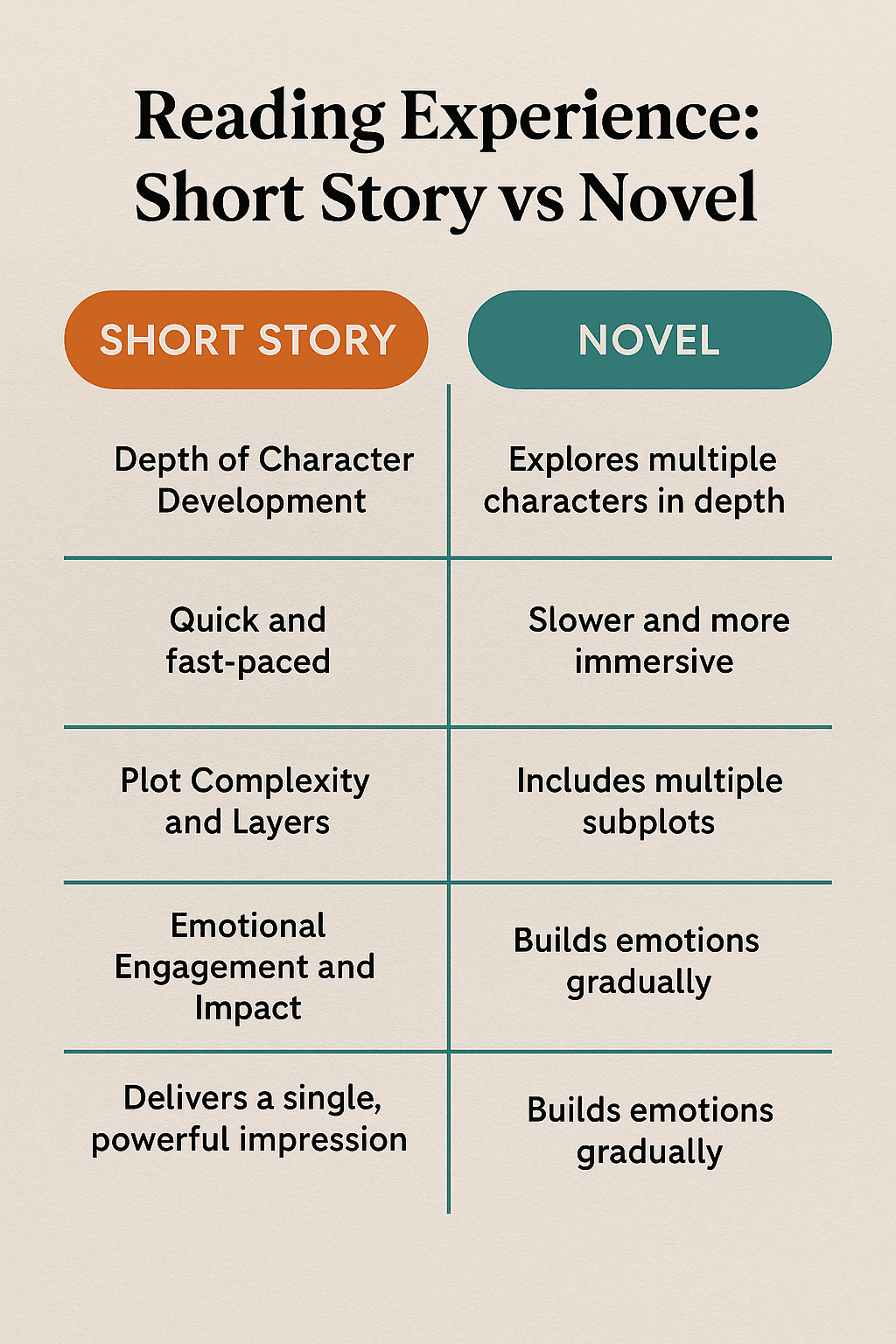
Reading Experience: Short Story vs Novel
Short stories and novels offer two very different reading experiences, each with its own strengths. While short stories deliver quick impact through tight plots and sharp emotions, novels provide a deeper, more immersive journey with layered characters and complex themes. Understanding how each format shapes the reading experience helps students choose the right kind of story for their mood, time, and learning goals.
Depth of Character Development
Novels explore characters in detail, revealing their backstories, emotions, motivations, and growth over time. Readers form stronger emotional connections because they spend more time with the characters. Short stories, however, focus on a single moment or trait, offering only a snapshot of the character’s life. This creates a sharper but shorter emotional impact.
Pace and Reading Time
Short stories move quickly, often beginning close to the main conflict and ending soon after resolution. This gives readers an immediate, fast-paced experience. Novels unfold slowly, allowing time to absorb details, relationships, and subplots. The pacing creates a more relaxed, immersive reading journey suited for those who enjoy long-form storytelling.
Also Read, Art of Storytelling for kids
Plot Complexity and Layers
Novels can explore multiple storylines, twists, settings, and themes simultaneously, giving readers a wide, rich narrative. Short stories usually follow one central idea or conflict, keeping the plot tight and focused. This makes short stories excellent for quick reflections, while novels excel at exploring big ideas in depth.
Emotional Engagement and Impact
Short stories often deliver sudden emotional intensity, surprise, shock, or insight, because of their brevity. They end quickly, leaving readers to reflect on the message. Novels build emotions gradually, allowing readers to feel invested in the characters’ journeys. This results in long-lasting emotional resonance and a deeper connection.
Reader’s Purpose and Preference
Readers choose short stories when they want quick inspiration, sharp themes, or a single, memorable moment. Novels are ideal when readers want full immersion, world-building, character growth, or extended escape. The choice depends on time, interest, and how deeply the reader wants to engage with the story.
Learn how to analyse stories smarter—Try Planet Spark free demo class!
When to Choose a Short Story
Short stories are perfect when you want a quick yet meaningful reading experience. They deliver powerful themes, sharp emotions, and memorable characters in a compact format. Ideal for busy readers, students, and beginners, short stories offer instant engagement without the time commitment of a novel. They sharpen comprehension, encourage critical thinking, and make literature easy to explore anytime.
- When You Have Limited Time: Short stories can be finished in one sitting, making them perfect for school assignments, travel, or daily reading without long-term commitment.
- When You Want Immediate Impact: Short stories deliver strong emotions and themes quickly. Their concise nature forces writers to be sharp, which gives readers a powerful takeaway in a short span.
- When Practicing Analysis or Exam Preparation: Students can easily analyse plot, theme, tone, symbolism, and character development within a shorter text, ideal for comprehension exercises and literary exams.
- When Exploring New Genres or Authors: Short stories let readers sample different writing styles, mystery, fantasy, realism, or horror, without diving into a full novel, helping them discover preferences.
- When You Want to Improve Writing Skills: The compact structure teaches clarity, precision, and creativity. Writers learn how to build tension, emotion, and meaning in fewer words.
- When You Prefer Focused, Single-Event Narratives: Short stories often revolve around one key moment, conflict, or realization. This makes the reading experience tighter, more intense, and easier to remember.
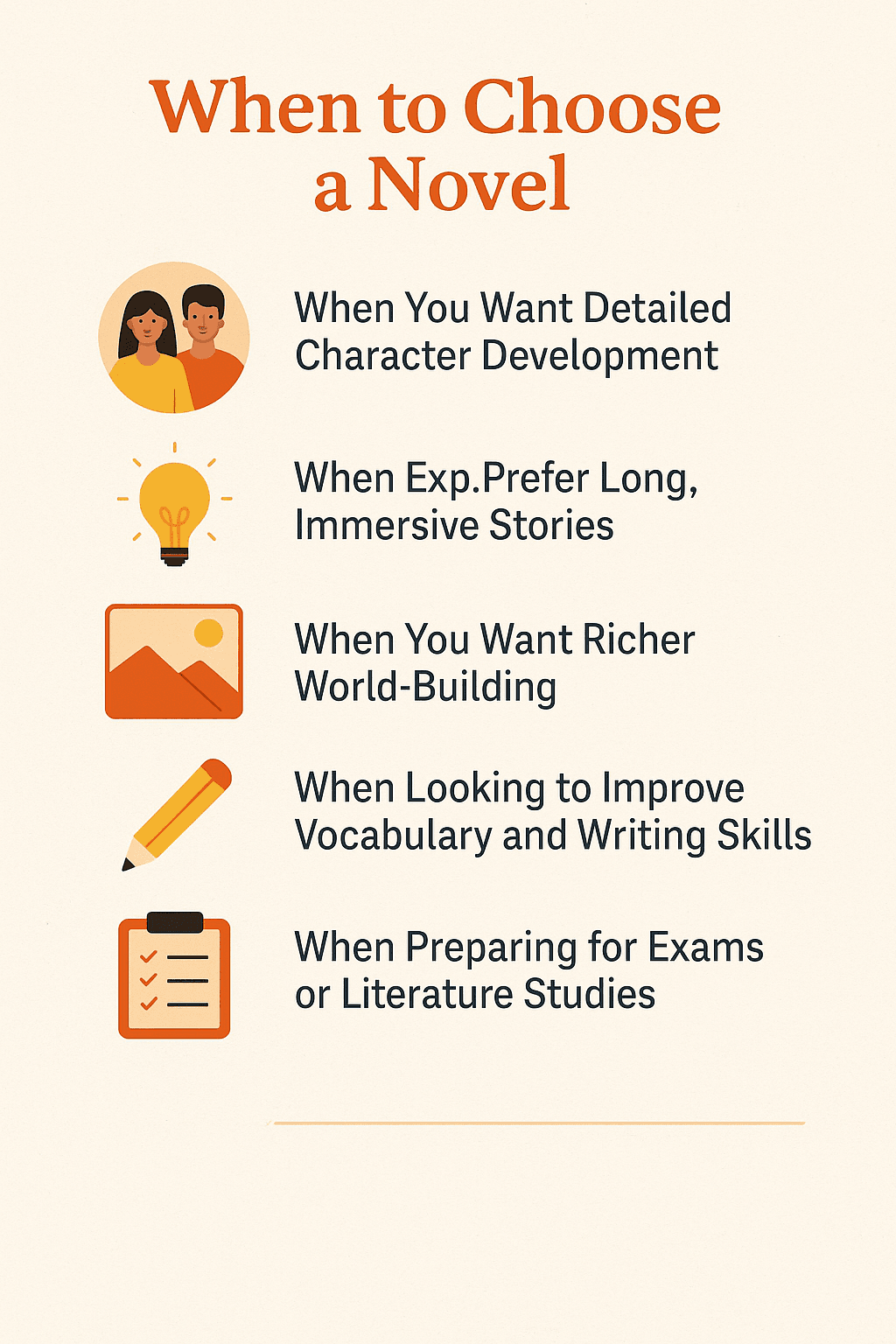
When to Choose a Novel
Novels are ideal when readers want a deeper, richer, and more immersive storytelling experience. They offer detailed character development, layered plots, emotional depth, and long-term engagement. Whether for learning, enjoyment, or analysis, novels provide space to explore complex themes, understand motivations, and experience a complete narrative journey. Here’s when choosing a novel makes the most sense.
- Novels allow readers to understand characters’ backgrounds, emotions, relationships, and growth arcs over time. This makes the reading experience more personal and emotionally engaging.
- If you enjoy diving into a new world or following a journey over many chapters, a novel offers the space needed for full exploration and imagination.
- Novels can tackle social issues, moral dilemmas, political conflicts, or philosophical questions in depth, making them ideal for reflective and analytical reading.
- Fantasy, historical, or adventure novels create detailed settings that transport readers into new environments, giving a fuller sensory and cultural experience.
- Novels contain varied sentence structures, descriptive passages, and dialogue styles that naturally strengthen a reader’s language skills and creativity.
- Many exams require deep analysis of plot, themes, symbols, and characterization, skills best developed by reading full-length novels.
Examples of Famous Short Stories and Novels
Short stories and novels have shaped literature for generations, offering powerful themes, unforgettable characters, and timeless lessons. From quick, impactful tales to full-length masterpieces, these works help students understand narrative techniques, literary devices, and storytelling styles. Here are some of the most famous short stories and novels that continue to inspire readers worldwide.
1. The Gift of the Magi – O. Henry
A touching short story about a young couple who sacrifice their most precious belongings to buy gifts for each other, showing deep love, irony, and generosity.
2. The Lottery – Shirley Jackson
A shocking tale about a small town following a cruel tradition without questioning it, highlighting themes of conformity, violence, and blind obedience.
3. The Tell-Tale Heart – Edgar Allan Poe
A psychological thriller told by an unreliable narrator who insists he is sane while confessing to a murder driven by obsession and guilt.
4. The Necklace – Guy de Maupassant
A story about a woman who borrows a diamond necklace and loses it, only to discover years later that the original was fake, showing pride, vanity, and consequences.
Understand story structures easily—Join our PlanetSpark demo class!
5. A Sound of Thunder – Ray Bradbury
A time-travel story where a small mistake in the past drastically changes the future, illustrating the butterfly effect and responsibility.
6. To Kill a Mockingbird – Harper Lee
A classic novel about justice, racism, and moral courage, seen through the eyes of a young girl growing up in the American South.
7. The Great Gatsby – F. Scott Fitzgerald
A novel about wealth, dreams, and illusion, following Jay Gatsby’s tragic pursuit of love during the glamorous Jazz Age.
8. Pride and Prejudice – Jane Austen
A beloved romance exploring misunderstandings, social class, and personal growth as Elizabeth Bennet learns not to judge too quickly.
9. The Alchemist – Paulo Coelho
A philosophical novel about a shepherd who follows his dreams and destiny, learning life lessons about faith, courage, and purpose.
10. The Hobbit – J.R.R. Tolkien
A fantasy adventure about Bilbo Baggins, who joins dwarves on a quest, discovering bravery, loyalty, and the thrill of the unknown.
How Planet Spark Helps in Strengthening Reading Skills Through Stories
Planet Spark uses the power of stories, both short and long, to build strong reading, comprehension, and thinking skills in children. Through interactive sessions, guided reading, and fun storytelling activities, kids learn to interpret themes, understand characters, and enjoy literature. This approach makes reading engaging, builds confidence, and helps children become thoughtful, expressive readers.
- Builds Strong Comprehension Using Short Stories: Planet Spark uses short, engaging stories to help children understand themes, characters, and plot quickly. This improves analytical thinking and boosts their ability to grasp ideas in a single sitting.
- Helps Students Practise Literary Devices with Short Texts: Short stories make it easier for children to identify metaphors, imagery, symbolism, and tone. Planet Spark’s exercises simplify these concepts through bite-sized passages.
- Improves Vocabulary and Expression Through Guided Reading: Children learn new words, sentence structures, and expressive language through interactive reading sessions. This enhances both spoken and written communication.
- Strengthens Critical Thinking with Discussion-Based Learning: Teachers encourage children to predict outcomes, explore character motives, and interpret messages, helping them think deeply instead of just reading passively.
- Builds Confidence Through Storytelling and Retelling: By narrating, summarising, and discussing stories, children improve fluency, clarity, and self-confidence, key skills for academic success and communication.
Conclusion
Understanding the difference between short stories and novels helps students choose the right format for their reading goals and build stronger comprehension skills. Both forms enrich imagination, analytical thinking, and creativity in unique ways. With Planet Spark’s engaging learning programs, children can master reading, storytelling, and communication with confidence. Enrol your child at Planet Spark today and help them become skilled, expressive, and enthusiastic young readers.
Frequently Asked Questions
A short story is brief and focuses on one central idea or moment, while a novel is much longer and explores characters, plots, and themes in depth.
Short stories are easier because they are quick, simple to follow, and can be read in one sitting.
Yes. Novels expose students to a wider range of words, descriptions, and dialogue, which naturally builds stronger vocabulary.
Absolutely. Short stories are perfect for analyzing themes, characters, and literary devices quickly, making them ideal for school assessments.
Short stories build quick comprehension skills, while novels improve focus, imagination, and deeper understanding. Together, they create strong, well-rounded readers.