
Comparing Conflicts Worksheet for Grade 7 English Skills
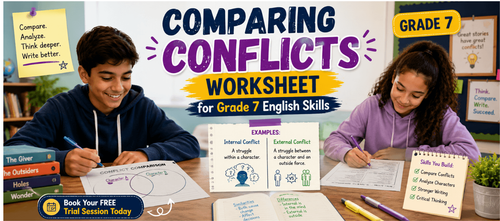

English grammar worksheet for Grade 7 – Comparing Conflicts Across Texts
Conflicts are the challenges that characters face in stories. They drive the plot forward and show us how people respond to difficulties. For Grade 7 students, learning to compare conflicts across texts is an important skill that builds comprehension and analytical thinking. This English grammar worksheet on Comparing Conflicts Across Texts helps learners explore how internal and external conflicts differ, how they are resolved, and what lessons they teach.
Download these English grammar worksheets and practice regularly to strengthen your language skills and build a strong foundation. You can also book a free trial to get expert guidance and improve your reading, writing, and comprehension abilities. The worksheets are designed in a simple and structured way to help K–8 students learn grammar concepts easily and use them confidently in everyday communication.
What Is the Topic?
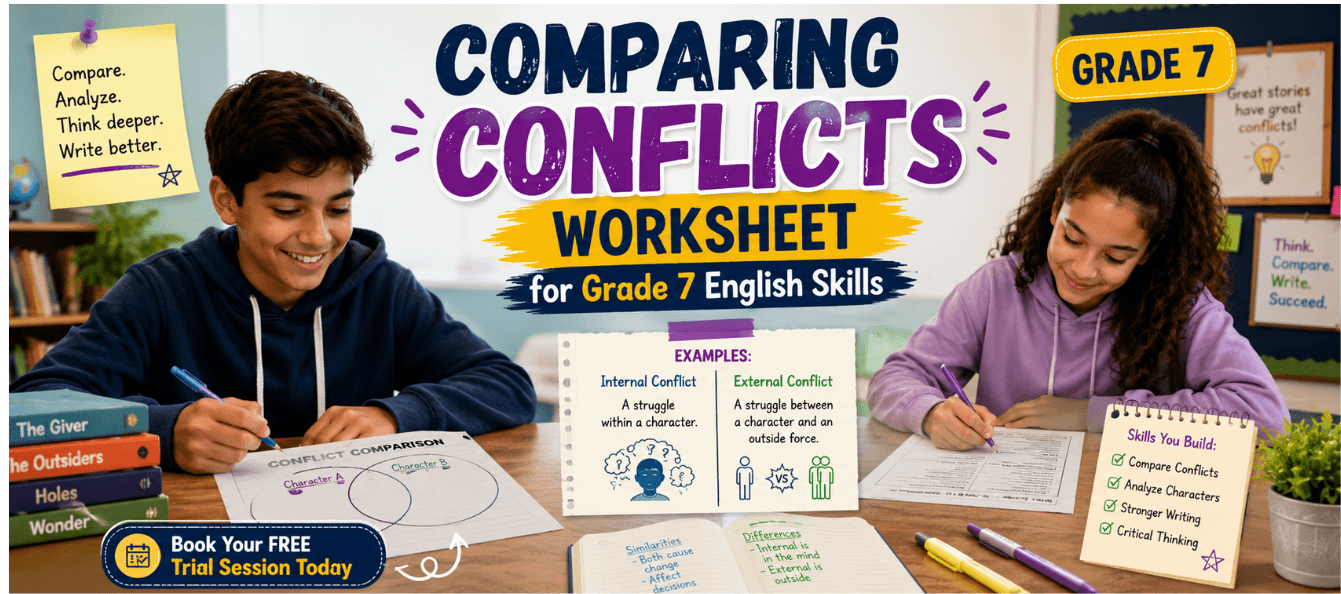
Comparing conflicts across texts means looking at two different stories and analyzing the struggles faced by characters. Students learn to identify internal conflicts (struggles within a character) and external conflicts (struggles with outside forces). This worksheet focuses on Arjun’s external conflict with enemy soldiers and Tara’s internal conflict with stage fear.
What’s in This Worksheet?
1. Multiple choice questions to identify conflict types and solutions.
2. Fill in the blanks to match literary elements with story details.
3. True and false questions to check understanding.
4. Identification tasks to label conflict types in sentences.
5. Paragraph-based exercises to apply terms in context.
Definitions, Examples, Techniques, and Tips
- ‘‘Internal conflict’’: A struggle within the character. Example: Tara’s fear of speaking.
- ‘‘External conflict’’: A struggle with outside forces. Example: Arjun’s battle with enemy soldiers.
- ‘‘Resolution’’: The way the conflict is solved. Example: Arjun recovers the sword, Tara speaks confidently.
- ‘‘Effort’’: Both conflicts require determination and courage.
- ‘‘Lesson’’: Conflicts may differ, but both need resilience to overcome.
Why Is It Important to Learn This?
Understanding conflicts helps students analyze how challenges shape characters and plots. It strengthens writing by teaching how to build tension and resolve struggles. Academically, it prepares students for exams where conflict analysis is often tested.
Where Will This Knowledge Help You?
- In exams, where comparing conflicts is a common question.
- In writing tasks, where students must analyze character struggles.
- In class discussions, where comparing conflicts builds deeper understanding.
How to Use This Worksheet?
1. Read both stories carefully.
2. Attempt each question independently.
3. Review the answer key in the exact worksheet order.
4. Correct mistakes and practice regularly.
Important Tips and Tricks
1. Always identify whether the conflict is internal or external.
2. Look for differences in how conflicts are resolved.
3. Remember that effort is the common factor in overcoming conflicts.
4. Examiners expect clear identification of conflict types.
5. For paragraph tasks, use the exact terms provided in the word bank.
Complete Answer Key
Exercise No. 1
1. b) external conflict
2. a) internal conflict
3. c) require effort
4. a) inner versus outer
5. b) stolen sword
6. b) stage fear
7. a) Arjun
8. c) Tara
9. a) action
10. c) courage
Exercise No. 2
1. external conflict
2. internal conflict
3. struggle
4. problem
5. action
6. courage
7. resolution
8. challenge
9. effort
10. resolution
Exercise No. 3
1. True
2. True
3. False
4. False
5. True
6. True
7. False
8. False
9. True
10. True
Exercise No. 4
1. external conflict
2. internal conflict
3. conflict
4. resolution (external)
5. resolution (internal)
6. action (Arjun)
7. courage (Tara)
8. external conflict
9. internal conflict
10. contrasting conflicts
Exercise No. 5
In a small kingdom near ‘‘Udaipur’’ lived Arjun, a young ‘‘warrior’’ who trained daily to protect his people.
He was ‘‘disciplined’’ and determined, rising with the sun each morning to sharpen his skills.
His dedication made him ‘‘respected’’ among the villagers, who trusted him to guard their land.
One day, however, the royal ‘‘sword’’—a symbol of honor and strength—was stolen by a rival kingdom.
Arjun felt ‘‘responsible’’ for its loss and decided that he must recover it.
This created an ‘‘external conflict’’ between Arjun and the enemy soldiers, forcing him to prepare for battle and plan a dangerous journey.
Arjun fought bravely against the enemy soldiers, using his skill and determination to defeat them.
After a fierce battle, he finally recovered the royal sword and returned it to his kingdom, restoring honor and pride.
By comparing Arjun and Tara’s conflicts, students learn how internal and external struggles differ but both require courage and effort. This Grade 7 English grammar worksheet on Comparing Conflicts Across Texts builds confidence in analyzing literature and prepares students for higher-level reading and writing tasks. Keep practicing, and remember that every conflict teaches us something valuable.
Book a free trial!