
Fun Creative Writing Exercises for Grade 2 [PDF]
![Fun Creative Writing Exercises for Grade 2 [PDF]](https://cdn5.planetspark.in/media/small_Fun_Creative_Writing_Exercises_for_Grade_2_PDF_69a833942f.png)

Creative & Mystery Story Writing: Fun Problem-Solving Activities for Kids
In Grade 2, creative, problem, and mystery writing allows students to explore their imagination and storytelling skills. This worksheet provides engaging exercises that guide students to create interesting stories, solve problems, and unravel mysteries. By practicing these exercises, students will enhance their creativity, develop problem-solving skills, and improve their ability to structure compelling narratives.
Download these English grammar worksheets and practice regularly to strengthen your language skills and build a strong foundation. You can also book a free trial to get expert guidance and improve your reading, writing, and comprehension abilities. The worksheets are designed in a simple and structured way to help K–8 students learn grammar concepts easily and use them confidently in everyday communication.
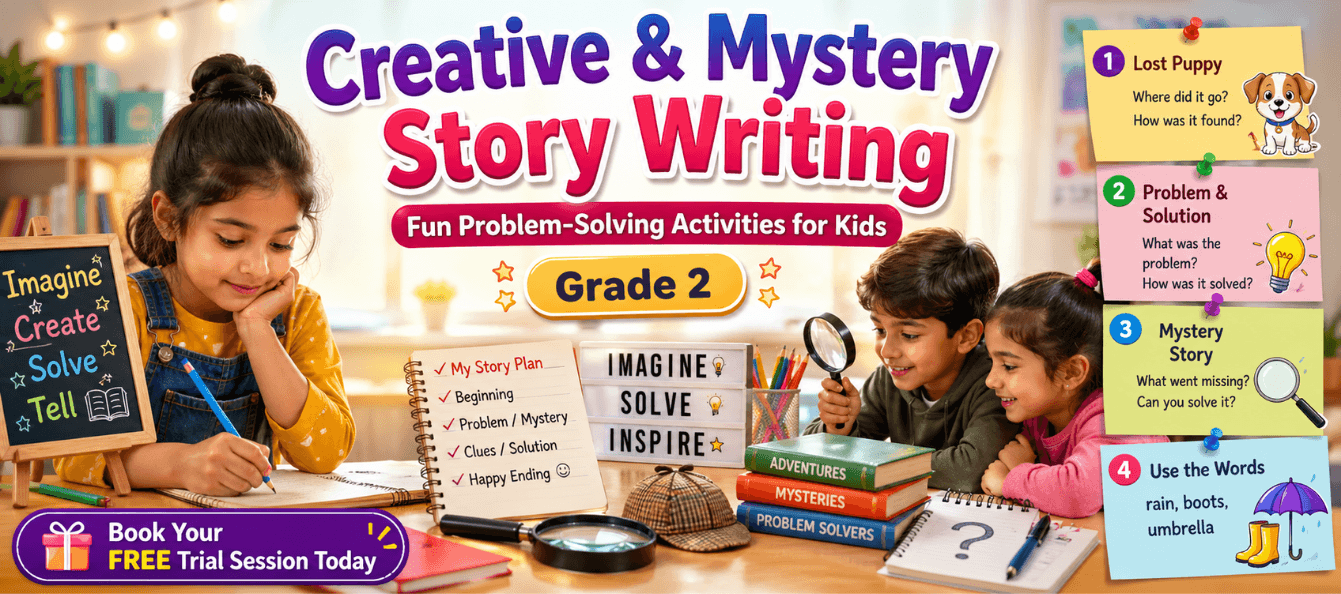
What is the topic?
This worksheet focuses on different types of writing: creative writing, problem-solving stories, and mystery writing. Students will practice writing stories about lost puppies, problems with solutions, and mysteries like missing items. They will also learn how to organize their writing into clear, structured narratives, making it easier for readers to follow the plot.
What's in this worksheet?
This worksheet includes the following types of exercises:
1. Writing a short story about a lost puppy, mentioning where it went and how it was found.
2. Creating a story with a problem and a solution, describing how the problem was solved.
3. Writing a mystery story about a missing pencil, including where the pencil was last seen and how it was found.
4. Writing a short paragraph using specific words like "rain," "boots," and "umbrella" to complete a story.
Definitions, examples, techniques, and tips
Definitions:
1. Creative writing: Writing that comes from the imagination, often involving fictional stories, characters, and events.
2. Problem-solving: A type of writing where a problem occurs in the story, and the characters work together to find a solution.
3. Mystery writing: A story that involves solving a mystery, often by discovering missing objects or events.
Examples:
1. "The lost puppy wandered into the woods and couldn’t find its way home. But after a long search, the puppy was found near the big oak tree and happily reunited with its owner."
2. "In the story, the problem was that the toys were missing. The solution was that the children worked together and found the toys under the bed."
3. "The missing pencil was last seen on the teacher’s desk. After a search in the classroom, it was found hidden inside a book."
Tips:
1. Start your story with an engaging introduction to hook the reader’s attention.
2. Clearly state the problem and provide a solution that makes sense.
3. Use mystery words like "clue," "search," and "disappear" to make your story more exciting.
4. Be creative with your endings, and don’t be afraid to think outside the box.
Why is it important to learn this?
Learning to write creative, problem-solving, and mystery stories helps students develop their imagination, critical thinking, and narrative skills. These exercises encourage students to think creatively while also focusing on story structure, which improves both writing and problem-solving abilities. It also boosts confidence in writing, helping students tackle more complex writing tasks in the future.
Where will this knowledge help you?
This knowledge will help you in:
1. Writing creative stories for school assignments.
2. Solving problems in writing and understanding how characters can resolve issues.
3. Writing engaging mystery stories that capture the reader’s interest.
4. Developing strong writing skills for both academic and creative purposes.
How to use this worksheet?
To make the most of this worksheet, follow these steps:
1. Think about the scenario or problem you want to write about. Consider the characters, setting, and plot.
2. Start your story by introducing the problem or mystery. Use clear descriptions to set the scene.
3. Write the middle of the story where the characters work on solving the problem or mystery.
4. End the story by providing a satisfying solution or resolution. Read your story to make sure it’s complete and coherent.
Important tips and tricks
1. When writing about a mystery, give subtle hints throughout the story that help the reader solve the mystery.
2. Use simple language and short sentences when writing for Grade 2 to keep your story easy to follow.
3. Always include a clear beginning, middle, and end in your story to make it more structured and engaging.
Complete Answer Key
Exercise No. 1: Write a short story about a lost puppy.
Example Answer:
"A little puppy was lost and wandered into the forest. It barked for help, and a kind person heard it. The puppy was found and taken back home safely."
Exercise No. 2: Write a short story with a problem and a solution.
Example Answer:
"There was a problem at the school – the playground ball was missing. Everyone searched, and they found it under a bush. The problem was solved, and they all played happily."
Exercise No. 3: Write a short mystery story about a missing pencil.
Example Answer:
"My pencil was missing. I last saw it on my desk. After looking all around the classroom, I found it in my pencil case, hidden under some papers."
Exercise No. 4: Write a short paragraph using the words rain, boots, and umbrella.
Example Answer:
"It was raining outside, so I put on my boots and grabbed my umbrella. I went out to play in the puddles, jumping and splashing all around."
By practicing these creative, problem-solving, and mystery writing exercises, you can improve your storytelling skills and become a better writer. Keep writing and experimenting with new ideas, and soon you’ll be able to write captivating stories.