
Grade 8 Tone & Mood Vocabulary Worksheet [Free PDF]
![Grade 8 Tone & Mood Vocabulary Worksheet [Free PDF]](https://cdn5.planetspark.in/media/small_1_b84858f0ef.png)

Master Tone and Mood Skills with This Grade 8 English Grammar Worksheet on Vocabulary in Passages
Understanding tone and mood can make reading more meaningful and writing more expressive. When students learn how vocabulary shapes emotions and attitudes in passages, they become stronger readers and more confident writers. This Grade 8 English grammar worksheet on Vocabulary for Tone & Mood in Passages helps students identify emotional language, understand context, and improve sentence construction skills through engaging practice activities.
The worksheet includes multiple-choice questions, fill in the blanks, true and false statements, grammar identification tasks, and sentence writing activities. These exercises help students recognize how words influence feelings, reactions, and the overall atmosphere in passages. By practicing regularly, students can improve comprehension, vocabulary usage, and written expression in a simple and structured way.
Download these English grammar worksheets and practice regularly to strengthen your language skills and build a strong foundation. You can also book a free trial to get expert guidance and improve your reading, writing, and comprehension abilities. The worksheets are designed in a simple and structured way to help K–8 students learn grammar concepts easily and use them confidently in everyday communication.
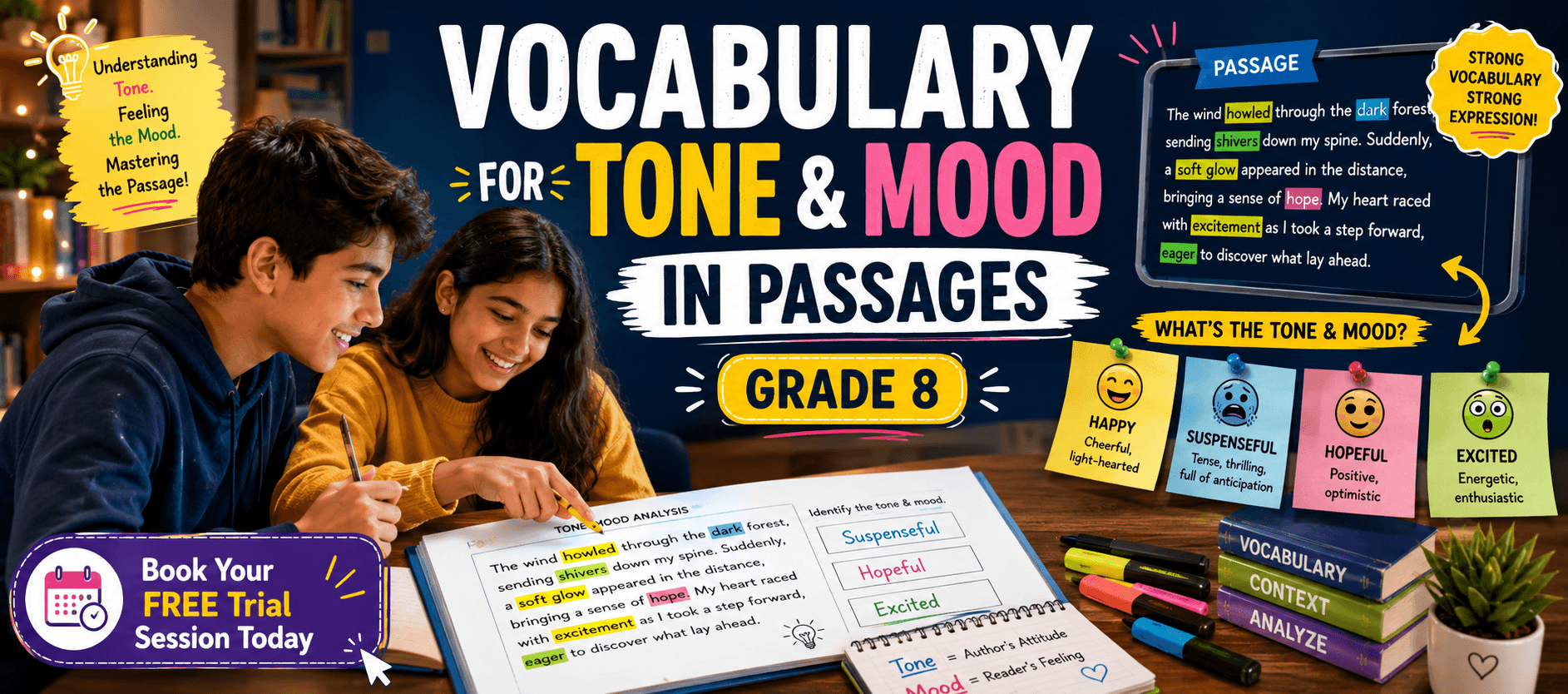
What Is the Topic?
Vocabulary for Tone & Mood in Passages focuses on understanding how words create emotions, feelings, and attitudes in reading passages. Tone reflects the writer’s attitude, while mood describes the feeling experienced by the reader. Students learn to identify vocabulary that creates emotions such as hopeful, gloomy, cheerful, fearful, calm, or tense.
In this Grade 8 English grammar worksheet, students practice choosing the best words according to sentence context, understanding emotional language, and writing meaningful sentences using vocabulary words. The worksheet also helps students understand how descriptive language affects communication and expression.
Students are expected to:
- Identify suitable vocabulary words in context
- Understand tone and mood in sentences
- Recognize emotional language
- Improve grammar and vocabulary usage
- Practice sentence construction skills
What’s in This Worksheet?
1. Multiple-choice questions that help students choose the correct tone or mood word based on sentence context.
2. Fill in the blanks exercises that develop vocabulary understanding using a word bank.
3. True and false statements that test understanding of tone, mood, vocabulary, and context clues.
4. Underline the noun and circle the verb activities that strengthen grammar identification skills.
5. Sentence writing exercises that encourage students to use vocabulary words correctly in original sentences.
6. Context-based learning activities that improve comprehension and expression skills.
7. Structured exercises that support exam preparation and classroom learning.
Definitions, Examples, Techniques, and Tips
Tone refers to the writer’s attitude shown through words and expressions. In this worksheet, students identify tones such as sarcastic, serious, annoyed, and hopeful.
Mood describes the feeling created for the reader. Examples from the worksheet include gloomy, eerie, joyful, and peaceful moods.
Context clues help readers understand the meaning of unfamiliar vocabulary by looking at surrounding words and sentence meaning.
Examples included in the worksheet:
- “The abandoned building created a ______ mood.”
- “The poem carried a ______ atmosphere throughout.”
- “Hopeful passages can encourage readers.”
The worksheet also includes emotional and descriptive vocabulary such as:
- hopeful
- gloomy
- calm
- tense
- anxious
- cheerful
- fearless
- delightedly
- confidently
Quick learning tips:
- Read the full sentence carefully before choosing a word.
- Pay attention to emotional clues in the sentence.
- Identify whether the sentence expresses positive, negative, or neutral feelings.
- Practice sentence writing regularly to improve vocabulary usage.
- Use context clues to understand the tone and mood correctly.
Why Is It Important to Learn This?
Learning vocabulary for tone and mood helps students become better readers and writers. It improves understanding of stories, poems, speeches, and passages by helping students recognize emotions and attitudes in language.
This topic also strengthens:
- Reading comprehension skills
- Vocabulary development
- Creative writing abilities
- Speaking confidence
- Sentence construction skills
Students who understand tone and mood can express ideas more clearly and communicate emotions effectively in both academic and daily communication.
This grammar concept is also useful for school assignments, exams, and classroom discussions because students are often required to understand the feelings and attitudes shown in passages.
Where Will This Knowledge Help You?
Students can use tone and mood vocabulary in many real-life and academic situations.
1. Exams and assessments
Understanding vocabulary in context helps students answer comprehension and grammar questions correctly.
2. Writing tasks
Students can use descriptive vocabulary to make stories, essays, and paragraphs more expressive.
3. Reading comprehension
Identifying tone and mood improves understanding of passages and literature.
4. Classroom participation
Students can confidently explain emotions, attitudes, and meanings during discussions.
5. Everyday communication
Using appropriate emotional vocabulary helps students express feelings more effectively.
How to Use This Worksheet?
1. Read each question carefully before answering.
2. Attempt all activities independently first.
3. Use context clues to understand the correct tone or mood word.
4. Review the answer key carefully after completing the worksheet.
5. Compare your answers with the worksheet order exactly.
6. Correct mistakes and understand why a word fits the sentence context.
7. Practice sentence writing activities regularly to improve vocabulary usage.
8. Revise emotional and descriptive vocabulary words frequently.
9. Pay attention to nouns and verbs while solving grammar identification exercises.
10. Remember that the solutions follow the exact worksheet order, so compare answers carefully.
Important Tips and Tricks
1. Read the complete sentence before choosing an answer in multiple-choice questions.
2. Look for emotional clues such as hopeful, gloomy, cheerful, or fearful words.
3. Understand the difference between tone and mood while reading passages.
4. Practice vocabulary words regularly to improve expression.
5. Use context clues to identify the correct meaning of unfamiliar words.
6. In sentence writing activities, make sure the sentence matches the meaning of the given word.
7. Avoid choosing words that do not match the emotion or atmosphere of the sentence.
8. For grammar identification tasks, carefully identify nouns and verbs separately.
9. Examiners expect students to understand emotional language and sentence context clearly.
10. For writing tasks, students should focus on meaningful and grammatically correct sentences.
Complete Answer Key
Exercise No. 1
1. b) inspired
2. a) sarcastic
3. b) eerie
4. a) serious
5. b) hopeful
6. a) confident
7. a) gloomy
8. b) composed
9. a) annoyed
10. a) excitedly
Exercise No. 2
1. fearlessly
2. hopefulness
3. confidently
4. gloominess
5. delightedly
6. anxiously
7. cheerfully
8. thankfully
9. calmly
10. restlessly
Exercise No. 3
1. True
2. False
3. True
4. True
5. True
6. True
7. True
8. True
9. True
10. False
Exercise No. 4
1. warmly
2. gloomy
3. confidently
4. calmly
5. anxiously
6. proudly
7. joyful
8. tense
9. hopefully
10. cheerfully
Exercise No. 5
1. Write a sentence using the word joyful.
The children felt joyful during the school celebration.
2. Write a sentence using the word gloomy.
The sky looked gloomy before the heavy rain started.
3. Write a sentence using the word hopeful.
Riya felt hopeful after completing her exam.
4. Write a sentence using the word tense.
The players looked tense before the final match.
5. Write a sentence using the word calm.
The teacher remained calm during the discussion.
6. Write a sentence using the word proud.
Asha felt proud after winning the competition.
7. Write a sentence using the word anxious.
Rahul felt anxious before his presentation.
8. Write a sentence about school assembly.
The students stood quietly during the school assembly.
9. Write a sentence about monsoon weather.
Dark clouds covered the sky during the monsoon weather.
10. Write a sentence about exam feelings.
Many students feel nervous before exams.
Practicing vocabulary for tone and mood regularly can help students become more expressive, confident, and thoughtful readers and writers. This Grade 8 English grammar worksheet provides useful activities that improve vocabulary understanding, grammar skills, and sentence formation in a structured and engaging way. With regular practice, students can develop stronger communication skills and perform better in school activities and exams.