
Kindergarten Worksheet: Trace Uppercase Letters [With Answers]
![Kindergarten Worksheet: Trace Uppercase Letters [With Answers]](https://cdn5.planetspark.in/media/small_1142026_1341_x_594_px_74298b8fe7.png)

Kindergarten Worksheet: Trace Uppercase Letters [With Answers]
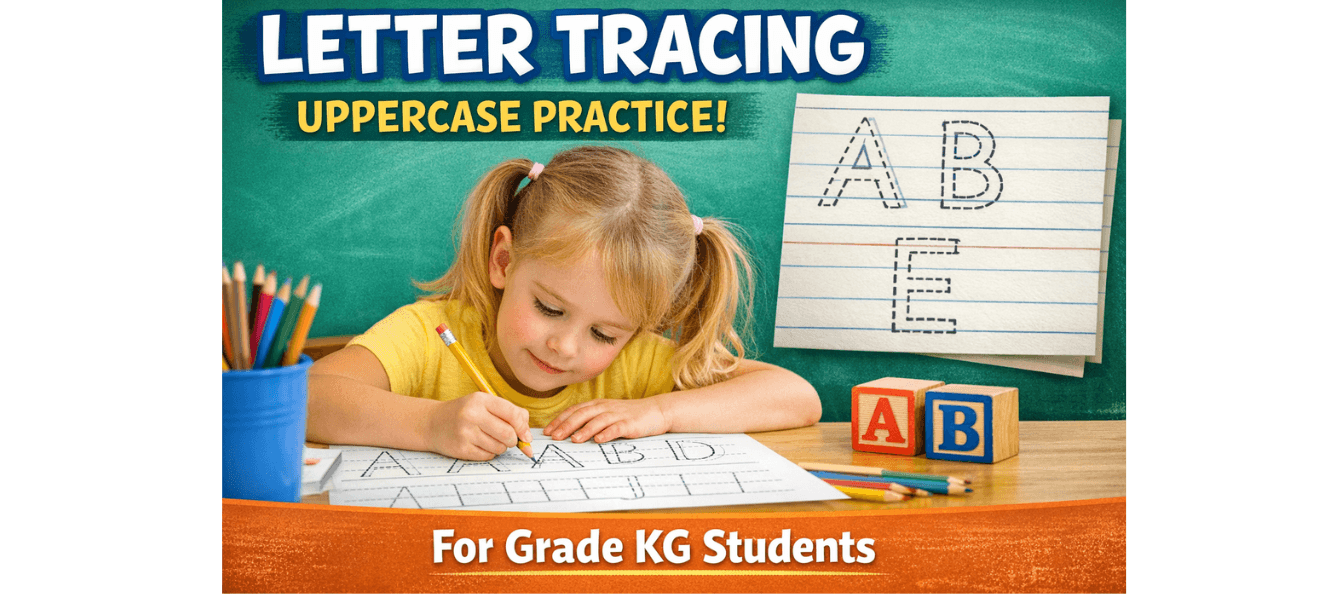
Grasping how to write capital letters correctly is an important milestone in early education. When young learners begin tracing uppercase letters, they improve handwriting skills while recognizing letter shapes and structures. This English grammar worksheet for Grade KG on Letter Tracing – Uppercase helps children practice capital letters through tracing, identification, and word association activities that make learning simple and enjoyable.
Download these English grammar worksheets and practice regularly to strengthen your language skills and build a strong foundation. You can also book a free trial to get expert guidance and improve your reading, writing, and comprehension abilities. The worksheets are designed in a simple and structured way to help K–8 students learn grammar concepts easily and use them confidently in everyday communication.
What Is The Topic?
The topic of this English grammar worksheet is Letter Tracing – Uppercase for Grade KG. The worksheet focuses on helping students recognize, trace, and understand uppercase letters.
Students learn how capital letters look, how they are formed using straight and curved lines, and how letters connect with words. The activities encourage learners to observe letter shapes carefully and develop proper writing habits.
Through tracing practice, true and false statements, letter identification questions, and word matching tasks, students build strong foundational grammar and writing skills.
What’s In This Worksheet?
This Grade KG English grammar worksheet contains structured activities designed for early learners.
1. Letter tracing practice for uppercase letters to improve handwriting.
2. True and false questions related to letter shapes and structures.
3. Multiple choice questions based on identifying letter characteristics.
4. Word matching activities connecting uppercase letters with words.
5. Shape recognition tasks involving curves, lines, and letter forms.
6. Progressive exercises that move from tracing to understanding letters.
7. Engaging grammar exercises that strengthen early literacy development.
These activities help children prepare for writing tasks and classroom participation.
Definitions, Examples, Techniques, And Tips
Definitions
Uppercase letters are capital letters used at the beginning of names and sentences.
Tracing letters means practicing writing letters by following their shapes repeatedly.
Curved letters contain round or bending lines.
Straight-line letters are formed using vertical or horizontal lines.
Examples From The Worksheet
Students trace uppercase letters A, B, D, E, L, F, P, H, T, and Z.
Statements help learners understand whether letters contain curves or straight lines.
Questions ask students to identify letters with bumps, curves, or straight lines.
Word prompts connect letters with matching vocabulary words.
Techniques Used In The Worksheet
Repeated tracing strengthens hand control.
Letter observation improves recognition skills.
Shape-based questions help students understand letter formation.
Word matching reinforces alphabet learning.
Quick Learning Tips
Trace slowly and carefully.
Observe whether the letter has curves or straight lines.
Say the letter name aloud while tracing.
Practice regularly for better handwriting.
Why Is It Important To Learn This?
Learning uppercase letters is essential for early writing development. Capital letters are used at the beginning of sentences and names, making them an important grammar skill.
Tracing helps children develop fine motor skills and improves pencil control. Understanding letter shapes also helps learners distinguish between similar-looking letters.
For Grade KG students, mastering uppercase letters builds confidence in reading, writing, and classroom learning.
Where Will This Knowledge Help You?
Students apply this knowledge in many real-life learning situations.
Writing names and sentences correctly.
Participating confidently in classroom writing tasks.
Recognizing letters in books and worksheets.
Improving handwriting during exams and assignments.
Developing strong early literacy skills.
How To Use This Worksheet?
1. Begin by tracing each uppercase letter carefully.
2. Follow the worksheet in the exact order provided.
3. Observe letter shapes before answering questions.
4. Read each statement carefully while deciding true or false.
5. Think about letter structure when choosing answers.
6. Complete word-matching activities neatly.
7. Review answers step by step since solutions follow worksheet order.
8. Practice tracing daily to improve handwriting accuracy.
Important Tips And Tricks
1. Keep pencil movements slow and controlled.
2. Notice curves and straight lines in each letter.
3. Avoid rushing while tracing.
4. Focus on letter structure during identification questions.
5. Write clearly during word-writing tasks.
6. Examiners expect neat tracing and correct identification.
7. Practice capital letters regularly for better memory.
8. Observe how each letter begins and ends.
Complete Answer Key
Letter Tracing – Uppercase
What’s Inside
Fill in the Blanks
True and False
Multiple Choice Questions
Sentence Rewriting
Exercise No. 1
Trace the uppercase letters given below.
1. A A A A
2. B B B B
3. D D D D
4. E E E E
5. L L L L
6. F F F F
7. P P P P
8. H H H H
9. T T T T
10. Z Z Z Z
Exercise No. 2
Decide if each statement is true or false as per letters.
1. Uppercase A has 5 straight lines. — False
2. Uppercase G is a curved closed shape. — True
3. Uppercase I is a simple straight line. — True
4. Uppercase J curves down at the end. — True
5. Uppercase D has two curved line. — False
6. Uppercase F has no bottom line. — True
7. Uppercase B has two curved parts. — True
8. Uppercase H has two tall lines. — True
9. Uppercase T has three small lines. — False
10. Uppercase C is a curved open shape. — True
Exercise No. 3
Choose the best option that fits each uppercase letter question.
1. Which letter is curved shape? — C
2. Which letter has two bumps on it? — B
3. Which letter looks like a half circle? — D
4. Which one has one curved side? — R
5. Which letter uses three short lines? — E
6. Which letter has no bottom line? — F
7. Which one has two tall lines? — H
8. Which letter is one straight line? — I
9. Which letter curves down at end? — J
10. Which letter is a simple curve? — C
Exercise No. 4
Follow the instruction in each prompt to write a matching word.
1. J is for — JUG
2. R is for — RUN
3. L is for — LIP
4. V is for — VAN
5. H is for — HAT
6. N is for — NET
7. F is for — FAN
8. S is for — SUN
9. A is for — ANT
10. G is for — GUN
Practicing uppercase letters regularly helps young learners gain confidence in writing and recognizing the alphabet. This English grammar worksheet for Grade KG on Letter Tracing – Uppercase builds strong handwriting habits while improving letter recognition skills. With consistent practice, children develop accuracy, confidence, and readiness for future grammar learning.