
Class KG Worksheet on Tracing Capital Letters

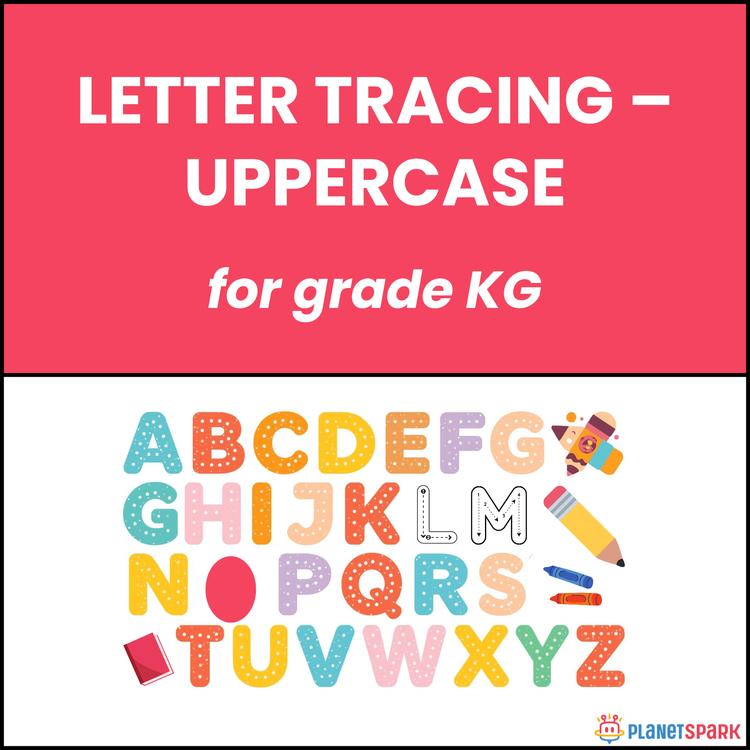
Class KG Worksheet on Tracing Capital Letters
Trace & Shine: Uppercase Letter Writing Practice for KG
This KG-friendly worksheet helps children learn to trace uppercase letters with confidence. Each activity is designed to build early handwriting control, strengthen alphabet recognition, and improve fine motor skills. The worksheet include guided tracing lines, letter-formation identification activities, and picture-supported word prompts.
Young learners get hands-on practice with repeated strokes, visual discrimination between curved and straight letters, and choosing correct letter shapes. The worksheet steadily develops pencil control and lays the foundation for neat, confident handwriting.
Why Uppercase Letter Tracing Matters in Grammar?
Letter tracing is an essential early-literacy skill because it helps children:
1. Learn correct alphabet shapes and strokes
2. Strengthen hand–eye coordination and muscle memory
3. Recognise letter features like lines, curves, and shapes
4. Build clear, confident handwriting habits for future writing tasks
What’s Inside This Worksheet?
Exercise 1 – Tracing Practice
Children trace A, B, D, E, L, F, P, H, T, Z and then write each letter once on their own (Page 3).
Exercise 2 – True or False (Letter Features)
Learners decide whether statements about letter shapes are correct—for example, whether A has straight lines, whether J curves down, or whether B has two curved parts (Page 4).
Exercise 3 – Multiple Choice Questions (Identifying Letter Shapes)
Students choose which letter matches a shape description such as “curved shape,” “one straight line,” or “curves down at end” (Pages 5–6).
Exercise 4 – Word Matching (Writing Words That Begin With Letters)
Children use a picture-word bank (LIP, SUN, VAN, NET, ANT, HAT, FAN, RUN, GUN, JUG) to write words that begin with letters like H, V, L, R, J, G, A, S, N, F (Pages 7–8).
This worksheet supports alphabet recognition and handwriting fluency in a simple, engaging, beginner-friendly way.
ANSWER KEY (For Parents & Educators )
Exercise 1 – Letter Tracing (Fill in the Blanks)
Children simply rewrite the same uppercase letter:
1. A
2. B
3. D
4. E
5. L
6. F
7. P
8. H
9. T
10. Z
Exercise 2 – True or False
1. False
2. False
3. True
4. True
5. False
6. True
7. True
8. True
9. False
10. True
Exercise 3 – MCQs
1. Curved shape → C
2. Two bumps → B
3. Half circle → D
4. One curved side → Q
5. Uses three short lines → T
6. No bottom line → F
7. Two tall lines → H
8. One straight line → I
9. Curves down at end → J
10. Simple curve → C
Exercise 4 – Matching Words (Picture-Based Answers)
1. H is for HAT
2. V is for VAN
3. L is for LIP
4. R is for RUN
5. J is for JUG
6. G is for GUN
7. A is for ANT
8. S is for SUN
9. N is for NET
10. F is for FAN
Support your child in developing confident handwriting—unlock smoother strokes, better control, and neater uppercase writing with guided expert-led learning!
Help your little one build perfect uppercase handwriting with an engaging skill-building session—designed just for KG learners!
Book a free trial!
Frequently Asked Questions
It builds muscle memory for writing clear, standard uppercase letters.
Their fine-motor control is still developing; slow tracing improves accuracy.
Consistent tracing followed by freehand practice strengthens confidence.