
Punctuation Practice for Grade 7: Semicolon and Dash Worksheet

Punctuation Practice for Grade 7: Semicolon and Dash Worksheet
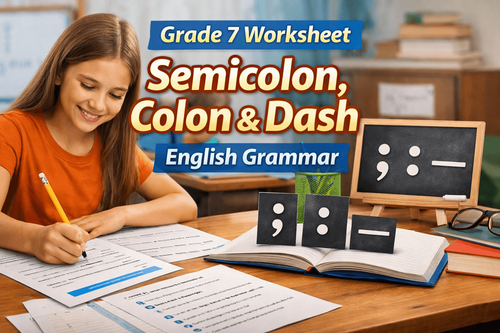
Basic understanding of punctuation can sometimes feel confusing, especially when different marks like semicolons, colons, and dashes seem similar. But with the right English grammar worksheet, students of Grade 7 can practice and become confident step by step. This worksheet on semicolon, colon, and dash usage helps students improve sentence clarity and writing skills in an easy and structured way.
What Is the Topic?
The topic of this English grammar worksheet is punctuation, specifically focusing on semicolon, colon, and dash usage. These punctuation marks help connect ideas, explain information, and add emphasis in sentences. Students are expected to understand how to use these marks correctly in different contexts such as joining clauses, introducing lists, showing contrast, and adding explanations.
What’s in This Worksheet?
1. Multiple choice questions where students
choose the correctly punctuated sentence
2. True and False section to identify correct punctuation usage
3. Fill in the blanks to practice inserting suitable punctuation marks
4. Sentence rewriting tasks to apply correct punctuation rules
5. A paragraph writing activity to use punctuation in context
This worksheet supports exam preparation by giving a variety of question types that test understanding and application of punctuation rules.
Definitions, Examples, Techniques, and Tips
Definitions
A semicolon is used to join two related clauses.
A colon is used to introduce a list, explanation, or example.
A dash is used to add emphasis or highlight a part of the sentence.
Examples
The exam was hard; the students passed.
The reason is clear: lack of effort.
She had only one wish— to succeed.
Techniques
Use a semicolon when two sentences are closely related.
Use a colon when introducing a list or explanation.
Use a dash when you want to emphasize a part of the sentence.
Quick learning tips
Check if both parts of a sentence can stand alone before using a semicolon.
Use a colon only when the first part of the sentence is complete.
Use a dash to add strong emphasis or a sudden break.
Why Is It Important to Learn This?
Learning punctuation like semicolons, colons, and dashes is important because it makes writing clear and meaningful. It helps students connect ideas properly and avoid confusion. Correct punctuation improves both writing and reading skills and helps students score better in exams.
Where Will This Knowledge Help You?
This knowledge will help in school exams where grammar is tested.
It improves writing tasks such as essays and answers.
It helps in class participation by forming clear and correct sentences.
How to Use This Worksheet?
1. Attempt all questions independently without looking at answers
2. Review your answers carefully after completing the worksheet
3. Compare your answers with the correct answer key given below
4. Practice regularly to improve accuracy and confidence
The solutions below follow the exact worksheet order. Students should compare their answers carefully.
Important Tips and Tricks
1. Avoid using commas to join two complete sentences
2. Use semicolons only between closely related clauses
3. Do not use semicolons before lists
4. Use colons correctly before lists and explanations
5. Use dashes for emphasis, not randomly
6. Read the sentence fully before choosing the punctuation
7. In rewriting tasks, focus on the meaning of the sentence
8. For paragraph-based questions, understand the flow before filling punctuation
Complete Answer Key
Exercise No. 1
1. b) The exam was hard; the students passed.
2. b) The reason is clear: lack of effort.
3. a) She had only one wish— to succeed.
4. c) The library has books: history, science, art.
5. a) He worked hard— he did not succeed.
6. a) There is one capital city— Delhi.
7. b) We reached late; the bus broke down.
8. b) She must bring: pens, pencils, erasers.
9. c) The result—unexpected—shocked everyone.
10. c) He failed the test; he did not prepare.
Exercise No. 2
1. True
2. True
3. True
4. False
5. True
6. False
7. False
8. False
9. True
10. True
Exercise No. 3
1. She had two choices: to study or to play.
2. The streets were empty; the rain was heavy.
3. He has one passion: cricket.
4. The wind was strong; the trees fell.
5. There are three values: honesty, courage, respect.
6. The game was intense; both teams scored equally.
7. He made a promise: to help his friend.
8. They visited Jaipur; it was raining.
9. She packed three items: books, pens, pencils.
10. The truth was simple: he had forgotten.
Exercise No. 4
1. The committee reached a decision; it was unanimous.
2. The scientist had three tools: microscope, slides, samples.
3. The debate was heated; both teams argued fiercely.
4. The report showed one main flaw: lack of evidence.
5. The historian noted three causes: war, famine, migration.
6. The lawyer was clear: he wanted justice.
7. The crowd was restless; the speech was delayed.
8. She carried essentials: pens, notes, calculator.
9. The storm was powerful; trees crashed onto the road.
10. His dream was strong—to study abroad.
Exercise No. 5
At the interschool debate competition, the auditorium was packed with students from six schools. Ananya began: “Education must change with time; it should focus on skill and character.” Her teammate added— “Discipline builds success.” The judges noted the key points: clarity, logic, and confidence. Later, they announced the winners; Ananya’s team had secured first place— a proud moment for the school. Their principal said, “This victory belongs to every participant: not just the winners.” The audience clapped; teachers smiled; and the students felt motivated to work even harder next time.
Practicing this English grammar worksheet for Grade 7 on semicolon, colon, and dash usage will help you build strong punctuation skills. With regular practice, you will feel more confident in writing and understanding sentences clearly. Keep practicing and improving step by step.