
Understanding Relative Conditional and Noun Clauses for Grade 8
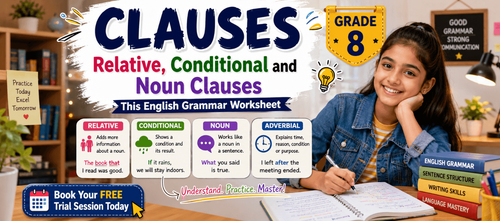

Clauses with This English Grammar Worksheet for Grade 8 on Relative, Conditional and Noun Clauses
Clauses are an important part of English grammar because they help students create meaningful, complete, and well-structured sentences. In Grade 8, students begin learning how different clauses work together to improve speaking and writing skills. This English grammar worksheet for Grade 8 on Relative, Conditional and Noun Clauses gives students an engaging way to practice sentence structure, sentence rewriting, and grammar identification tasks.
The worksheet includes exercises based on relative clauses, conditional clauses, noun clauses, and adverbial clauses. Students get to identify clauses, rewrite sentences, complete blanks, and practice paragraph writing. These activities help learners understand how clauses function in everyday communication and academic writing.
Download these English grammar worksheets and practice regularly to strengthen your language skills and build a strong foundation. You can also book a free trial to get expert guidance and improve your reading, writing, and comprehension abilities. The worksheets are designed in a simple and structured way to help K–8 students learn grammar concepts easily and use them confidently in everyday communication.
What Is the Topic?
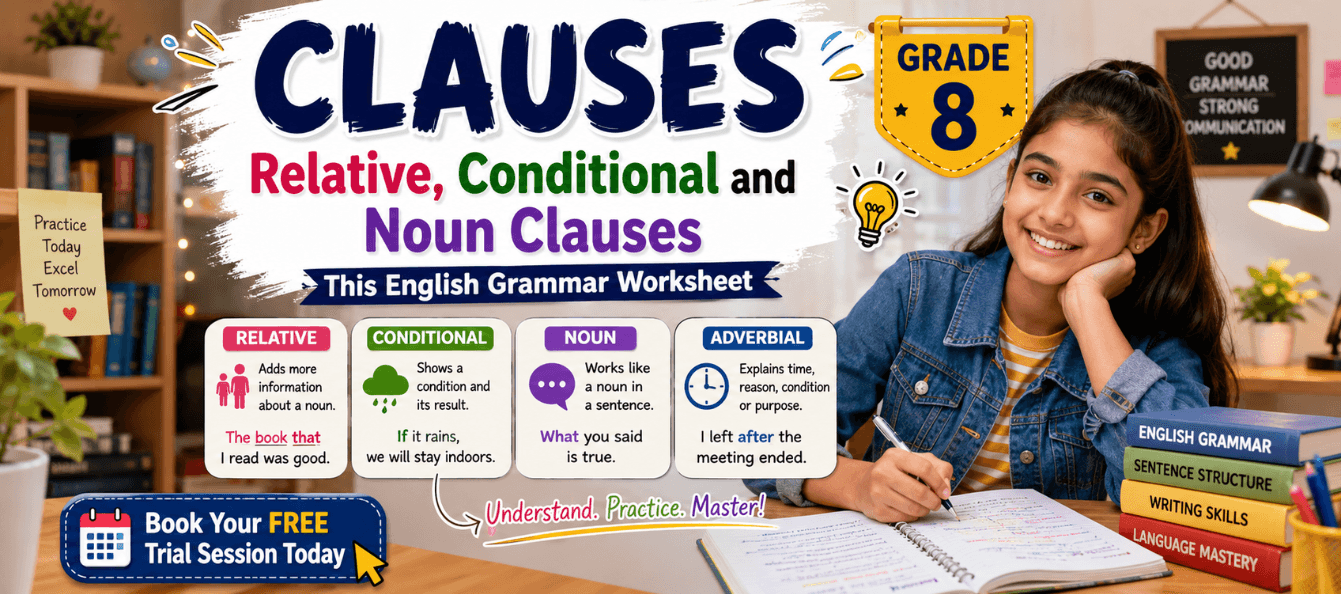
This English grammar worksheet for Grade 8 focuses on four important types of clauses:
1. Relative Clauses
These clauses give additional information about a noun. Words such as who, whose, where, and which are commonly used.
2. Conditional Clauses
These clauses describe conditions and possible results. They usually begin with if or unless.
3. Noun Clauses
These clauses work like nouns in a sentence and can act as subjects or objects.
4. Adverbial Clauses
These clauses explain time, reason, condition, purpose, or manner in a sentence.
Students are expected to learn how to:
• Identify different kinds of clauses
• Use clauses correctly in sentences
• Rewrite sentences using specific clause types
• Improve grammar accuracy through practice
What’s in This Worksheet?
1. Label the Sentences
Students identify whether the sentence contains a relative, conditional, noun, or adverbial clause.
2. Multiple Choice Questions
Students choose the correct option to complete grammar-based sentences.
3. Sentence Rewriting
Students rewrite sentences according to the clause type mentioned.
4. Fill in the Blanks
Students complete a passage using suitable words.
5. Paragraph Writing
Students write a short paragraph using different clause types.
6. Grammar Skills Practiced
• Sentence structure
• Clause identification
• Grammar usage
• Sentence transformation
• Writing skills
7. Exam Preparation Support
The worksheet improves grammar accuracy, sentence formation, and writing confidence, which are important for school assessments and grammar tests.
Definitions, Examples, Techniques, and Tips
Relative Clauses
These clauses describe a noun in more detail.
Examples from the worksheet:
• The book that I read was good.
• This is the house where I was born.
Conditional Clauses
These clauses express a condition and its result.
Examples from the worksheet:
• If it rains, we will stay indoors.
• You cant pass unless you study.
Noun Clauses
These clauses function as nouns.
Examples from the worksheet:
• What you said is true.
• The teacher emphasized that practice makes a perfect.
Adverbial Clauses
These clauses explain reason, time, condition, or purpose.
Examples from the worksheet:
• I left after the meeting ended.
• I couldn’t go because I was unwell.
Quick Learning Tips
• Read the sentence carefully before identifying the clause.
• Look for clue words such as if, because, where, who, and that.
• Practice rewriting sentences in different forms.
• Check whether the clause gives information, condition, reason, or acts like a noun.
Why Is It Important to Learn This?
Learning clauses helps students build stronger and clearer sentences. Relative, conditional, noun, and adverbial clauses improve grammar and make writing more detailed and meaningful.
These grammar concepts help students:
• Speak more confidently
• Write longer and better sentences
• Improve paragraph writing
• Understand sentence relationships
• Perform better in grammar exams
Clauses are also useful in comprehension passages, essays, creative writing, and classroom communication.
Where Will This Knowledge Help You?
Students can use clause knowledge in many situations:
• School grammar tests
• English writing assignments
• Paragraph and essay writing
• Classroom discussions
• Reading comprehension
• Spoken English activities
• Competitive exams
Understanding clauses also helps students communicate ideas more clearly and correctly.
How to Use This Worksheet?
1. Read every sentence carefully before answering.
2. Attempt all questions independently first.
3. Follow the exact instruction given in each exercise.
4. Compare your answers carefully with the solutions.
5. Practice identifying clause types regularly.
6. Rewrite incorrect answers and understand the mistakes.
7. Use the worksheet order correctly while checking answers.
8. The solutions below follow the exact worksheet order for easy comparison.
Important Tips and Tricks
1. Relative clauses usually begin with words like who, whose, which, and where.
2. Conditional clauses often include if, unless, or provided that.
3. Noun clauses act like subjects or objects in sentences.
4. Adverbial clauses explain time, reason, purpose, or condition.
5. Read the entire sentence before selecting an answer in MCQs.
6. In sentence rewriting tasks, carefully follow the clause type mentioned.
7. Avoid changing the meaning of the original sentence.
8. In paragraph writing, try using different clause types naturally.
9. Examiners expect correct grammar structure and proper clause usage.
10. Practice regularly to improve speed and accuracy.
Complete Answer Key
Exercise No. 1
1. The book that I read was good. — Relative
2. I left after the meeting ended. — Adverbial
3. What you said is true. — Noun
4. He acts as if he owned the place. — Adverbial
5. If it rains, we will stay indoors. — Conditional
6. You cant pass unless you study. — Conditional
7. I couldn’t go because I was unwell. — Adverbial
8. Here is the copy you wanted. — Relative
9. The teacher emphasized that practice makes a perfect. — Noun
10. Mary had a little lamb whose fleece was white as snow. — Relative
Exercise No. 2
1. a) who
2. c) you will pass the exam
3. b) what
4. b) when
5. c) we would have stayed indoors
6. a) which
7. c) whom
8. a) so that
9. b) provided that
10. a) whose
Exercise No. 3
1. The boy plays football because he loves sports.
Use Adverbial Clause
2. He will succeed if he works hard.
Use Conditional Clause
3. This is the house where I was born.
Use Relative Clause
4. I know that you are honest.
Use Noun Clause
5. She left early since it was raining.
Use Adverbial Clause
6. If I were you, I would study more.
Use Conditional Clause
7. The student who topped the class is from Pune.
Use Relative Clause
8. He didn’t come because he was ill.
Use Adverbial Clause
9. I believe that she will win the prize.
Use Noun Clause
10. You can go if you finish your homework.
Use Conditional Clause
Exercise No. 4
Read the passage and fill the blanks with suitable words.
When the final examinations were announced, every student promised to work harder and stay focused throughout the term. Riya believed that sincere practice always brings success. She revised her notes daily so that she could remember all the main ideas clearly. The teacher who taught English constantly encouraged the class to keep practicing. If any student had a doubt, it was resolved with patience. Those who completed their work on time were appreciated by the teachers. The day when the results were declared was full of excitement and joy. Everyone congratulated the friends who had scored excellent marks and thanked the teachers who had helped them succeed. Later, the principal addressed the assembly and praised their dedication. He reminded them that discipline, hard work, and consistency are the real keys to success.
Exercise No. 5
My Dream Vacation
My dream vacation is a trip to the mountains where I can enjoy nature and peaceful surroundings. I would visit a place that has beautiful lakes and green forests. If I get a chance, I will travel with my family during the summer holidays. I believe that vacations help people relax and feel refreshed. We would stay in a hotel that overlooks the hills because the view would be amazing. Since I love adventure activities, I would also try trekking and camping. If the weather remains pleasant, we will spend more time outdoors. I hope that this dream vacation becomes a reality soon.
This English grammar worksheet for Grade 8 on Relative, Conditional and Noun Clauses is an excellent way to improve grammar understanding and sentence-building skills. By practicing these exercises regularly, students can become more confident in writing and speaking English correctly. Consistent practice will help learners master different clause types and use them naturally in daily communication and exams.