
Class 5 Worksheet on Different Points of View

Class 5 Worksheet on Different Points of View
See Through Every Lens: Mastering Points of View for Class 5
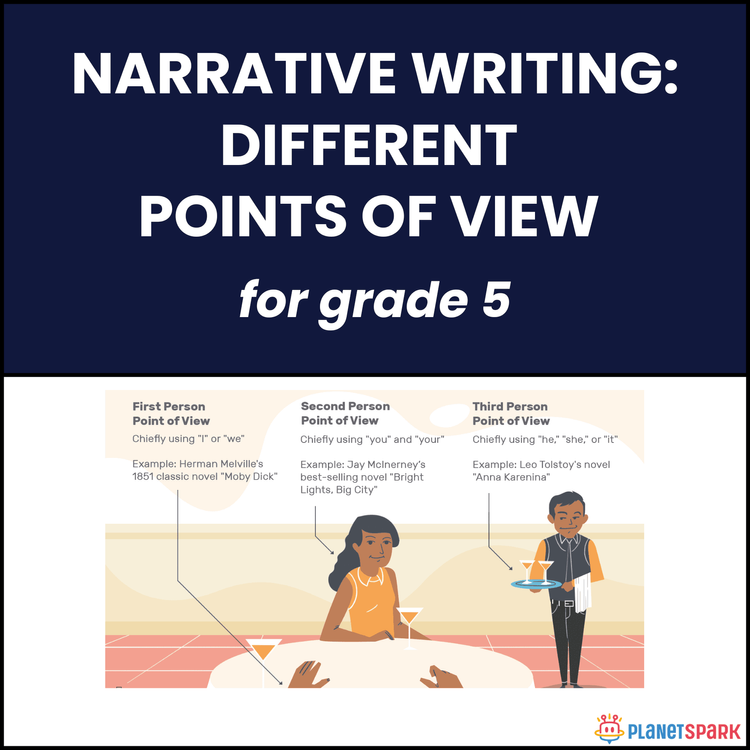
This Class 5 worksheet helps learners understand how stories change depending on *who* is telling them. Through guided exercises on page 3–7, students explore first person, second person, third person limited, and third person omniscient points of view.
With clear explanations, sentence identification, passage rewrites, scene descriptions, and a POV comparison activity, this worksheet builds strong narrative awareness and writing flexibility.
Students learn to:
• Identify different points of view
• Rewrite passages from a new narrator’s perspective
• Understand how thoughts and feelings differ by viewpoint
• Describe scenes from multiple narrators
• Compare how POV affects emotions, details, and storytelling
This worksheet develops deeper reading comprehension, creative writing skills, and the ability to analyse stories with precision.
------------------------------------
ANSWER KEY (Included for Parents & Teachers)
Exercise 1 – Circle the POV
1. She saw her brother… → **3rd person limited**
2. You step onto the bridge… → **2nd person**
3. Riya wanted to tell the truth… → **3rd person omniscient** (shows thoughts of two characters)
4. He opened the box… → **3rd person limited**
5. We hurried across the field… → **1st person plural**
6. You open the ancient book… → **2nd person**
7. They pushed the heavy door… → **3rd person limited**
Exercise 2 – Rewrite 1st → 3rd Person Limited (Sample)
Original: *I raced down the hallway as the bell rang. My books almost slipped from my hands.*
Rewrite (sample):
**Aarav raced down the hallway as the bell rang. His books almost slipped from his hands as he tried to hold onto them.**
Exercise 3 – Rewrite 3rd Person Limited → 1st Person (Sample)
Original: *Meera peeked behind the curtain. She hoped no one had seen her hide the surprise gift.*
Rewrite (sample):
**I peeked behind the curtain and hoped no one had seen me hide the surprise gift.**
Exercise 4 – Describe a Scene from Two POVs (Samples)
Event: A dog runs away with someone’s sandwich.
Paragraph 1 (Child’s POV):
**I had just opened my lunchbox when a brown dog dashed past, snatched my sandwich, and sprinted across the park! I yelled in surprise, but all I could do was watch him disappear with my lunch.**
Paragraph 2 (Dog’s POV):
**The dog spotted the delicious sandwich and couldn’t resist. He grabbed it quickly, his tail wagging wildly as he ran. He didn’t understand why the child was shouting—he just knew this was the best meal he’d found all day!**
Exercise 5 – Compare Two Points of View
1. Which passage shows only the narrator’s own thoughts?
→ **Passage A (1st person)**
2. Which passage shows thoughts of more than one character?
→ **Passage B (3rd person omniscient)**
3. How does each narrator feel?
→ Passage A narrator feels **scared and unsure** (wobbly legs, grabbing rope).
→ Passage B narrator (Tara) feels **afraid**, while the coach feels **worried yet hopeful** she will trust herself.
------------------------------------
Help your child become a flexible, confident storyteller by understanding how point of view shapes every narrative!
Boost storytelling power with expert-guided POV practice—start learning today!
🔖Book a free trial!
Frequently Asked Questions
Point of view refers to who is telling the story and determines what information the reader receives.
Students can check pronouns: “I/me” signals first-person, while “he/she/they” indicates third-person narration.
Recognizing perspective helps students understand bias, narrator knowledge, and how a story changes depending on who tells it.