
Class 1 English Worksheet on Spatial Location Questions

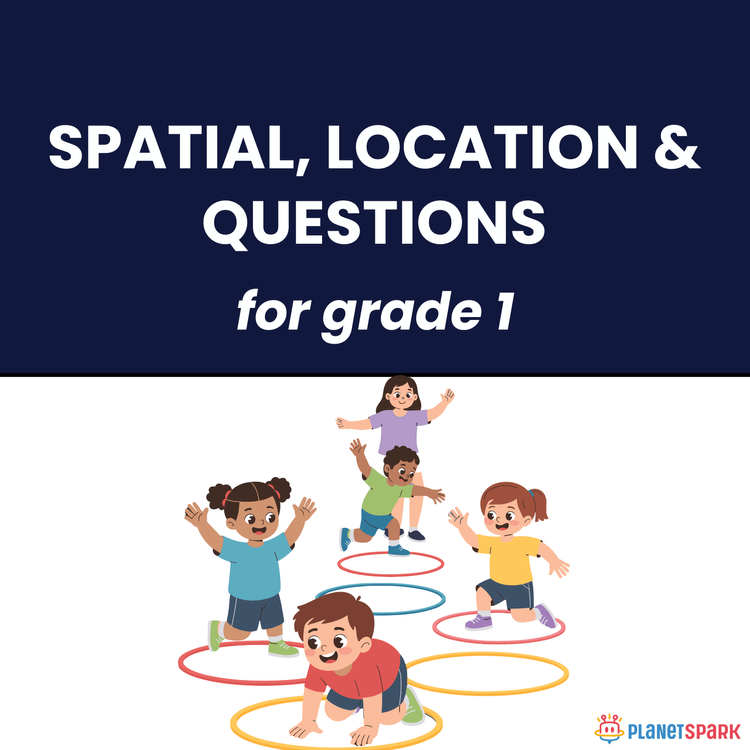
Class 1 English Worksheet on Spatial Location Questions
Finding Where Things Are: Spatial, Location and Questions for Class 1
This engaging Class 1 worksheet introduces young learners to spatial words, location concepts, and simple question answering through clear, picture-based activities. By observing illustrations and reading short sentences, children learn to describe where objects and people are using correct spatial words and answer basic questions confidently.
The worksheet helps students understand common position words such as in, on, under, above, near, behind, inside, and outside. Through everyday scenes and familiar objects, children practise identifying locations, answering yes/no questions, and responding to simple “who” and “what” questions in an age-appropriate and enjoyable way.
Why Spatial, Location, and Questions Matter in Class 1?
Understanding spatial words and answering questions are key early language skills. For Grade 1 learners, this topic is important because:
1. It helps children describe where objects and people are located.
2. It builds understanding of position and direction using visual clues.
3. It strengthens sentence comprehension and question-answering skills.
4. It supports clear communication and everyday language use.
What’s Inside This Worksheet?
This worksheet includes five carefully structured grammar and comprehension activities:
📍 Exercise 1 – Choose the Correct Preposition
Students fill in the blanks with the correct spatial word by looking at pictures.
🖼️ Exercise 2 – Identify Correct Spatial Words from Pictures
Children observe pictures and choose the right location word such as near, far, above, or inside.
✅ Exercise 3 – Yes or No Questions from Sentences
Learners read simple sentences and decide whether the statement is correct or not.
👀 Exercise 4 – Answer Yes/No Questions from Pictures
Students look at pictures and answer yes or no based on what they see.
❓ Exercise 5 – Answer Simple Questions from Pictures
Children answer “who” and “what” questions by carefully observing pictures.
This worksheet helps children build strong foundational language skills by combining spatial understanding, observation, and question answering in a clear, engaging, and confidence-building way.
🔖Book a free trial!
Frequently Asked Questions
They help children understand position words used in sentences.
They support understanding of instructions and descriptions.
They can use words like in, on, and under during daily activities.